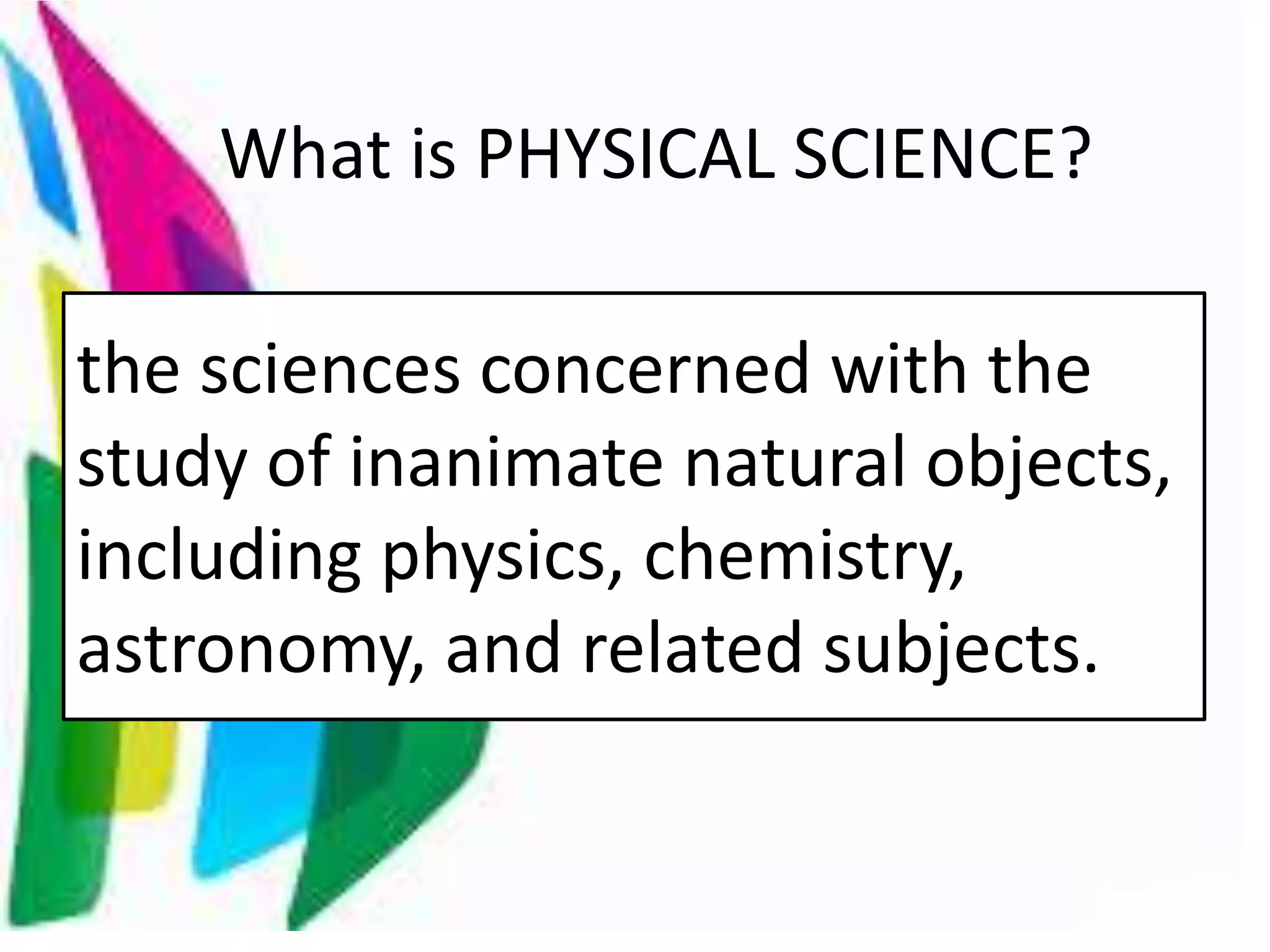
Physical science is a broad and fascinating field that encompasses the study of the natural world through observation, experimentation, and theoretical analysis. It seeks to understand the fundamental principles that govern the universe, from the smallest subatomic particles to the vast expanses of the cosmos. This field is divided into several key disciplines, each focusing on different aspects of the physical world. Understanding what is physical science involves delving into these disciplines and exploring their interconnectedness.
What is Physical Science?
What is physical science? It is the systematic study of the inorganic world, encompassing a wide range of phenomena and processes. This field is crucial for advancing our understanding of the universe and developing technologies that improve our daily lives. Physical science is often contrasted with life science, which focuses on living organisms. However, both fields are interconnected and often overlap in areas such as biochemistry and biophysics.
The Core Disciplines of Physical Science
Physical science is composed of several core disciplines, each with its own set of principles and methodologies. These disciplines include:
- Physics
- Chemistry
- Astronomy
- Earth Science
Physics: The Fundamental Science
Physics is often referred to as the fundamental science because it deals with the most basic principles of the universe. It seeks to understand the behavior of matter and energy at all scales, from the subatomic to the cosmic. Key areas of study in physics include:
- Mechanics: The study of motion and forces.
- Electromagnetism: The study of electric and magnetic fields and their interactions.
- Thermodynamics: The study of heat and energy transfer.
- Quantum Mechanics: The study of the behavior of particles at the atomic and subatomic levels.
- Relativity: The study of the behavior of objects at high speeds and in strong gravitational fields.
Physics provides the foundation for many other scientific disciplines and technological advancements. For example, the principles of electromagnetism are essential for the development of electronics and communication technologies.
Chemistry: The Science of Matter
Chemistry is the study of the composition, structure, properties, and behavior of matter. It involves the investigation of atoms, molecules, and the interactions between them. Key areas of study in chemistry include:
- Organic Chemistry: The study of carbon-based compounds.
- Inorganic Chemistry: The study of compounds that do not contain carbon.
- Physical Chemistry: The study of the physical and fundamental basis of chemical systems.
- Analytical Chemistry: The study of the composition of matter.
- Biochemistry: The study of chemical processes within and related to living organisms.
Chemistry is crucial for understanding the properties of materials and developing new substances with specific properties. It plays a vital role in industries such as pharmaceuticals, agriculture, and manufacturing.
Astronomy: The Study of the Universe
Astronomy is the scientific study of celestial objects and phenomena beyond Earth’s atmosphere. It involves the observation and analysis of stars, planets, galaxies, and other cosmic entities. Key areas of study in astronomy include:
- Astrophysics: The study of the physical properties and behavior of celestial objects.
- Cosmology: The study of the origin and evolution of the universe.
- Planetary Science: The study of planets and other bodies in the solar system.
- Galactic Astronomy: The study of the structure and dynamics of galaxies.
Astronomy provides insights into the origins and evolution of the universe, as well as the conditions necessary for life. It also drives technological advancements in areas such as optics and data analysis.
Earth Science: The Study of Our Planet
Earth science, also known as geoscience, is the study of the Earth’s physical structure, composition, and processes. It encompasses a wide range of disciplines, including:
- Geology: The study of the Earth’s solid materials and processes.
- Meteorology: The study of the Earth’s atmosphere and weather patterns.
- Oceanography: The study of the Earth’s oceans and their interactions with the atmosphere and land.
- Climatology: The study of the Earth’s climate and its changes over time.
Earth science is essential for understanding natural phenomena such as earthquakes, volcanoes, and climate change. It also plays a crucial role in resource management and environmental conservation.
The Interconnectedness of Physical Science Disciplines
While each discipline within physical science has its own focus, they are all interconnected and often overlap. For example, physics and chemistry are closely related, as the behavior of matter is governed by physical laws. Similarly, astronomy and earth science share many principles, as the processes that shape the Earth are similar to those that shape other planets and celestial bodies.
This interconnectedness is evident in many areas of research and technology. For instance, the development of new materials often involves principles from both physics and chemistry. Similarly, the study of climate change requires knowledge from earth science, physics, and chemistry.
Applications of Physical Science
Physical science has numerous applications in various fields, including technology, medicine, and engineering. Some of the key applications include:
- Technology: Physical science is the foundation for many technological advancements, such as electronics, communication devices, and renewable energy sources.
- Medicine: Principles from physics and chemistry are used in medical imaging, diagnostic tools, and the development of new drugs.
- Engineering: Physical science provides the principles and methodologies for designing and building structures, machines, and systems.
- Environmental Science: Understanding physical processes is crucial for addressing environmental challenges such as climate change, pollution, and resource management.
These applications highlight the importance of physical science in improving our quality of life and addressing global challenges.
The Role of Physical Science in Education
Physical science plays a crucial role in education, providing students with the knowledge and skills necessary to understand the natural world and contribute to scientific advancements. Key aspects of physical science education include:
- Curriculum Development: Physical science is a core component of science curricula at all levels, from elementary school to university.
- Laboratory Experiments: Hands-on experiments and demonstrations are essential for teaching physical science concepts and fostering scientific inquiry.
- Interdisciplinary Learning: Physical science education often integrates principles from multiple disciplines, providing a holistic understanding of the natural world.
Physical science education is not only about imparting knowledge but also about developing critical thinking, problem-solving, and analytical skills. These skills are essential for success in various fields and for making informed decisions in everyday life.
Challenges and Future Directions in Physical Science
Despite its many achievements, physical science faces several challenges and opportunities for future research. Some of the key challenges include:
- Complexity: Many physical phenomena are highly complex and require advanced mathematical and computational tools for understanding.
- Interdisciplinary Collaboration: Addressing complex problems often requires collaboration across multiple disciplines, which can be challenging.
- Funding and Resources: Research in physical science often requires significant funding and resources, which can be a limiting factor.
Future directions in physical science include:
- Advances in Technology: New technologies, such as artificial intelligence and machine learning, are revolutionizing the way we conduct research and analyze data.
- Interdisciplinary Research: There is a growing emphasis on interdisciplinary research, which combines principles from multiple disciplines to address complex problems.
- Global Collaboration: International collaboration is essential for tackling global challenges such as climate change and sustainable development.
These challenges and future directions highlight the dynamic and evolving nature of physical science, as well as its potential to address some of the most pressing issues of our time.
📚 Note: The table below provides a summary of the core disciplines of physical science and their key areas of study.
| Discipline | Key Areas of Study |
|---|---|
| Physics | Mechanics, Electromagnetism, Thermodynamics, Quantum Mechanics, Relativity |
| Chemistry | Organic Chemistry, Inorganic Chemistry, Physical Chemistry, Analytical Chemistry, Biochemistry |
| Astronomy | Astrophysics, Cosmology, Planetary Science, Galactic Astronomy |
| Earth Science | Geology, Meteorology, Oceanography, Climatology |
Physical science is a vast and fascinating field that encompasses the study of the natural world through observation, experimentation, and theoretical analysis. It seeks to understand the fundamental principles that govern the universe, from the smallest subatomic particles to the vast expanses of the cosmos. This field is divided into several key disciplines, each focusing on different aspects of the physical world. Understanding what is physical science involves delving into these disciplines and exploring their interconnectedness.
Physical science has numerous applications in various fields, including technology, medicine, and engineering. It plays a crucial role in education, providing students with the knowledge and skills necessary to understand the natural world and contribute to scientific advancements. Despite its many achievements, physical science faces several challenges and opportunities for future research. These challenges and future directions highlight the dynamic and evolving nature of physical science, as well as its potential to address some of the most pressing issues of our time.
In conclusion, physical science is a fundamental and interdisciplinary field that provides the foundation for understanding the natural world and developing technologies that improve our daily lives. Its applications are vast and varied, and its future holds immense potential for addressing global challenges and advancing human knowledge.
Related Terms:
- what is physical change
- what is biological science
- what is natural science
- what is physical science definition
- define physical science