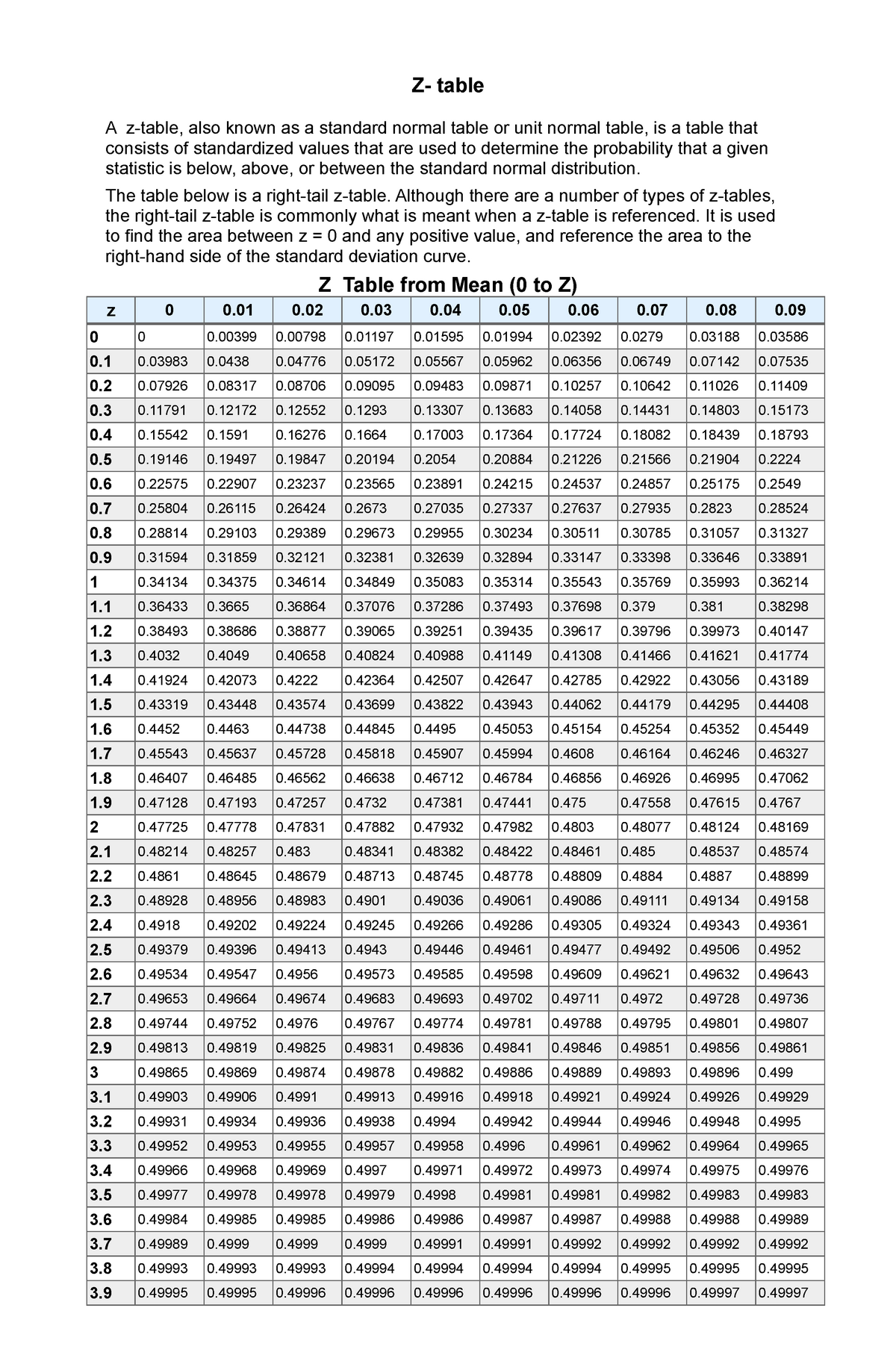
Understanding the Unit Normal Table is crucial for anyone working with statistics, particularly in fields like data analysis, finance, and engineering. This table, also known as the standard normal distribution table or Z-table, provides the probabilities associated with the standard normal distribution. It is an essential tool for calculating probabilities and performing hypothesis tests. This post will delve into the intricacies of the Unit Normal Table, its applications, and how to use it effectively.
What is the Unit Normal Table?
The Unit Normal Table is a reference table that lists the cumulative probabilities for the standard normal distribution. The standard normal distribution is a special case of the normal distribution with a mean of 0 and a standard deviation of 1. This table is used to find the probability that a normally distributed random variable falls within a certain range.
The table is typically organized with Z-scores in the left column and corresponding probabilities in the body of the table. The Z-score represents the number of standard deviations a data point is from the mean. For example, a Z-score of 1.5 means the data point is 1.5 standard deviations above the mean.
Understanding Z-Scores
Z-scores are fundamental to using the Unit Normal Table. A Z-score is calculated using the formula:
Z = (X - μ) / σ
Where:
- X is the value of the data point.
- μ is the mean of the distribution.
- σ is the standard deviation of the distribution.
Z-scores standardize the data, allowing for comparison across different distributions. Once you have the Z-score, you can use the Unit Normal Table to find the corresponding probability.
How to Use the Unit Normal Table
Using the Unit Normal Table involves several steps. Here’s a step-by-step guide:
- Calculate the Z-score: Use the formula mentioned above to calculate the Z-score for your data point.
- Locate the Z-score in the table: Find the Z-score in the left column of the Unit Normal Table.
- Read the corresponding probability: The probability associated with the Z-score is listed in the body of the table.
For example, if you have a Z-score of 1.2, you would locate 1.2 in the left column and read the corresponding probability from the table. This probability represents the area under the standard normal curve to the left of the Z-score.
Interpreting the Unit Normal Table
The Unit Normal Table provides cumulative probabilities, which means it gives the probability that a random variable is less than or equal to a given Z-score. To find the probability that a random variable is between two Z-scores, you need to subtract the cumulative probability of the lower Z-score from the cumulative probability of the upper Z-score.
For instance, to find the probability that a random variable is between Z = 0.5 and Z = 1.5, you would:
- Find the cumulative probability for Z = 1.5 in the Unit Normal Table.
- Find the cumulative probability for Z = 0.5 in the Unit Normal Table.
- Subtract the probability for Z = 0.5 from the probability for Z = 1.5.
This gives you the probability that the random variable falls between these two Z-scores.
Applications of the Unit Normal Table
The Unit Normal Table has numerous applications in various fields. Some of the key applications include:
- Hypothesis Testing: In hypothesis testing, the Unit Normal Table is used to determine the p-value, which helps in deciding whether to reject the null hypothesis.
- Confidence Intervals: The table is used to calculate confidence intervals for population parameters, providing a range within which the true parameter is likely to fall.
- Quality Control: In manufacturing, the Unit Normal Table is used to monitor and control the quality of products by analyzing the distribution of measurements.
- Finance: In finance, the table is used to calculate the probabilities of different outcomes in investment decisions, such as the likelihood of a stock price moving within a certain range.
Example Calculation
Let’s go through an example to illustrate how to use the Unit Normal Table. Suppose you have a normally distributed variable with a mean of 50 and a standard deviation of 10. You want to find the probability that the variable is between 40 and 60.
- Calculate the Z-scores:
- For X = 40: Z = (40 - 50) / 10 = -1
- For X = 60: Z = (60 - 50) / 10 = 1
- Locate the Z-scores in the table:
- Find the cumulative probability for Z = -1 and Z = 1 in the Unit Normal Table.
- Read the corresponding probabilities:
- The cumulative probability for Z = -1 is approximately 0.1587.
- The cumulative probability for Z = 1 is approximately 0.8413.
- Calculate the probability:
- Subtract the probability for Z = -1 from the probability for Z = 1: 0.8413 - 0.1587 = 0.6826.
Therefore, the probability that the variable is between 40 and 60 is approximately 0.6826 or 68.26%.
📝 Note: The Unit Normal Table typically provides probabilities for positive Z-scores. For negative Z-scores, you can use the symmetry of the normal distribution or refer to a table that includes negative values.
Common Mistakes to Avoid
When using the Unit Normal Table, it’s important to avoid common mistakes that can lead to incorrect results. Some of these mistakes include:
- Incorrect Z-score Calculation: Ensure that you correctly calculate the Z-score using the formula. Double-check your mean and standard deviation values.
- Misreading the Table: Be careful when reading the probabilities from the table. Make sure you are looking at the correct Z-score and corresponding probability.
- Ignoring Symmetry: Remember that the normal distribution is symmetric. If you need the probability for a negative Z-score, you can use the symmetry property or refer to a table that includes negative values.
Advanced Topics
For those who want to delve deeper into the Unit Normal Table and its applications, there are several advanced topics to explore:
- Inverse Normal Distribution: The inverse normal distribution allows you to find the Z-score corresponding to a given probability. This is useful in scenarios where you need to determine the critical value for a hypothesis test.
- Multivariate Normal Distribution: The multivariate normal distribution extends the concept of the normal distribution to multiple variables. Understanding this distribution can be crucial in fields like machine learning and data analysis.
- Central Limit Theorem: The Central Limit Theorem states that the sum (or average) of a large number of independent, identically distributed variables will be approximately normally distributed, regardless of the original distribution. This theorem is fundamental in statistics and probability.
Exploring these advanced topics can provide a deeper understanding of the Unit Normal Table and its applications in various fields.
To further illustrate the use of the Unit Normal Table, let's consider an example involving hypothesis testing. Suppose you are conducting a hypothesis test to determine if the average height of a population is significantly different from 170 cm. You collect a sample of 30 individuals and find that the sample mean height is 172 cm with a standard deviation of 5 cm.
- State the Hypotheses:
- Null Hypothesis (H0): μ = 170 cm
- Alternative Hypothesis (H1): μ ≠ 170 cm
- Calculate the Test Statistic:
- Z = (X̄ - μ) / (σ / √n) = (172 - 170) / (5 / √30) ≈ 2.45
- Find the p-value:
- Locate the Z-score of 2.45 in the Unit Normal Table.
- The cumulative probability for Z = 2.45 is approximately 0.9929.
- Since this is a two-tailed test, the p-value is 2 * (1 - 0.9929) = 0.0142.
- Make a Decision:
- Compare the p-value to the significance level (α). If α = 0.05, since 0.0142 < 0.05, you reject the null hypothesis.
Therefore, you conclude that there is sufficient evidence to suggest that the average height of the population is significantly different from 170 cm.
📝 Note: In hypothesis testing, it’s important to choose an appropriate significance level (α) based on the context of the study and the consequences of making a Type I error.
Another important application of the Unit Normal Table is in calculating confidence intervals. Confidence intervals provide a range within which the true population parameter is likely to fall. For example, suppose you want to calculate a 95% confidence interval for the mean height of a population based on a sample of 30 individuals with a sample mean of 172 cm and a standard deviation of 5 cm.
- Calculate the Standard Error:
- SE = σ / √n = 5 / √30 ≈ 0.91
- Find the Critical Value:
- For a 95% confidence interval, the critical value is the Z-score that corresponds to the cumulative probability of 0.975 in the Unit Normal Table. This value is approximately 1.96.
- Calculate the Margin of Error:
- ME = Z * SE = 1.96 * 0.91 ≈ 1.78
- Calculate the Confidence Interval:
- CI = X̄ ± ME = 172 ± 1.78
Therefore, the 95% confidence interval for the mean height of the population is approximately (170.22, 173.78).
📝 Note: The confidence interval provides a range of plausible values for the population parameter. The width of the interval depends on the sample size and the chosen confidence level.
In quality control, the Unit Normal Table is used to monitor and control the quality of products. For example, suppose you are manufacturing light bulbs and you want to ensure that the average lifespan of the bulbs is at least 1000 hours. You collect a sample of 50 bulbs and find that the sample mean lifespan is 980 hours with a standard deviation of 50 hours.
- State the Hypotheses:
- Null Hypothesis (H0): μ ≥ 1000 hours
- Alternative Hypothesis (H1): μ < 1000 hours
- Calculate the Test Statistic:
- Z = (X̄ - μ) / (σ / √n) = (980 - 1000) / (50 / √50) ≈ -2.83
- Find the p-value:
- Locate the Z-score of -2.83 in the Unit Normal Table.
- The cumulative probability for Z = -2.83 is approximately 0.0023.
- Since this is a one-tailed test, the p-value is 0.0023.
- Make a Decision:
- Compare the p-value to the significance level (α). If α = 0.05, since 0.0023 < 0.05, you reject the null hypothesis.
Therefore, you conclude that there is sufficient evidence to suggest that the average lifespan of the bulbs is less than 1000 hours, indicating a potential quality issue.
📝 Note: In quality control, it’s important to regularly monitor the process and take corrective actions if necessary to ensure that the products meet the required quality standards.
In finance, the Unit Normal Table is used to calculate the probabilities of different outcomes in investment decisions. For example, suppose you are analyzing the performance of a stock and you want to determine the probability that the stock price will increase by more than 5% in the next month. You have historical data showing that the monthly returns of the stock are normally distributed with a mean of 2% and a standard deviation of 3%.
- Calculate the Z-score:
- Z = (X - μ) / σ = (5 - 2) / 3 ≈ 1
- Find the Probability:
- Locate the Z-score of 1 in the Unit Normal Table.
- The cumulative probability for Z = 1 is approximately 0.8413.
- The probability that the stock price will increase by more than 5% is 1 - 0.8413 = 0.1587 or 15.87%.
Therefore, there is a 15.87% chance that the stock price will increase by more than 5% in the next month.
📝 Note: In finance, it’s important to consider various factors and uncertainties when making investment decisions. The Unit Normal Table provides a useful tool for quantifying the probabilities of different outcomes.
In conclusion, the Unit Normal Table is a powerful tool in statistics that provides the probabilities associated with the standard normal distribution. It is used in various fields, including data analysis, finance, and engineering, to calculate probabilities, perform hypothesis tests, and monitor quality control. Understanding how to use the Unit Normal Table effectively can enhance your analytical skills and improve decision-making processes. By following the steps outlined in this post and avoiding common mistakes, you can confidently apply the Unit Normal Table to solve a wide range of statistical problems.
Related Terms:
- z score normal distribution table
- z score unit normal table
- standard normal table pdf
- unit normal table printable
- normal distribution full table
- full unit normal table