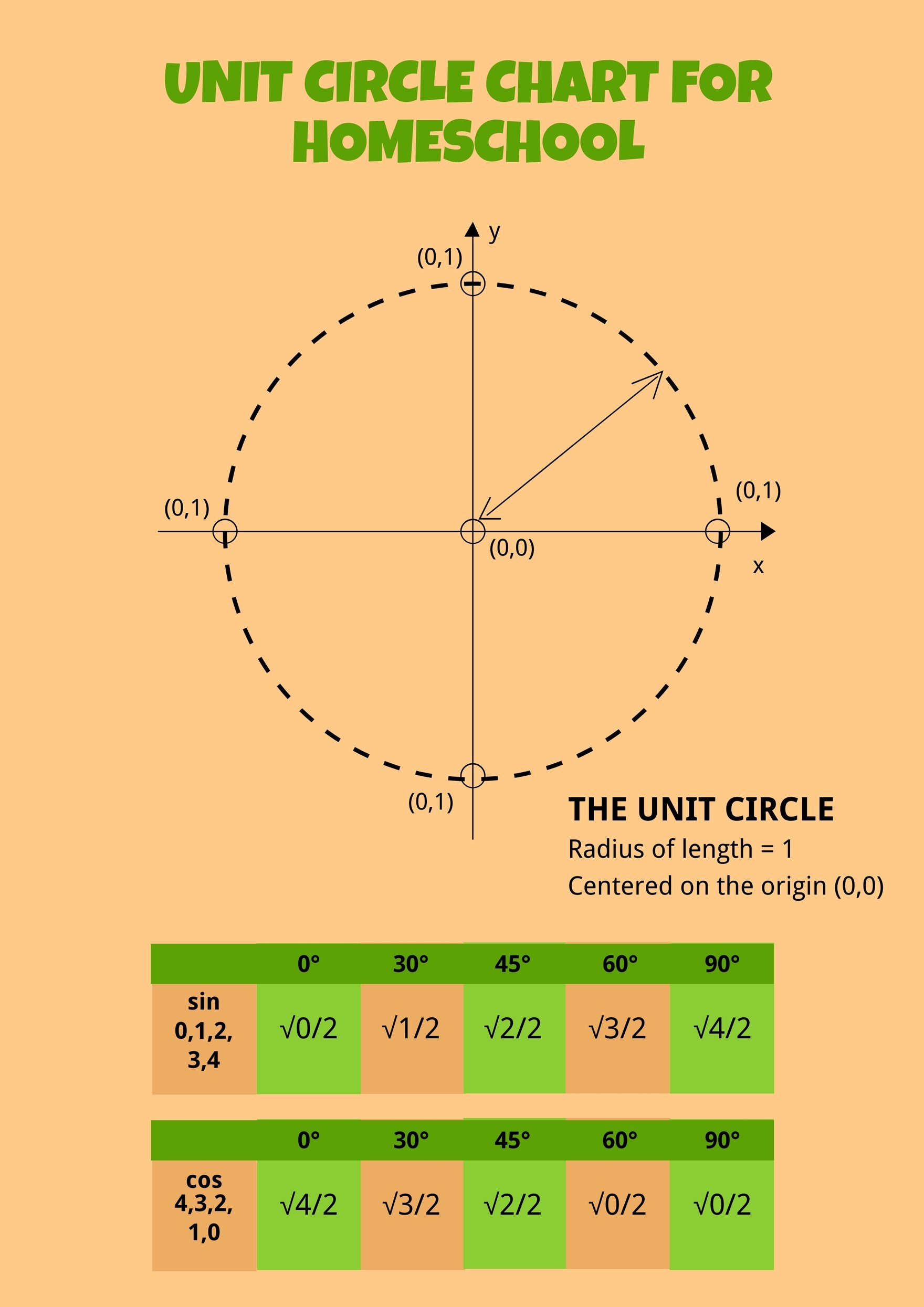
The unit circle with labels is a fundamental concept in trigonometry and mathematics, serving as a visual representation of the relationships between angles and their corresponding trigonometric functions. This circle, with a radius of one unit, is centered at the origin of a Cartesian coordinate system. Understanding the unit circle with labels is crucial for grasping the behavior of sine, cosine, and tangent functions, as well as for solving various trigonometric problems.
Understanding the Unit Circle
The unit circle is a circle with a radius of one unit, centered at the origin (0,0) of the coordinate plane. The circumference of the unit circle is 2π, which corresponds to 360 degrees or one full rotation around the circle. The unit circle is divided into four quadrants, each representing a 90-degree segment of the circle. These quadrants are labeled as follows:
- Quadrant I: 0° to 90°
- Quadrant II: 90° to 180°
- Quadrant III: 180° to 270°
- Quadrant IV: 270° to 360°
Each point on the unit circle can be represented as (x, y), where x and y are the coordinates of the point. The coordinates of any point on the unit circle can be determined using the trigonometric functions sine and cosine. For an angle θ, the coordinates (x, y) are given by:
- x = cos(θ)
- y = sin(θ)
These coordinates help in visualizing the unit circle with labels, where each angle corresponds to a specific point on the circle.
Key Points on the Unit Circle
Several key points on the unit circle are frequently referenced due to their special angles and corresponding trigonometric values. These points include:
- 0° (or 0 radians): (1, 0)
- 90° (or π/2 radians): (0, 1)
- 180° (or π radians): (-1, 0)
- 270° (or 3π/2 radians): (0, -1)
Additionally, points corresponding to 30°, 45°, 60°, and their multiples are also important. These angles have well-known trigonometric values that are essential for solving trigonometric problems.
Trigonometric Functions on the Unit Circle
The unit circle provides a clear visual representation of the trigonometric functions sine, cosine, and tangent. For any angle θ:
- Sine (sin(θ)): The y-coordinate of the point on the unit circle corresponding to the angle θ.
- Cosine (cos(θ)): The x-coordinate of the point on the unit circle corresponding to the angle θ.
- Tangent (tan(θ)): The ratio of the sine to the cosine of the angle θ, i.e., tan(θ) = sin(θ) / cos(θ).
These functions are fundamental in trigonometry and are used extensively in various fields such as physics, engineering, and computer graphics.
Labeling the Unit Circle
Labeling the unit circle with labels involves marking key angles and their corresponding coordinates. This labeling helps in understanding the relationships between angles and trigonometric functions. Here is a step-by-step guide to labeling the unit circle:
- Draw a circle with a radius of one unit centered at the origin (0,0).
- Mark the key angles: 0°, 90°, 180°, 270°, 30°, 45°, 60°, and their multiples.
- Label the coordinates of these points using the sine and cosine values.
- Include the quadrants and their respective angle ranges.
Here is an example of how the unit circle might be labeled:
| Angle (θ) | Quadrant | Coordinates (x, y) |
|---|---|---|
| 0° | I | (1, 0) |
| 30° | I | (√3/2, 1/2) |
| 45° | I | (√2/2, √2/2) |
| 60° | I | (1/2, √3/2) |
| 90° | II | (0, 1) |
| 180° | III | (-1, 0) |
| 270° | IV | (0, -1) |
📝 Note: The coordinates are derived from the sine and cosine values of the respective angles.
Applications of the Unit Circle
The unit circle with labels has numerous applications in mathematics and other fields. Some of the key applications include:
- Trigonometric Identities: The unit circle helps in deriving and understanding trigonometric identities, such as sin²(θ) + cos²(θ) = 1.
- Graphing Trigonometric Functions: The unit circle provides a basis for graphing sine and cosine functions, which are periodic and repeat every 2π.
- Complex Numbers: The unit circle is used to represent complex numbers in the complex plane, where the real part is the x-coordinate and the imaginary part is the y-coordinate.
- Physics and Engineering: The unit circle is used in various physical and engineering applications, such as wave analysis, signal processing, and rotational motion.
Understanding the unit circle is essential for solving problems in these areas and for gaining a deeper understanding of trigonometric concepts.
Practical Examples
To illustrate the practical use of the unit circle with labels, let's consider a few examples:
Example 1: Finding Coordinates
Find the coordinates of the point on the unit circle corresponding to an angle of 120°.
Solution:
For θ = 120°:
- x = cos(120°) = -1/2
- y = sin(120°) = √3/2
Therefore, the coordinates are (-1/2, √3/2).
Example 2: Trigonometric Values
Find the sine, cosine, and tangent of 210°.
Solution:
For θ = 210°:
- sin(210°) = -1/2
- cos(210°) = -√3/2
- tan(210°) = sin(210°) / cos(210°) = 1/√3
These examples demonstrate how the unit circle can be used to find trigonometric values and coordinates.
Example 3: Graphing Sine and Cosine Functions
Graph the sine and cosine functions using the unit circle.
Solution:
To graph the sine function, plot the y-coordinates of the points on the unit circle as the angle θ varies from 0° to 360°. Similarly, to graph the cosine function, plot the x-coordinates of the points on the unit circle as the angle θ varies from 0° to 360°. The resulting graphs will be periodic waves with a period of 2π.
These examples highlight the versatility of the unit circle in solving trigonometric problems and understanding trigonometric functions.

Example 4: Complex Numbers
Represent the complex number z = 1 + i on the unit circle.
Solution:
The complex number z = 1 + i corresponds to the point (1, 1) in the complex plane. To represent this on the unit circle, we need to find the angle θ such that:
- cos(θ) = 1/√2
- sin(θ) = 1/√2
This corresponds to an angle of 45° (or π/4 radians). Therefore, the complex number z = 1 + i can be represented as a point on the unit circle at an angle of 45°.
These examples illustrate the practical applications of the unit circle with labels in various mathematical and scientific contexts.
Example 5: Rotational Motion
Consider a point rotating around the origin with a constant angular velocity ω. The position of the point at any time t can be represented using the unit circle.
Solution:
The position of the point at time t is given by (cos(ωt), sin(ωt)). This means that the point traces out a circular path on the unit circle as it rotates. The angular velocity ω determines the speed of rotation, and the position at any time t can be found using the trigonometric functions sine and cosine.
This example demonstrates how the unit circle can be used to model rotational motion in physics and engineering.
Example 6: Wave Analysis
Analyze a sinusoidal wave using the unit circle.
Solution:
A sinusoidal wave can be represented by the equation y = A sin(ωt + φ), where A is the amplitude, ω is the angular frequency, and φ is the phase shift. The unit circle can be used to visualize the wave by plotting the sine function as the angle θ varies from 0° to 360°. The amplitude A determines the height of the wave, and the angular frequency ω determines the period of the wave.
This example shows how the unit circle can be used to analyze and understand sinusoidal waves in various applications.
Example 7: Signal Processing
Process a signal using the unit circle.
Solution:
In signal processing, signals are often represented as complex exponentials or sinusoidal waves. The unit circle can be used to analyze and process these signals by representing them as points on the circle. The phase and amplitude of the signal can be determined using the trigonometric functions sine and cosine, and the signal can be manipulated using various mathematical techniques.
This example illustrates the use of the unit circle in signal processing and its applications in engineering and technology.
Example 8: Computer Graphics
Render a rotating object in computer graphics using the unit circle.
Solution:
In computer graphics, rotating objects can be rendered using the unit circle. The position of each point on the object can be determined using the trigonometric functions sine and cosine, and the object can be rotated around the origin by updating the angle θ. This allows for smooth and accurate rendering of rotating objects in real-time applications.
This example demonstrates the use of the unit circle in computer graphics and its applications in rendering and animation.
Example 9: Navigation Systems
Determine the direction of a moving object using the unit circle.
Solution:
In navigation systems, the direction of a moving object can be determined using the unit circle. The angle θ between the object's current position and a reference point can be found using the trigonometric functions sine and cosine. This angle can then be used to calculate the object's direction and update its position in real-time.
This example shows how the unit circle can be used in navigation systems to determine the direction and position of moving objects.
Example 10: Robotics
Control the movement of a robotic arm using the unit circle.
Solution:
In robotics, the movement of a robotic arm can be controlled using the unit circle. The position of each joint on the arm can be determined using the trigonometric functions sine and cosine, and the arm can be moved to a desired position by updating the angles of the joints. This allows for precise and accurate control of the robotic arm in various applications.
This example illustrates the use of the unit circle in robotics and its applications in controlling the movement of robotic arms.
Example 11: Astronomy
Calculate the position of a celestial object using the unit circle.
Solution:
In astronomy, the position of a celestial object can be calculated using the unit circle. The angle θ between the object's current position and a reference point can be found using the trigonometric functions sine and cosine. This angle can then be used to calculate the object's position in the sky and track its movement over time.
This example demonstrates the use of the unit circle in astronomy to calculate the position and movement of celestial objects.
Example 12: Music Theory
Analyze the frequency of a musical note using the unit circle.
Solution:
In music theory, the frequency of a musical note can be analyzed using the unit circle. The frequency f of a note is related to its period T by the equation f = 1/T. The period T can be represented as the time it takes for a point to complete one full rotation around the unit circle. This allows for the analysis and understanding of the frequency and pitch of musical notes.
This example shows how the unit circle can be used in music theory to analyze the frequency and pitch of musical notes.
Example 13: Economics
Model economic cycles using the unit circle.
Solution:
In economics, economic cycles can be modeled using the unit circle. The phases of the cycle, such as expansion, peak, contraction, and trough, can be represented as points on the unit circle. The trigonometric functions sine and cosine can be used to analyze the cycle and predict future trends.
This example illustrates the use of the unit circle in economics to model and analyze economic cycles.
Example 14: Biology
Study the circadian rhythm using the unit circle.
Solution:
In biology, the circadian rhythm can be studied using the unit circle. The circadian rhythm is a 24-hour cycle that regulates various physiological processes in living organisms. The unit circle can be used to represent the cycle and analyze its phases, such as wakefulness and sleep. This allows for a better understanding of the circadian rhythm and its effects on health and well-being.
This example demonstrates the use of the unit circle in biology to study the circadian rhythm and its effects on living organisms.
Example 15: Psychology
Analyze emotional states using the unit circle.
Solution:
In psychology, emotional states can be analyzed using the unit circle. The emotional states can be represented as points on the unit circle, with different quadrants representing different emotional categories, such as positive and negative emotions. The trigonometric functions sine and cosine can be used to analyze the emotional states and understand their relationships.
This example shows how the unit circle can be used in psychology to analyze emotional states and their relationships.
Example 16: Sociology
Study social networks using the unit circle.
Solution:
In sociology, social networks can be studied using the unit circle. The relationships between individuals in a social network can be represented as points on the unit circle, with different quadrants representing different types of relationships, such as friends and acquaintances. The trigonometric functions sine and cosine can be used to analyze the network and understand its structure and dynamics.
This example illustrates the use of the unit circle in sociology to study social networks and their structure and dynamics.
Example 17: Anthropology
Analyze cultural patterns using the unit circle.
Solution:
In anthropology, cultural patterns can be analyzed using the unit circle. The cultural patterns can be represented as points on the unit circle, with different quadrants representing different cultural categories, such as rituals and beliefs. The trigonometric functions sine and cosine can be used to analyze the patterns and understand their relationships.
This example demonstrates the use of the unit circle in anthropology to analyze cultural patterns and their relationships.
Example 18: Linguistics
Study language patterns using the unit circle.
Solution:
In linguistics, language patterns can be studied using the unit circle. The language patterns can be represented as points on the unit circle, with different quadrants representing different linguistic categories, such as phonemes and morphemes. The trigonometric functions sine and cosine can be used to analyze the patterns and understand their relationships.
This example shows how the unit circle can be used in linguistics to study language patterns and their relationships.
Example 19: Education
Teach trigonometry using the unit circle.
Solution:
In education, trigonometry can be taught using the unit circle. The unit circle provides a visual representation of trigonometric functions and their relationships, making it easier for students to understand and apply these concepts. The unit circle can be used to teach various trigonometric identities, graphing techniques, and problem-solving strategies.
This example illustrates the use of the unit circle in education to teach trigonometry and its applications.
Example 20: Art and Design
Create symmetrical patterns using the unit circle.
Solution:
In art and design, symmetrical patterns can be created using the unit circle. The unit circle can be used to generate symmetrical shapes and patterns by rotating points around the origin. The trigonometric functions sine and cosine can be used to calculate the positions of the points and create intricate and visually appealing designs.
This example demonstrates the use of the unit circle in art and design to create symmetrical patterns and designs.
**Example 21: Architecture
Design circular structures using the unit circle.
Solution: