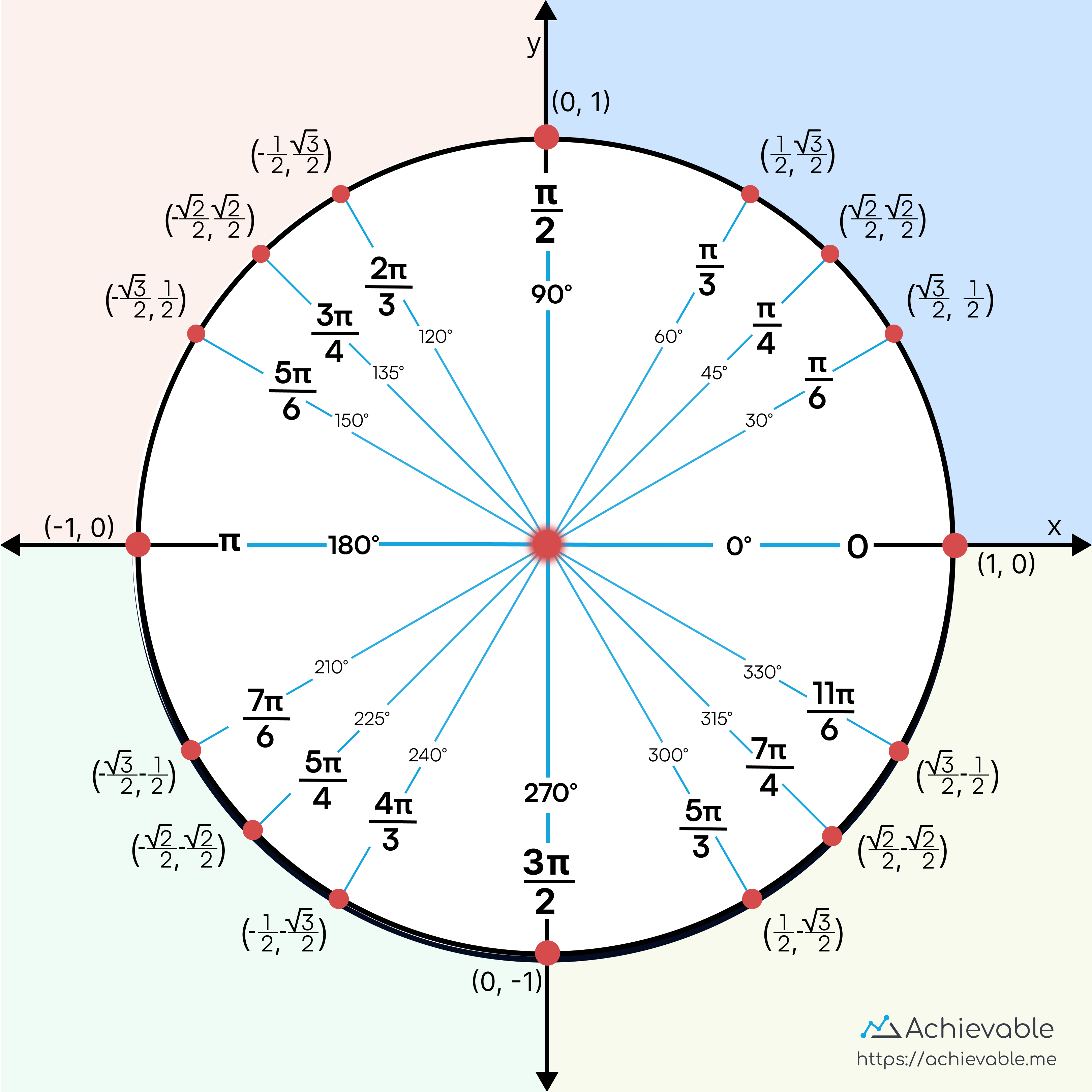
The unit circle with coordinates is a fundamental concept in trigonometry and mathematics, serving as a visual representation of the relationships between angles and their corresponding trigonometric functions. This circle has a radius of one unit and is centered at the origin (0,0) of a Cartesian coordinate system. Understanding the unit circle with coordinates is crucial for grasping the behavior of sine, cosine, and other trigonometric functions, as well as for solving problems in geometry, physics, and engineering.
Understanding the Unit Circle
The unit circle is defined as a circle with a radius of one unit. It is placed in the Cartesian coordinate system with its center at the origin. The equation of the unit circle is given by:
x2 + y2 = 1
This equation represents all points (x, y) that lie on the circle. The unit circle is divided into four quadrants, each representing a different range of angles. The quadrants are:
- First Quadrant: 0° to 90° (0 to π/2 radians)
- Second Quadrant: 90° to 180° (π/2 to π radians)
- Third Quadrant: 180° to 270° (π to 3π/2 radians)
- Fourth Quadrant: 270° to 360° (3π/2 to 2π radians)
Coordinates on the Unit Circle
The coordinates of any point on the unit circle can be determined using the trigonometric functions sine and cosine. For an angle θ (measured in radians or degrees), the coordinates (x, y) of the point on the unit circle are given by:
x = cos(θ)
y = sin(θ)
These coordinates represent the projection of the angle θ onto the x-axis and y-axis, respectively. The unit circle with coordinates provides a visual way to understand how these trigonometric functions change as the angle θ varies.
Key Points on the Unit Circle
There are several key points on the unit circle that correspond to common angles. These points are essential for understanding the periodicity and symmetry of trigonometric functions. Some of the key points include:
| Angle (θ) | Coordinates (x, y) |
|---|---|
| 0° (0 radians) | (1, 0) |
| 90° (π/2 radians) | (0, 1) |
| 180° (π radians) | (-1, 0) |
| 270° (3π/2 radians) | (0, -1) |
| 360° (2π radians) | (1, 0) |
These points help in visualizing the unit circle and understanding the behavior of trigonometric functions at these specific angles.
📌 Note: The coordinates of these key points are derived directly from the definitions of sine and cosine. For example, at 90° (π/2 radians), the cosine value is 0 and the sine value is 1, giving the coordinates (0, 1).
Trigonometric Functions and the Unit Circle
The unit circle with coordinates is instrumental in defining and understanding trigonometric functions. The primary trigonometric functions—sine, cosine, and tangent—can be visualized on the unit circle:
- Sine (sin(θ)): Represents the y-coordinate of the point on the unit circle corresponding to the angle θ.
- Cosine (cos(θ)): Represents the x-coordinate of the point on the unit circle corresponding to the angle θ.
- Tangent (tan(θ)): Represents the ratio of the y-coordinate to the x-coordinate of the point on the unit circle corresponding to the angle θ.
These functions are periodic, meaning their values repeat at regular intervals. The period of sine and cosine functions is 2π radians (360 degrees), while the period of the tangent function is π radians (180 degrees).
Applications of the Unit Circle
The unit circle with coordinates has numerous applications in various fields of mathematics and science. Some of the key applications include:
- Geometry: The unit circle is used to solve problems involving angles, arcs, and sectors. It helps in understanding the relationships between different geometric shapes and their properties.
- Physics: In physics, the unit circle is used to model periodic phenomena such as waves, oscillations, and rotations. It helps in understanding the behavior of physical systems that exhibit periodic motion.
- Engineering: Engineers use the unit circle to analyze and design systems that involve rotating or oscillating components. It is essential in fields such as mechanical engineering, electrical engineering, and aerospace engineering.
- Computer Graphics: In computer graphics, the unit circle is used to generate smooth curves and shapes. It is also used in the implementation of algorithms for rendering and animation.
The unit circle with coordinates provides a powerful tool for visualizing and understanding trigonometric functions and their applications.
📌 Note: The unit circle is not limited to these applications. It is a fundamental concept that finds use in many other areas of mathematics and science.
Visualizing the Unit Circle
Visualizing the unit circle with coordinates can greatly enhance understanding. Here are some steps to visualize the unit circle:
- Draw a circle with a radius of one unit centered at the origin (0,0) of the Cartesian coordinate system.
- Mark the key points corresponding to common angles (0°, 90°, 180°, 270°, and 360°).
- For any given angle θ, plot the point (cos(θ), sin(θ)) on the circle.
- Observe how the coordinates change as the angle θ varies.
By following these steps, you can create a visual representation of the unit circle and understand how trigonometric functions behave.
📌 Note: You can use graphing software or online tools to visualize the unit circle and explore different angles and their corresponding coordinates.

Practical Examples
Let's consider a few practical examples to illustrate the use of the unit circle with coordinates:
- Example 1: Finding Coordinates
- Example 2: Using Trigonometric Functions
Find the coordinates of the point on the unit circle corresponding to an angle of 45° (π/4 radians).
Solution: The coordinates are given by (cos(45°), sin(45°)). Using the values of cosine and sine for 45°, we get:
x = cos(45°) = √2/2
y = sin(45°) = √2/2
Therefore, the coordinates are (√2/2, √2/2).
Find the value of sin(300°) using the unit circle.
Solution: The angle 300° corresponds to a point in the fourth quadrant. The reference angle is 60° (since 300° - 240° = 60°). In the fourth quadrant, the sine value is negative. Therefore, sin(300°) = -sin(60°) = -√3/2.
These examples demonstrate how the unit circle with coordinates can be used to solve problems involving trigonometric functions.
📌 Note: Practice with different angles and quadrants to gain a deeper understanding of the unit circle and its applications.
In conclusion, the unit circle with coordinates is a fundamental concept in trigonometry that provides a visual and intuitive way to understand trigonometric functions. It is essential for solving problems in geometry, physics, engineering, and other fields. By mastering the unit circle, you can gain a deeper understanding of trigonometry and its applications, enabling you to tackle more complex problems with confidence.
Related Terms:
- unit circle chart labeled
- 420 degrees on unit circle
- unit circle coordinates calculator
- unit circle 15 degrees coordinates
- unit circle coordinate sin cos
- unit circle coordinates only