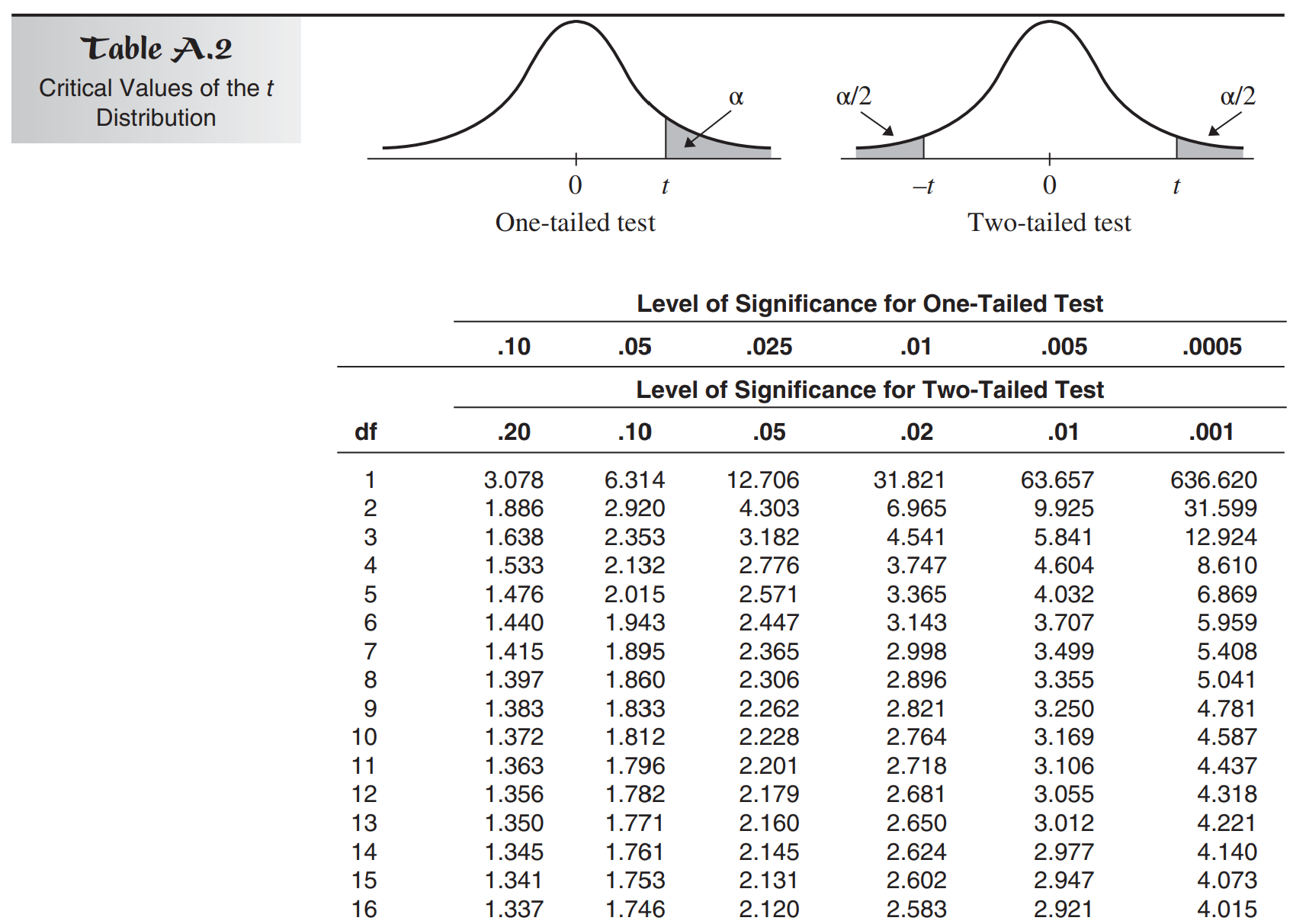
In the realm of data analysis and statistics, the T Table is an indispensable tool. It provides critical values for the Student's t-distribution, which is essential for hypothesis testing and constructing confidence intervals. Understanding how to use a T Table effectively can significantly enhance the accuracy and reliability of statistical analyses. This post delves into the intricacies of the T Table, its applications, and how to interpret its values.
Understanding the T Table
The T Table, also known as the Student's t-distribution table, is a statistical table that lists the critical values of the t-distribution for various degrees of freedom and confidence levels. The t-distribution is used when the sample size is small, and the population standard deviation is unknown. This makes the T Table particularly useful in scenarios where the sample size is less than 30.
The T Table is structured with rows representing degrees of freedom (df) and columns representing different confidence levels or significance levels (α). The degrees of freedom are calculated as n - 1, where n is the sample size. The confidence levels typically range from 90% to 99%, with common values being 95% and 99%.
Components of the T Table
The T Table consists of several key components:
- Degrees of Freedom (df): This is calculated as n - 1, where n is the sample size. It represents the number of values in the final calculation of a statistic that are free to vary.
- Confidence Level: This is the probability that the confidence interval will contain the true population parameter. Common confidence levels are 90%, 95%, and 99%.
- Critical Values: These are the values from the t-distribution that correspond to the given degrees of freedom and confidence level. They are used to determine the rejection region in hypothesis testing.
How to Use the T Table
Using the T Table involves several steps. Here’s a step-by-step guide:
- Determine the Degrees of Freedom: Calculate the degrees of freedom (df) using the formula df = n - 1, where n is the sample size.
- Identify the Confidence Level: Decide on the confidence level you need for your analysis. Common choices are 95% and 99%.
- Locate the Critical Value: Find the intersection of the degrees of freedom row and the confidence level column in the T Table. This value is the critical t-value.
- Apply the Critical Value: Use the critical value in your statistical calculations, such as hypothesis testing or constructing confidence intervals.
📝 Note: Always ensure that the degrees of freedom and confidence level match the requirements of your specific analysis. Incorrect values can lead to erroneous conclusions.
Applications of the T Table
The T Table has numerous applications in statistics and data analysis. Some of the most common uses include:
- Hypothesis Testing: The T Table is used to determine the critical values for t-tests, which are used to compare the means of two groups or to test if a sample mean is significantly different from a population mean.
- Confidence Intervals: The T Table provides the critical values needed to construct confidence intervals for the mean when the population standard deviation is unknown.
- Sample Size Determination: The T Table can help in determining the appropriate sample size for a study to achieve a desired level of confidence and precision.
Interpreting T Table Values
Interpreting the values from the T Table requires an understanding of the context in which they are used. Here are some key points to consider:
- Critical Values: These values are used to determine the rejection region in hypothesis testing. If the calculated t-value falls within the rejection region, the null hypothesis is rejected.
- Confidence Intervals: The critical values from the T Table are used to calculate the margin of error for confidence intervals. The interval is then constructed around the sample mean.
- Degrees of Freedom: The degrees of freedom affect the shape of the t-distribution. As the degrees of freedom increase, the t-distribution approaches the normal distribution.
For example, if you have a sample size of 15 and you want to construct a 95% confidence interval for the mean, you would:
- Calculate the degrees of freedom: df = 15 - 1 = 14.
- Locate the critical value for 14 degrees of freedom and a 95% confidence level in the T Table.
- Use this critical value to calculate the margin of error and construct the confidence interval.
📝 Note: Always double-check the degrees of freedom and confidence level to ensure accuracy in your calculations.
Example of Using the T Table
Let's walk through an example to illustrate how to use the T Table in practice.
Suppose you have a sample of 20 observations with a mean of 50 and a standard deviation of 10. You want to test the hypothesis that the population mean is 45 at a 95% confidence level.
- Calculate the degrees of freedom: df = 20 - 1 = 19.
- Locate the critical value for 19 degrees of freedom and a 95% confidence level in the T Table. The critical value is approximately 2.093.
- Calculate the t-statistic using the formula:
t = (sample mean - population mean) / (standard deviation / sqrt(sample size))
t = (50 - 45) / (10 / sqrt(20)) = 2.236
Compare the calculated t-value (2.236) to the critical value (2.093). Since 2.236 is greater than 2.093, you reject the null hypothesis and conclude that the population mean is significantly different from 45 at a 95% confidence level.
Common Mistakes to Avoid
When using the T Table, it's important to avoid common mistakes that can lead to incorrect conclusions. Some of these mistakes include:
- Incorrect Degrees of Freedom: Ensure that you calculate the degrees of freedom correctly. A common error is using n instead of n - 1.
- Wrong Confidence Level: Make sure you use the correct confidence level for your analysis. Using a higher confidence level than intended can lead to overly conservative results.
- Misinterpreting Critical Values: Understand the context in which the critical values are used. For example, in hypothesis testing, the critical value determines the rejection region.
📝 Note: Always verify your calculations and ensure that the degrees of freedom and confidence level are appropriate for your analysis.
Advanced Topics in T Table Usage
For more advanced statistical analyses, the T Table can be used in conjunction with other statistical tools and techniques. Some advanced topics include:
- Paired t-Tests: Used to compare the means of the same group under two different conditions. The T Table provides the critical values for determining significance.
- Independent Samples t-Tests: Used to compare the means of two independent groups. The T Table is used to find the critical values for hypothesis testing.
- ANOVA and Post-Hoc Tests: While ANOVA itself does not use the T Table, post-hoc tests like Tukey's HSD often rely on t-distributions and critical values from the T Table.
For example, in a paired t-test, you might have the following data:
| Condition 1 | Condition 2 | Difference |
|---|---|---|
| 5 | 7 | 2 |
| 6 | 8 | 2 |
| 7 | 9 | 2 |
| 8 | 10 | 2 |
| 9 | 11 | 2 |
You would calculate the mean and standard deviation of the differences, then use the T Table to find the critical value for the appropriate degrees of freedom and confidence level.
📝 Note: Advanced statistical analyses often require a deeper understanding of the underlying distributions and assumptions. Ensure you have the necessary statistical knowledge before proceeding.
In conclusion, the T Table is a fundamental tool in statistical analysis, providing critical values for the t-distribution. Understanding how to use the T Table effectively can enhance the accuracy and reliability of your statistical analyses. Whether you are conducting hypothesis tests, constructing confidence intervals, or determining sample sizes, the T Table is an invaluable resource. By following the steps outlined in this post and avoiding common mistakes, you can leverage the power of the T Table to make informed decisions based on your data.
Related Terms:
- t distribution table pdf
- t table two tailed
- t statistic
- t table values
- t table printable
- t table statistics pdf