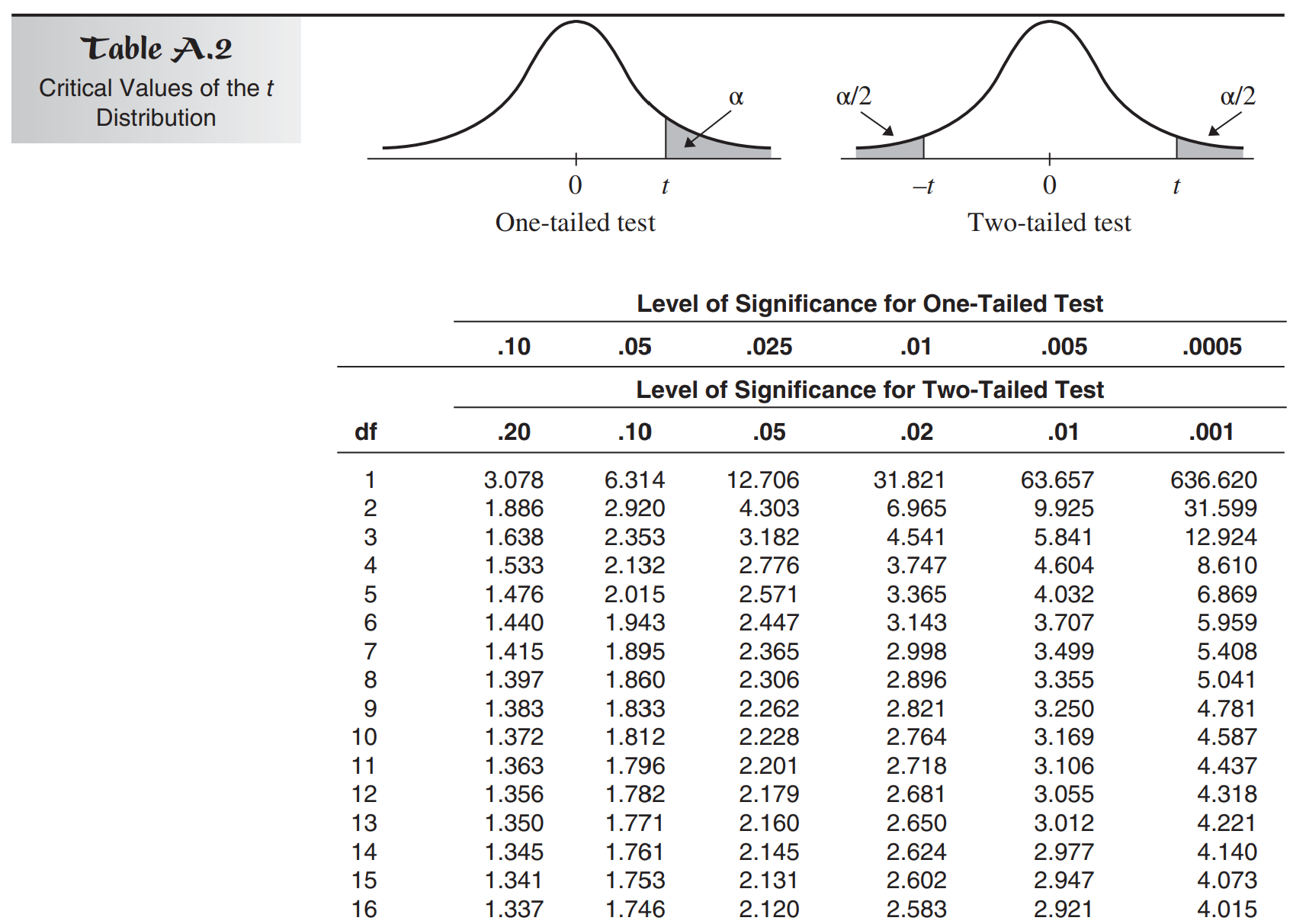
Understanding the T Table Distribution is crucial for anyone involved in statistical analysis, particularly when dealing with small sample sizes. The T Table Distribution, also known as Student's t-distribution, is a fundamental concept in inferential statistics. It is used to estimate population parameters when the sample size is small, and the population standard deviation is unknown. This distribution is particularly useful in hypothesis testing and constructing confidence intervals.
What is the T Table Distribution?
The T Table Distribution is a probability distribution that arises when estimating the mean of a normally distributed population in situations where the sample size is small and the population standard deviation is unknown. It was developed by William Sealy Gosset, who published it under the pseudonym "Student." The t-distribution is similar to the normal distribution but has heavier tails, meaning it is more prone to producing values that fall far from its mean.
Key Characteristics of the T Table Distribution
The T Table Distribution has several key characteristics that distinguish it from the normal distribution:
- Degrees of Freedom (df): The shape of the t-distribution is determined by its degrees of freedom, which is typically equal to the sample size minus one (n - 1). As the degrees of freedom increase, the t-distribution approaches the normal distribution.
- Heavier Tails: The t-distribution has heavier tails than the normal distribution, meaning it has a higher probability of producing values that are far from the mean.
- Symmetry: Like the normal distribution, the t-distribution is symmetric about the mean.
Applications of the T Table Distribution
The T Table Distribution is widely used in various statistical applications, including:
- Hypothesis Testing: The t-distribution is used to test hypotheses about the mean of a population when the sample size is small and the population standard deviation is unknown. Common tests include the one-sample t-test, two-sample t-test, and paired t-test.
- Confidence Intervals: The t-distribution is used to construct confidence intervals for the mean of a population when the sample size is small and the population standard deviation is unknown.
- Regression Analysis: In linear regression, the t-distribution is used to test the significance of regression coefficients.
Using the T Table Distribution in Hypothesis Testing
One of the most common applications of the T Table Distribution is in hypothesis testing. Here's a step-by-step guide on how to use the t-distribution in hypothesis testing:
- State the Hypotheses: Formulate the null hypothesis (H0) and the alternative hypothesis (H1).
- Choose the Significance Level: Select the significance level (α), which is the probability of rejecting the null hypothesis when it is true. Common choices are 0.05, 0.01, and 0.10.
- Calculate the Test Statistic: Compute the t-statistic using the formula:
📝 Note: The formula for the t-statistic is t = (x̄ - μ) / (s / √n), where x̄ is the sample mean, μ is the population mean, s is the sample standard deviation, and n is the sample size.
- Determine the Critical Value: Use the T Table Distribution to find the critical value based on the degrees of freedom and the chosen significance level.
- Make a Decision: Compare the calculated t-statistic to the critical value. If the absolute value of the t-statistic is greater than the critical value, reject the null hypothesis. Otherwise, do not reject the null hypothesis.
- Draw a Conclusion: Interpret the results in the context of the problem.
Constructing Confidence Intervals with the T Table Distribution
The T Table Distribution is also used to construct confidence intervals for the mean of a population. Here's how to do it:
- Choose the Confidence Level: Select the confidence level (e.g., 95%, 99%).
- Determine the Critical Value: Use the T Table Distribution to find the critical value based on the degrees of freedom and the chosen confidence level.
- Calculate the Margin of Error: Compute the margin of error using the formula:
📝 Note: The formula for the margin of error is ME = t * (s / √n), where t is the critical value, s is the sample standard deviation, and n is the sample size.
- Construct the Confidence Interval: Calculate the confidence interval using the formula:
📝 Note: The formula for the confidence interval is x̄ ± ME, where x̄ is the sample mean and ME is the margin of error.
T Table Distribution vs. Normal Distribution
While the T Table Distribution and the normal distribution share many similarities, there are key differences that make the t-distribution more appropriate for certain situations. Here's a comparison:
| Characteristic | T Table Distribution | Normal Distribution |
|---|---|---|
| Shape | Heavier tails, more prone to outliers | Lighter tails, less prone to outliers |
| Degrees of Freedom | Depends on sample size (n - 1) | Does not depend on sample size |
| Use Case | Small sample sizes, unknown population standard deviation | Large sample sizes, known population standard deviation |
Interpreting the T Table Distribution
Interpreting the T Table Distribution involves understanding the relationship between the degrees of freedom, the critical values, and the probability of making a Type I error (rejecting the null hypothesis when it is true). Here are some key points to consider:
- Degrees of Freedom: As the degrees of freedom increase, the t-distribution approaches the normal distribution. This means that for large sample sizes, the t-distribution and the normal distribution yield similar results.
- Critical Values: The critical values for the t-distribution are larger than those for the normal distribution, especially for small sample sizes. This is because the t-distribution has heavier tails, making it more likely to produce extreme values.
- Type I Error: The probability of making a Type I error is determined by the significance level (α). For example, a significance level of 0.05 means there is a 5% chance of rejecting the null hypothesis when it is true.
To illustrate the T Table Distribution, consider the following example:

Example of Using the T Table Distribution
Let's walk through an example to see how the T Table Distribution is applied in practice. Suppose we want to test whether the average height of students in a school is different from 160 cm. We take a random sample of 20 students and find that the sample mean height is 162 cm with a sample standard deviation of 5 cm. We want to test this at a 5% significance level.
- State the Hypotheses:
📝 Note: H0: μ = 160 cm, H1: μ ≠ 160 cm
- Choose the Significance Level: α = 0.05
- Calculate the Test Statistic: t = (162 - 160) / (5 / √20) = 2.828
- Determine the Critical Value: With 19 degrees of freedom and a 5% significance level, the critical value from the T Table Distribution is approximately 2.093.
- Make a Decision: Since the absolute value of the t-statistic (2.828) is greater than the critical value (2.093), we reject the null hypothesis.
- Draw a Conclusion: There is sufficient evidence to conclude that the average height of students in the school is different from 160 cm.
This example demonstrates how the T Table Distribution is used to make inferences about a population mean based on a small sample size.
In summary, the T Table Distribution is a powerful tool in statistical analysis, particularly when dealing with small sample sizes and unknown population standard deviations. It is widely used in hypothesis testing and constructing confidence intervals, providing a robust framework for making inferences about population parameters. Understanding the T Table Distribution and its applications is essential for anyone involved in statistical analysis, as it enables more accurate and reliable conclusions to be drawn from data.
Related Terms:
- complete t distribution table pdf
- t table distribution pdf
- t distribution table full
- t distribution critical values table
- t distribution table right tailed
- t distribution table 0.05 pdf