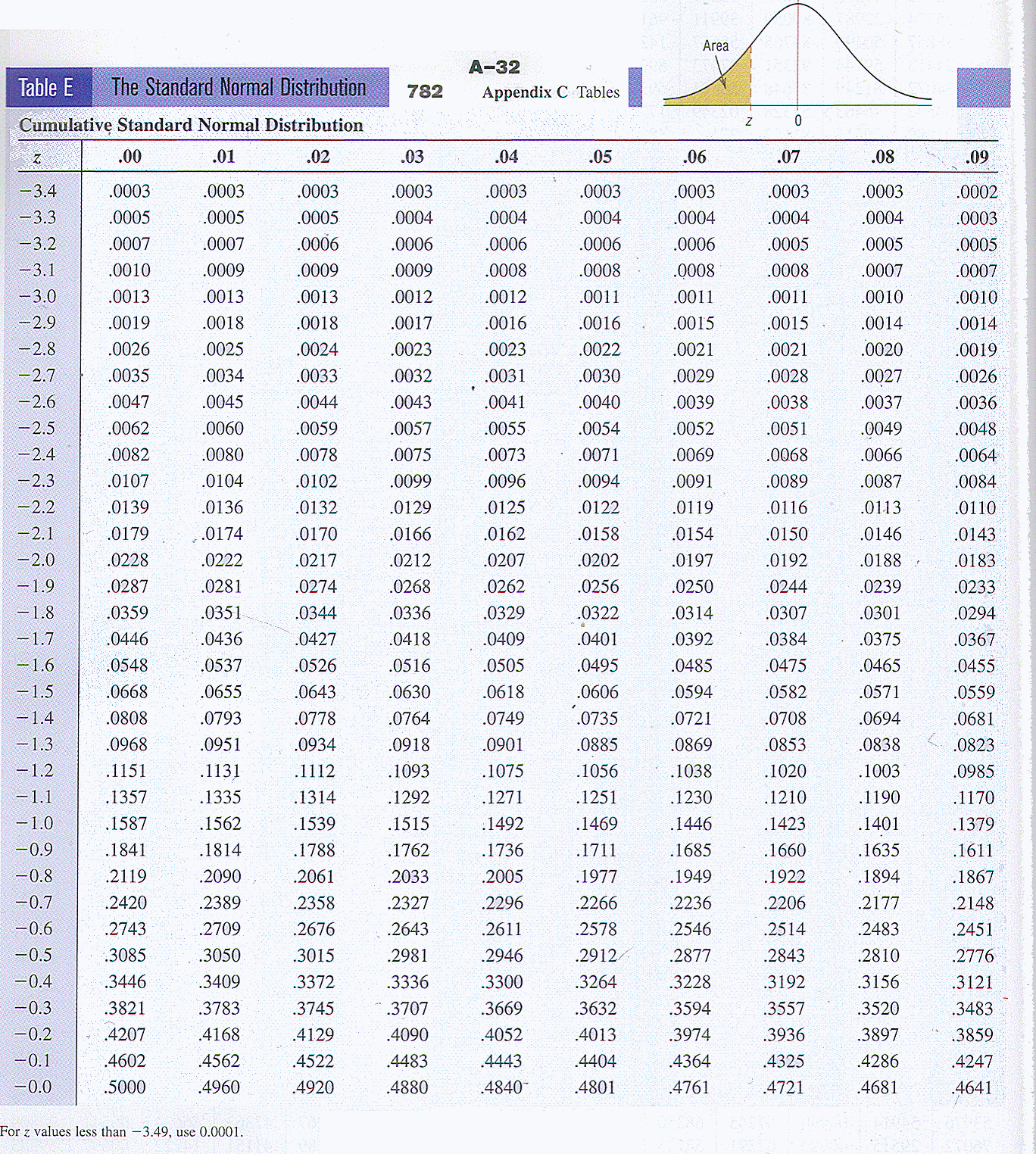
Understanding the Standard Normal Distribution Table is crucial for anyone working in statistics, data analysis, or fields that require probabilistic modeling. This table is a fundamental tool that provides the cumulative probabilities for the standard normal distribution, which is a normal distribution with a mean of 0 and a standard deviation of 1. By mastering the use of this table, you can solve a wide range of problems involving normal distributions, from calculating probabilities to performing hypothesis tests.
What is the Standard Normal Distribution?
The standard normal distribution is a special case of the normal distribution where the mean (μ) is 0 and the standard deviation (σ) is 1. This distribution is often denoted by the symbol Z. The standard normal distribution is important because any normal distribution can be transformed into the standard normal distribution by standardizing the values. This standardization process involves converting the original values into Z-scores, which are then used to look up probabilities in the Standard Normal Distribution Table.
Understanding Z-Scores
Z-scores are a way to measure how many standard deviations a data point is from the mean. The formula for calculating a Z-score is:
Z = (X - μ) / σ
Where:
- X is the raw score.
- μ is the mean of the population.
- σ is the standard deviation of the population.
For example, if you have a data point X = 10, a mean μ = 5, and a standard deviation σ = 2, the Z-score would be calculated as follows:
Z = (10 - 5) / 2 = 2.5
This means the data point is 2.5 standard deviations above the mean.
Using the Standard Normal Distribution Table
The Standard Normal Distribution Table provides the cumulative probabilities for Z-scores. These probabilities represent the area under the standard normal curve to the left of a given Z-score. The table is typically organized with Z-scores in the left column and the corresponding probabilities in the body of the table.
Here is an example of how the table might look:
| Z | 0.00 | 0.01 | 0.02 | 0.03 |
|---|---|---|---|---|
| 0.0 | 0.5000 | 0.5040 | 0.5080 | 0.5120 |
| 0.1 | 0.5398 | 0.5438 | 0.5478 | 0.5517 |
| 0.2 | 0.5793 | 0.5832 | 0.5871 | 0.5910 |
| 0.3 | 0.6179 | 0.6217 | 0.6255 | 0.6293 |
To use the table, follow these steps:
- Calculate the Z-score for the data point you are interested in.
- Locate the Z-score in the left column of the table.
- Find the corresponding probability in the body of the table.
For example, if you have a Z-score of 0.53, you would look up 0.5 in the left column and 0.03 in the top row. The corresponding probability is 0.7019. This means that the probability of a Z-score being less than 0.53 is 0.7019.
📝 Note: The Standard Normal Distribution Table typically provides probabilities for positive Z-scores. For negative Z-scores, you can use the symmetry of the normal distribution. The probability for a negative Z-score is 1 minus the probability for the corresponding positive Z-score.
Calculating Probabilities
Once you have the Z-score, you can use the Standard Normal Distribution Table to calculate various probabilities. Here are some common types of probabilities you might need to calculate:
Probability of a Value Being Less Than a Given Z-Score
This is straightforward. Simply look up the Z-score in the table to find the cumulative probability.
Probability of a Value Being Greater Than a Given Z-Score
To find the probability of a value being greater than a given Z-score, subtract the cumulative probability from 1.
P(Z > z) = 1 - P(Z ≤ z)
Probability of a Value Being Between Two Z-Scores
To find the probability of a value being between two Z-scores, subtract the cumulative probability of the lower Z-score from the cumulative probability of the higher Z-score.
P(a < Z < b) = P(Z < b) - P(Z < a)
Applications of the Standard Normal Distribution
The Standard Normal Distribution Table has numerous applications in statistics and data analysis. Some of the most common applications include:
Hypothesis Testing
In hypothesis testing, the standard normal distribution is used to determine the p-value, which helps in deciding whether to reject the null hypothesis. By standardizing the test statistic, you can use the Standard Normal Distribution Table to find the corresponding probability.
Confidence Intervals
Confidence intervals provide a range within which the true population parameter is likely to fall. The standard normal distribution is used to calculate the margin of error, which is then used to construct the confidence interval.
Quality Control
In quality control, the standard normal distribution is used to monitor and control processes. By standardizing the data, you can use the Standard Normal Distribution Table to determine the probability of a process being within acceptable limits.
Example Problems
Let’s go through a few example problems to illustrate how to use the Standard Normal Distribution Table.
Example 1: Finding the Probability of a Value Being Less Than a Given Z-Score
Find the probability that a value is less than 1.25.
Step 1: Calculate the Z-score (already given as 1.25).
Step 2: Look up 1.2 in the left column and 0.05 in the top row. The corresponding probability is 0.8944.
Therefore, the probability that a value is less than 1.25 is 0.8944.
Example 2: Finding the Probability of a Value Being Greater Than a Given Z-Score
Find the probability that a value is greater than -1.5.
Step 1: Calculate the Z-score (already given as -1.5).
Step 2: Use the symmetry of the normal distribution. The probability for a Z-score of 1.5 is 0.9332.
Step 3: Subtract this probability from 1.
P(Z > -1.5) = 1 - 0.9332 = 0.0668
Therefore, the probability that a value is greater than -1.5 is 0.0668.
Example 3: Finding the Probability of a Value Being Between Two Z-Scores
Find the probability that a value is between -0.5 and 1.0.
Step 1: Calculate the Z-scores (already given as -0.5 and 1.0).
Step 2: Look up the probabilities for -0.5 and 1.0 in the table.
Step 3: The probability for -0.5 is 0.3085 (using symmetry, 1 - 0.6915).
Step 4: The probability for 1.0 is 0.8413.
Step 5: Subtract the lower probability from the higher probability.
P(-0.5 < Z < 1.0) = 0.8413 - 0.3085 = 0.5328
Therefore, the probability that a value is between -0.5 and 1.0 is 0.5328.
These examples illustrate how to use the Standard Normal Distribution Table to solve various types of problems involving normal distributions.
In conclusion, the Standard Normal Distribution Table is an essential tool for anyone working with normal distributions. By understanding how to calculate Z-scores and use the table to find probabilities, you can solve a wide range of statistical problems. Whether you are performing hypothesis tests, constructing confidence intervals, or monitoring quality control processes, the Standard Normal Distribution Table provides the foundation for accurate and reliable statistical analysis. Mastering this tool will enhance your ability to interpret data and make informed decisions based on probabilistic modeling.
Related Terms:
- standard normal distribution calculator
- standard normal distribution curve
- standard normal distribution table calculator
- standard normal distribution table download
- standard normal distribution table wiki