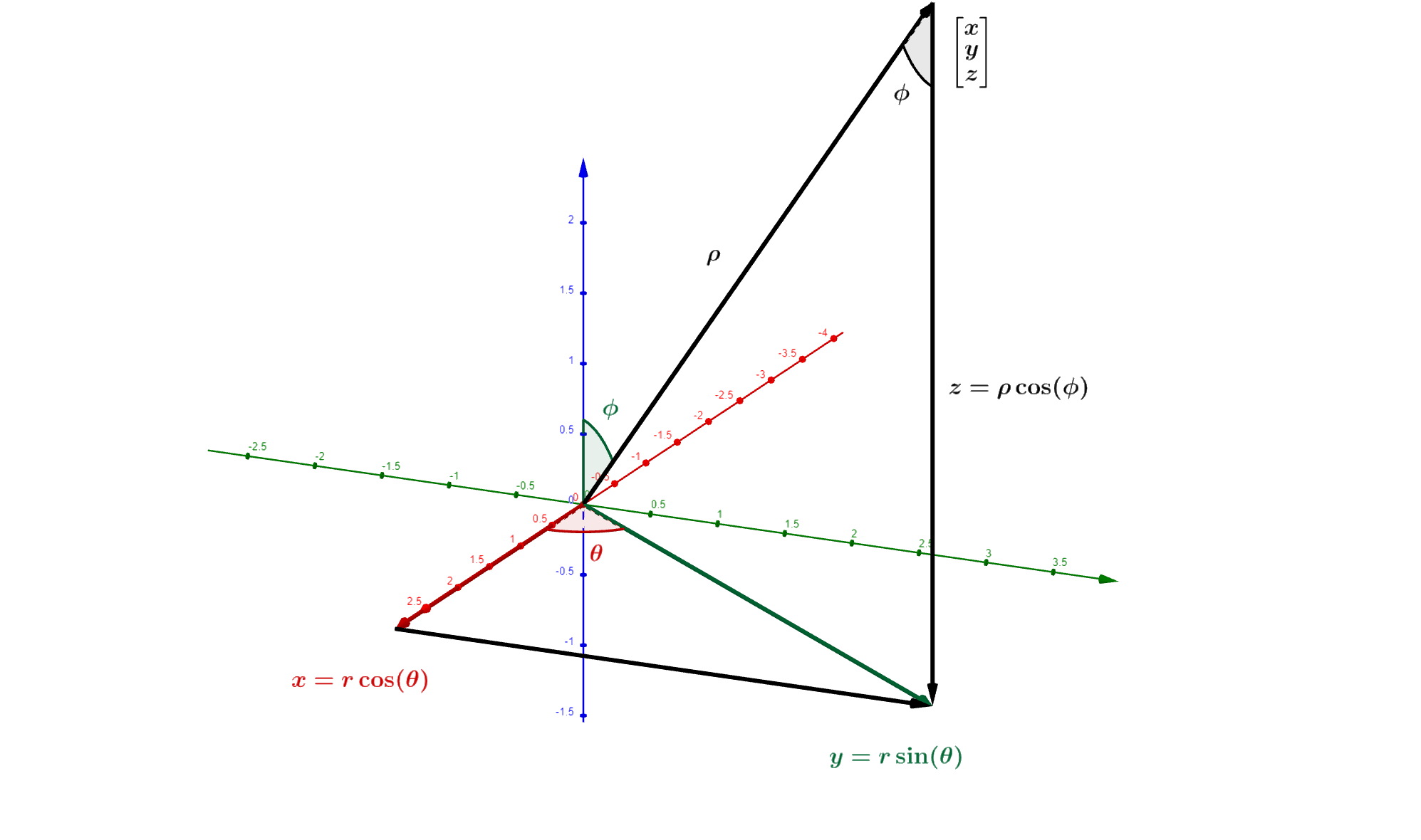
In the realm of mathematics and physics, understanding different coordinate systems is crucial for solving complex problems. One such system is the spherical coordinate system, which is particularly useful for describing points in three-dimensional space. When transitioning between different coordinate systems, the Spherical Coordinates Jacobian plays a pivotal role. This determinant helps in transforming integrals and differential equations from one coordinate system to another, making it an essential tool in various fields such as physics, engineering, and computer graphics.
Understanding Spherical Coordinates
Spherical coordinates are a way of specifying the position of a point in three-dimensional space using three coordinates: the radial distance r, the polar angle θ, and the azimuthal angle φ. These coordinates are defined as follows:
- r: The radial distance from the origin to the point.
- θ: The polar angle measured from the positive z-axis.
- φ: The azimuthal angle measured from the positive x-axis in the xy-plane.
These coordinates provide a more intuitive way to describe points in space, especially when dealing with problems that have spherical symmetry.
The Jacobian Determinant
The Jacobian determinant is a fundamental concept in multivariable calculus. It represents the factor by which the volume of a region changes when transformed from one coordinate system to another. In the context of spherical coordinates, the Spherical Coordinates Jacobian is particularly important. It allows us to convert integrals and differential equations from Cartesian coordinates (x, y, z) to spherical coordinates (r, θ, φ).
Deriving the Spherical Coordinates Jacobian
To derive the Spherical Coordinates Jacobian, we start by expressing the Cartesian coordinates in terms of spherical coordinates:
- x = r sin(θ) cos(φ)
- y = r sin(θ) sin(φ)
- z = r cos(θ)
The Jacobian matrix J is then constructed from the partial derivatives of these expressions:
| r | θ | φ | |
|---|---|---|---|
| x | sin(θ) cos(φ) | r cos(θ) cos(φ) | -r sin(θ) sin(φ) |
| y | sin(θ) sin(φ) | r cos(θ) sin(φ) | r sin(θ) cos(φ) |
| z | cos(θ) | -r sin(θ) | 0 |
The determinant of this matrix, known as the Spherical Coordinates Jacobian, is given by:
J = r2 sin(θ)
This determinant is crucial for transforming integrals from Cartesian to spherical coordinates. For example, the volume element dx dy dz in Cartesian coordinates becomes r2 sin(θ) dr dθ dφ in spherical coordinates.
📝 Note: The Spherical Coordinates Jacobian is always positive, which simplifies many calculations involving integrals and differential equations.
Applications of the Spherical Coordinates Jacobian
The Spherical Coordinates Jacobian has numerous applications in various fields. Some of the key areas where it is extensively used include:
- Physics: In problems involving spherical symmetry, such as the gravitational field of a spherical mass or the electric field of a charged sphere, spherical coordinates are often used. The Spherical Coordinates Jacobian helps in transforming the equations of motion and field equations into a more manageable form.
- Engineering: In fields like aerospace engineering, where the motion of objects in three-dimensional space is studied, spherical coordinates provide a natural framework. The Spherical Coordinates Jacobian is used to convert equations of motion and control systems into spherical coordinates.
- Computer Graphics: In rendering three-dimensional objects, spherical coordinates are used to describe the position and orientation of objects. The Spherical Coordinates Jacobian helps in transforming the coordinates of vertices and normals, ensuring accurate rendering.
Examples of Using the Spherical Coordinates Jacobian
To illustrate the use of the Spherical Coordinates Jacobian, let’s consider a few examples.
Example 1: Volume of a Sphere
To find the volume of a sphere of radius R, we can use spherical coordinates. The volume element in spherical coordinates is given by r2 sin(θ) dr dθ dφ. The integral for the volume of the sphere is:
V = ∫02π ∫0π ∫0R r2 sin(θ) dr dθ dφ
Evaluating this integral, we get:
V = (4⁄3)πR3
Example 2: Gravitational Field of a Spherical Mass
Consider a spherical mass distribution with density ρ®. The gravitational field g® at a distance r from the center can be found using the Spherical Coordinates Jacobian. The integral for the gravitational field is:
g® = -∫0r (4πGρ(r’)r’2) dr’
Using the Spherical Coordinates Jacobian, we can transform this integral into spherical coordinates and solve it to find the gravitational field.
📝 Note: The Spherical Coordinates Jacobian is particularly useful in problems involving spherical symmetry, where the equations simplify significantly in spherical coordinates.
Challenges and Considerations
While the Spherical Coordinates Jacobian is a powerful tool, there are some challenges and considerations to keep in mind:
- Complexity: Transforming equations from Cartesian to spherical coordinates can be complex and may require a deep understanding of multivariable calculus.
- Singularities: Spherical coordinates have singularities at the poles (θ = 0 and θ = π), which can cause difficulties in numerical computations.
- Boundary Conditions: When solving differential equations, the boundary conditions in spherical coordinates may differ from those in Cartesian coordinates, requiring careful handling.
Despite these challenges, the Spherical Coordinates Jacobian remains an indispensable tool for solving problems in three-dimensional space.
In summary, the Spherical Coordinates Jacobian is a fundamental concept in mathematics and physics that enables the transformation of integrals and differential equations between Cartesian and spherical coordinates. Its applications range from physics and engineering to computer graphics, making it a versatile tool for solving complex problems. By understanding and utilizing the Spherical Coordinates Jacobian, researchers and engineers can gain deeper insights into the behavior of systems in three-dimensional space.
Related Terms:
- jacobian when converting to spherical
- spherical coordinates jacobian determinant
- how do spherical coordinates work
- 3d cartesian to spherical coordinates
- calculus 3 spherical coordinates
- spherical coordinate identities