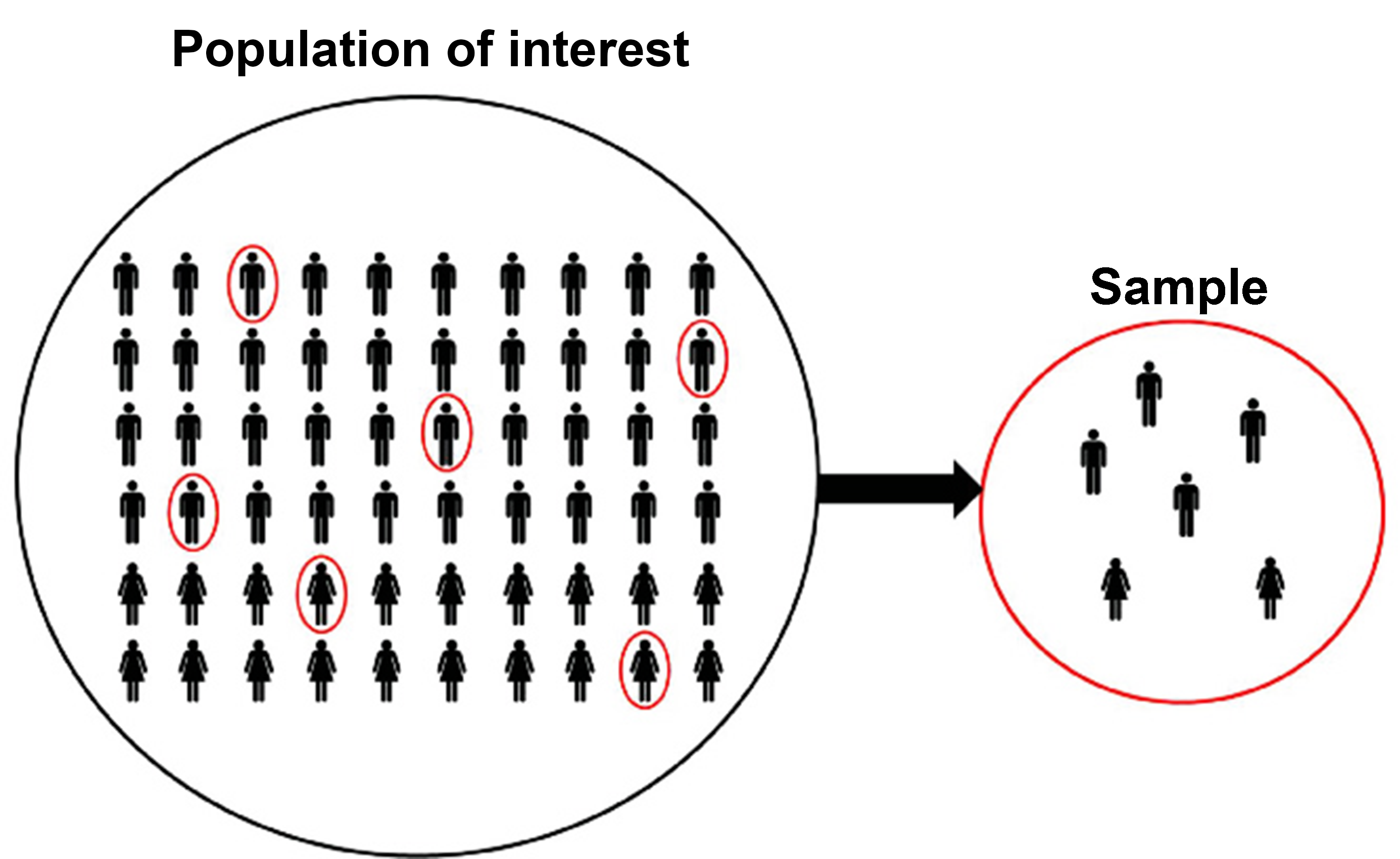
Understanding the difference between a sample and a population mean is crucial in statistics. This concept forms the backbone of inferential statistics, where we make inferences about a population based on a sample. By grasping the nuances of sample vs population mean, researchers and analysts can draw meaningful conclusions from data, leading to better decision-making in various fields.
Understanding Population Mean
The population mean is a fundamental concept in statistics. It represents the average value of a dataset that includes every member of a population. For example, if you want to know the average height of all adult males in a country, you would measure the height of every adult male and calculate the mean. This value is the population mean.
Mathematically, the population mean is denoted by the Greek letter μ (mu) and is calculated using the formula:
μ = (ΣX) / N
where ΣX is the sum of all values in the population and N is the total number of values in the population.
Understanding Sample Mean
In many cases, it is impractical or impossible to measure every member of a population. This is where the sample mean comes into play. A sample is a subset of the population, and the sample mean is the average value of this subset. The sample mean is denoted by the symbol x̄ (x-bar) and is calculated using the formula:
x̄ = (Σx) / n
where Σx is the sum of all values in the sample and n is the total number of values in the sample.
Why Use a Sample?
Using a sample to estimate the population mean has several advantages:
- Cost-Effective: Collecting data from a sample is often less expensive than collecting data from the entire population.
- Time-Saving: Sampling can significantly reduce the time required to gather data.
- Feasibility: In some cases, it may be impossible to measure the entire population, making sampling the only viable option.
Sampling Methods
There are various methods to select a sample from a population. Some of the most common methods include:
- Simple Random Sampling: Every member of the population has an equal chance of being selected.
- Stratified Sampling: The population is divided into subgroups (strata), and samples are taken from each subgroup.
- Systematic Sampling: Samples are taken at regular intervals from an ordered list of the population.
- Cluster Sampling: The population is divided into clusters, and entire clusters are selected for sampling.
Sample vs Population Mean: Key Differences
While both the sample mean and the population mean represent averages, there are key differences between the two:
- Scope: The population mean includes all members of the population, while the sample mean includes only a subset.
- Accuracy: The population mean is the true average of the population, while the sample mean is an estimate.
- Variability: The sample mean can vary from sample to sample, whereas the population mean is fixed.
Estimating the Population Mean
Since it is often impractical to calculate the population mean directly, statisticians use the sample mean to estimate it. The accuracy of this estimate depends on several factors, including the sample size and the sampling method. Larger samples generally provide more accurate estimates.
To understand how well the sample mean estimates the population mean, statisticians use the concept of the sampling distribution of the sample mean. This distribution shows the range of possible sample means and their frequencies if you were to take many samples from the population.
The sampling distribution of the sample mean has several important properties:
- Mean: The mean of the sampling distribution is equal to the population mean (μ).
- Standard Deviation: The standard deviation of the sampling distribution, known as the standard error, is equal to the population standard deviation (σ) divided by the square root of the sample size (n).
- Shape: If the population is normally distributed, the sampling distribution will also be normally distributed. If the population is not normally distributed, the sampling distribution will approximate a normal distribution as the sample size increases (Central Limit Theorem).
Confidence Intervals
Confidence intervals provide a range of values within which the population mean is likely to fall. They are calculated using the sample mean, the standard error, and a chosen confidence level (e.g., 95%). The formula for a confidence interval is:
x̄ ± (z * (σ/√n))
where z is the z-score corresponding to the chosen confidence level.
For example, if you have a sample mean of 50, a standard error of 2, and a 95% confidence level (z ≈ 1.96), the confidence interval would be:
50 ± (1.96 * 2)
which simplifies to:
50 ± 3.92
So, the confidence interval would be 46.08 to 53.92.
Hypothesis Testing
Hypothesis testing is another important application of the sample vs population mean concept. In hypothesis testing, you make a claim about the population mean and use sample data to test this claim. The process involves:
- Formulating a null hypothesis (H0) and an alternative hypothesis (H1).
- Choosing a significance level (α), typically 0.05.
- Calculating the test statistic, often a z-score or t-score, based on the sample mean and standard error.
- Comparing the test statistic to the critical value from the appropriate distribution.
- Making a decision to reject or fail to reject the null hypothesis.
For example, suppose you want to test whether the average height of adult males in a city is greater than 170 cm. Your null hypothesis might be that the average height is 170 cm or less (H0: μ ≤ 170), and your alternative hypothesis might be that the average height is greater than 170 cm (H1: μ > 170). You would collect a sample, calculate the sample mean and standard error, and perform the hypothesis test.
Importance of Sample Size
The size of the sample plays a crucial role in the accuracy of the estimate. Larger samples tend to provide more accurate estimates of the population mean. The relationship between sample size and the standard error is given by:
Standard Error = σ/√n
As the sample size (n) increases, the standard error decreases, making the sample mean a more precise estimate of the population mean.
However, increasing the sample size also increases the cost and time required to collect data. Therefore, it is essential to balance the need for accuracy with practical considerations.
Real-World Applications
The concept of sample vs population mean is applied in various real-world scenarios. Some examples include:
- Market Research: Companies use samples to estimate consumer preferences and market trends.
- Healthcare: Researchers use samples to test the effectiveness of new treatments and medications.
- Education: Educators use samples to assess student performance and the effectiveness of teaching methods.
- Quality Control: Manufacturers use samples to ensure product quality and consistency.
Common Mistakes to Avoid
When working with samples and populations, it is essential to avoid common mistakes that can lead to inaccurate conclusions:
- Small Sample Size: Using a very small sample can lead to a high standard error and less reliable estimates.
- Non-Random Sampling: Failing to use a random sampling method can introduce bias into the sample, leading to inaccurate estimates.
- Ignoring Outliers: Outliers can significantly affect the sample mean and standard error. It is important to identify and handle outliers appropriately.
- Incorrect Assumptions: Making incorrect assumptions about the population distribution can lead to incorrect inferences.
📝 Note: Always ensure that your sampling method is appropriate for the population and that your sample size is large enough to provide reliable estimates.
Conclusion
The distinction between sample vs population mean is a cornerstone of statistical analysis. Understanding how to use samples to estimate population parameters allows researchers and analysts to make informed decisions based on data. By carefully selecting samples, calculating sample means, and using statistical methods to estimate population means, we can gain valuable insights into various phenomena. Whether in market research, healthcare, education, or quality control, the principles of sampling and estimation are essential for accurate and reliable analysis.
Related Terms:
- examples of a population
- example of sample and population
- find population mean from sample
- example of a population mean
- sample vs population statistics
- calculating population mean from sample