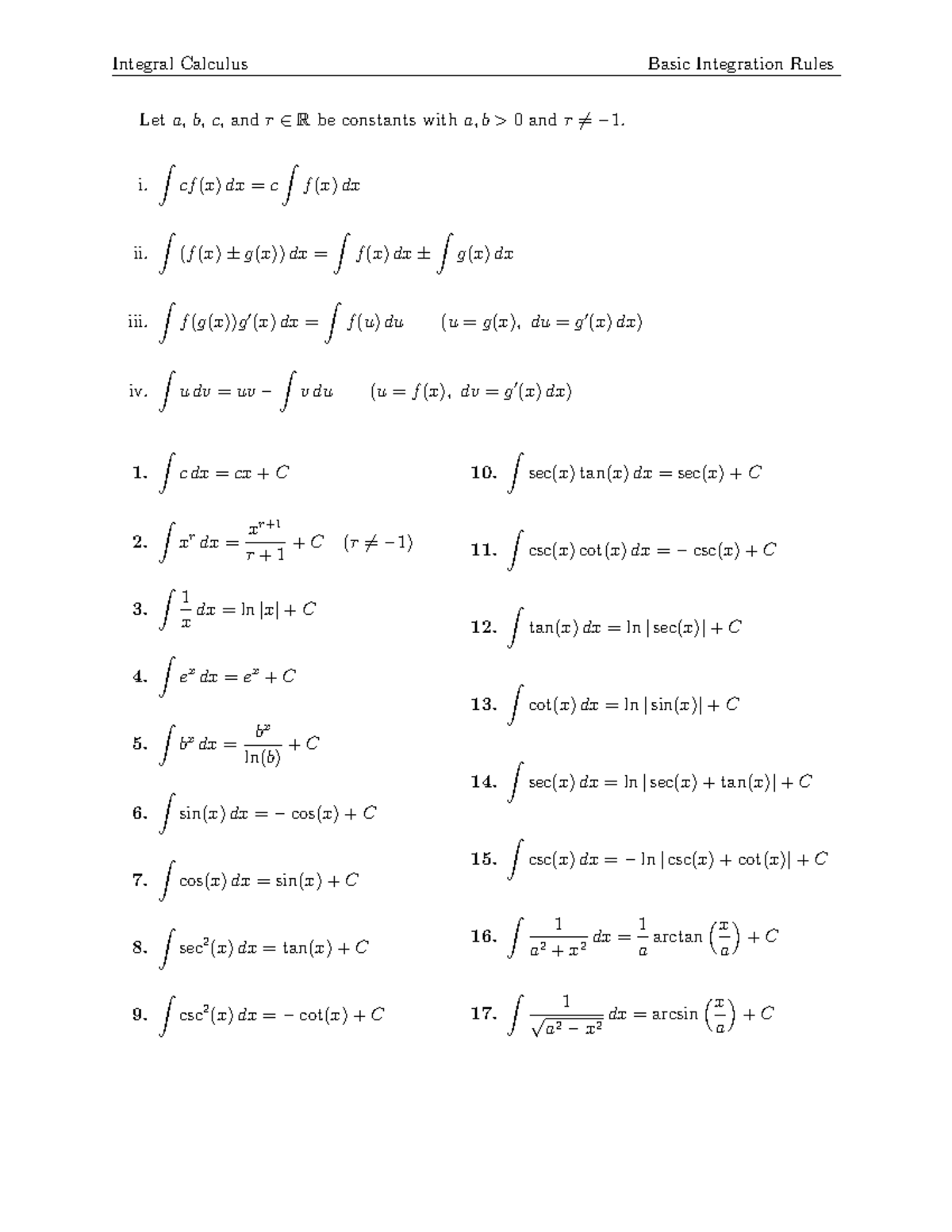
Calculus is a fundamental branch of mathematics that deals with rates of change and accumulation of quantities. One of the core concepts in calculus is differentiation, which involves finding the derivative of a function. The Rules of Derivatives are essential tools that help simplify the process of differentiation. Understanding these rules is crucial for anyone studying calculus, as they form the basis for more advanced topics.
Understanding Derivatives
Before diving into the Rules of Derivatives, it’s important to understand what a derivative is. A derivative represents the rate at which a function is changing at a specific point. It is the slope of the tangent line to the function at that point. The derivative of a function f(x) is denoted by f’(x) or dy/dx.
The Basic Rules of Derivatives
The Rules of Derivatives can be categorized into basic and advanced rules. The basic rules include:
- The Constant Rule
- The Power Rule
- The Constant Multiple Rule
- The Sum and Difference Rules
The Constant Rule
The Constant Rule states that the derivative of a constant function is zero. Mathematically, if f(x) = c, where c is a constant, then f’(x) = 0.
The Power Rule
The Power Rule is one of the most commonly used Rules of Derivatives. It states that if f(x) = x^n, where n is a constant, then f’(x) = nx^(n-1). This rule is particularly useful for polynomials.
The Constant Multiple Rule
The Constant Multiple Rule states that the derivative of a constant times a function is the constant times the derivative of the function. If f(x) = c cdot g(x), where c is a constant, then f’(x) = c cdot g’(x).
The Sum and Difference Rules
The Sum and Difference Rules allow you to find the derivative of a sum or difference of functions. If f(x) = g(x) + h(x), then f’(x) = g’(x) + h’(x). Similarly, if f(x) = g(x) - h(x), then f’(x) = g’(x) - h’(x).
Advanced Rules of Derivatives
In addition to the basic rules, there are several advanced Rules of Derivatives that are essential for more complex functions. These include:
- The Product Rule
- The Quotient Rule
- The Chain Rule
The Product Rule
The Product Rule is used to find the derivative of a product of two functions. If f(x) = g(x) cdot h(x), then f’(x) = g’(x) cdot h(x) + g(x) cdot h’(x).
The Quotient Rule
The Quotient Rule is used to find the derivative of a quotient of two functions. If f(x) = g(x) / h(x), then f’(x) = [g’(x) cdot h(x) - g(x) cdot h’(x)] / [h(x)]^2.
The Chain Rule
The Chain Rule is one of the most powerful Rules of Derivatives. It is used to find the derivative of a composition of functions. If f(x) = g(h(x)), then f’(x) = g’(h(x)) cdot h’(x). This rule is particularly useful for functions that are nested within each other.
Examples of Applying the Rules of Derivatives
Let’s go through some examples to illustrate how the Rules of Derivatives are applied.
Example 1: Basic Rules
Find the derivative of f(x) = 3x^4 - 2x^2 + 5.
Using the Power Rule, Constant Multiple Rule, and Sum and Difference Rules:
- f'(x) = 3 cdot 4x^3 - 2 cdot 2x + 0
- f'(x) = 12x^3 - 4x
Example 2: Product Rule
Find the derivative of f(x) = (x^2 + 1)(x^3 - 2).
Using the Product Rule:
- f'(x) = (2x)(x^3 - 2) + (x^2 + 1)(3x^2)
- f'(x) = 2x^4 - 4x + 3x^4 + 3x^2
- f'(x) = 5x^4 + 3x^2 - 4x
Example 3: Quotient Rule
Find the derivative of f(x) = (x^2 + 1) / (x^3 - 2).
Using the Quotient Rule:
- f'(x) = [(2x)(x^3 - 2) - (x^2 + 1)(3x^2)] / (x^3 - 2)^2
- f'(x) = [2x^4 - 4x - 3x^4 - 3x^2] / (x^3 - 2)^2
- f'(x) = [-x^4 - 3x^2 - 4x] / (x^3 - 2)^2
Example 4: Chain Rule
Find the derivative of f(x) = (x^2 + 1)^3.
Using the Chain Rule:
- Let g(u) = u^3 and h(x) = x^2 + 1
- g'(u) = 3u^2 and h'(x) = 2x
- f'(x) = 3(x^2 + 1)^2 cdot 2x
- f'(x) = 6x(x^2 + 1)^2
📝 Note: When applying the Chain Rule, it's important to correctly identify the inner and outer functions.
Implicit Differentiation
Implicit differentiation is a technique used to find the derivative of an implicitly defined function. This method is particularly useful when the function is not easily expressed in terms of y as a function of x. The Rules of Derivatives are applied to both sides of the equation with respect to x, treating y as a function of x.
For example, consider the equation x^2 + y^2 = 1. To find dy/dx, we differentiate both sides with respect to x:
- 2x + 2y cdot dy/dx = 0
- 2y cdot dy/dx = -2x
- dy/dx = -x/y
📝 Note: Implicit differentiation is a powerful tool, but it requires careful application of the Rules of Derivatives.
Logarithmic Differentiation
Logarithmic differentiation is another technique used to find the derivative of complex functions. This method involves taking the natural logarithm of both sides of the equation before differentiating. The Rules of Derivatives are then applied to find the derivative.
For example, consider the function f(x) = x^x. To find f'(x), we take the natural logarithm of both sides:
- ln(f(x)) = ln(x^x)
- ln(f(x)) = x cdot ln(x)
Differentiating both sides with respect to x:
- 1/f(x) cdot f'(x) = ln(x) + 1
- f'(x) = f(x) cdot (ln(x) + 1)
- f'(x) = x^x cdot (ln(x) + 1)
📝 Note: Logarithmic differentiation is particularly useful for functions that are products or quotients of powers of x.
Table of Derivative Rules
| Rule | Formula |
|---|---|
| Constant Rule | f(x) = c ⇒ f’(x) = 0 |
| Power Rule | f(x) = x^n ⇒ f’(x) = nx^(n-1) |
| Constant Multiple Rule | f(x) = c cdot g(x) ⇒ f’(x) = c cdot g’(x) |
| Sum and Difference Rules | f(x) = g(x) ± h(x) ⇒ f’(x) = g’(x) ± h’(x) |
| Product Rule | f(x) = g(x) cdot h(x) ⇒ f’(x) = g’(x) cdot h(x) + g(x) cdot h’(x) |
| Quotient Rule | f(x) = g(x) / h(x) ⇒ f’(x) = [g’(x) cdot h(x) - g(x) cdot h’(x)] / [h(x)]^2 |
| Chain Rule | f(x) = g(h(x)) ⇒ f’(x) = g’(h(x)) cdot h’(x) |
Understanding and applying the Rules of Derivatives is essential for mastering calculus. These rules provide a systematic approach to finding derivatives, which are fundamental to solving a wide range of problems in mathematics, physics, engineering, and other fields. By practicing with various examples and techniques, one can become proficient in using these rules to solve complex differentiation problems.
In summary, the Rules of Derivatives are a set of fundamental principles that simplify the process of differentiation. They include basic rules like the Constant Rule, Power Rule, Constant Multiple Rule, and Sum and Difference Rules, as well as advanced rules like the Product Rule, Quotient Rule, and Chain Rule. Techniques such as implicit and logarithmic differentiation further enhance the ability to find derivatives of complex functions. Mastering these rules and techniques is crucial for anyone studying calculus, as they form the basis for more advanced topics and applications.
Related Terms:
- differentiation rules cheat sheet
- rules of derivatives calculus
- derivatives rules with examples
- derivative rules pdf cheat sheet
- derivative rules sheet
- derivatives rules cheat sheet