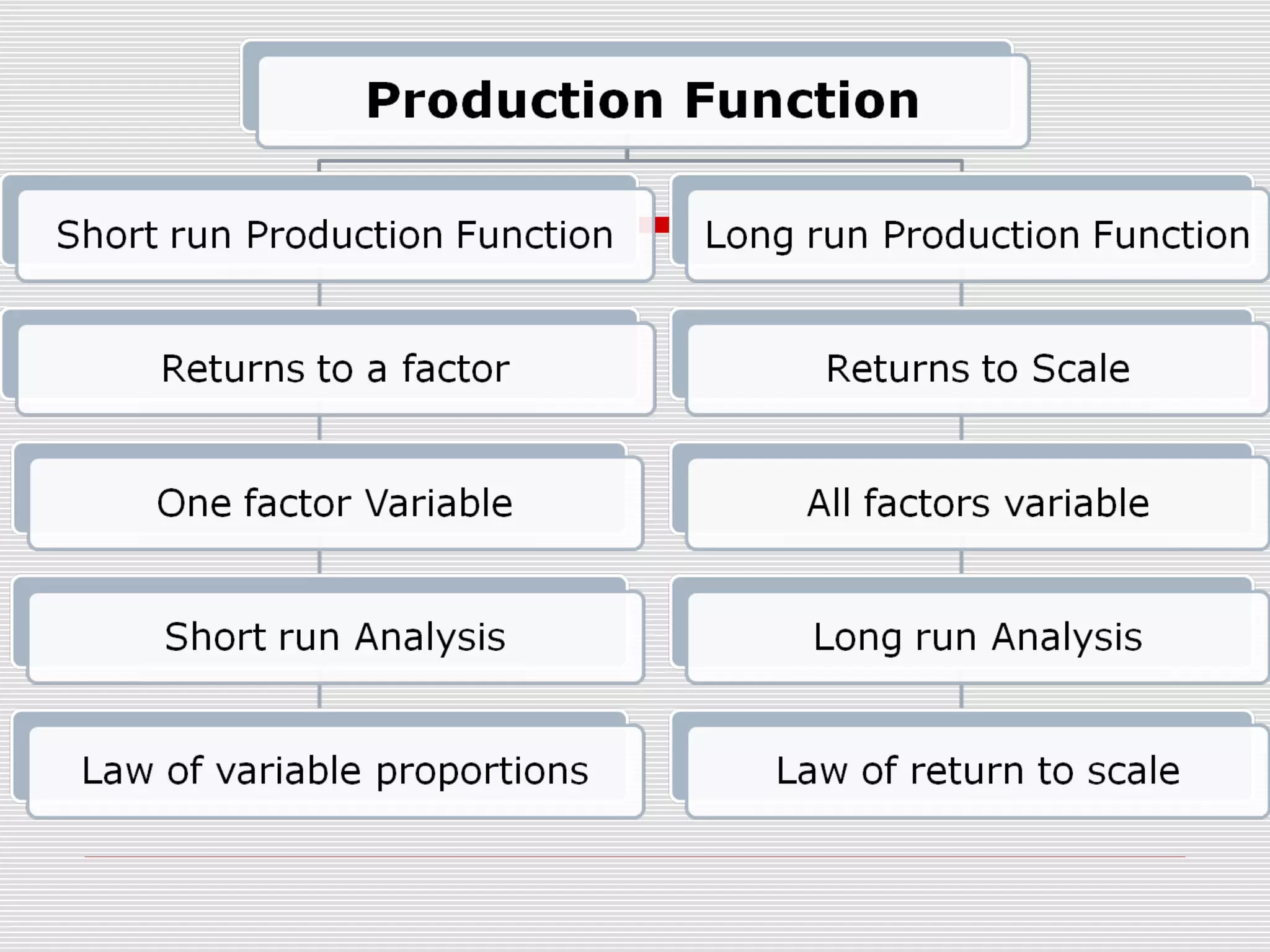
Understanding the intricacies of production and production function is crucial for anyone involved in economics, business, or management. These concepts form the backbone of economic theory and are essential for making informed decisions in various industries. This post will delve into the fundamentals of production, explore different types of production functions, and discuss their applications in real-world scenarios.
Understanding Production
Production refers to the process of creating goods and services. It involves transforming inputs, such as raw materials and labor, into outputs that have economic value. The efficiency of this process is a key determinant of a firm's profitability and competitiveness. In economic terms, production can be broken down into several components:
- Inputs: These are the resources used in the production process. They can be categorized into four main types: land, labor, capital, and entrepreneurship.
- Outputs: These are the goods and services produced. They can be either final goods (ready for consumption) or intermediate goods (used in further production).
- Technology: This refers to the methods and techniques used to combine inputs to produce outputs. Technological advancements can significantly enhance production efficiency.
The Production Function
The production function is a mathematical representation of the relationship between inputs and outputs in the production process. It shows how changes in inputs affect the quantity of output produced. The general form of a production function is:
Q = f(L, K, T)
Where:
- Q represents the quantity of output.
- L represents labor.
- K represents capital.
- T represents technology.
There are several types of production functions, each with its own characteristics and applications.
Types of Production Functions
Linear Production Function
The linear production function assumes that the output increases proportionally with the increase in inputs. Mathematically, it can be represented as:
Q = aL + bK
Where a and b are constants. This function is simple but often unrealistic because it does not account for diminishing returns to scale.
Cobb-Douglas Production Function
The Cobb-Douglas production function is one of the most widely used production functions in economics. It is given by:
Q = AL^αK^β
Where A is a constant representing technology, and α and β are parameters that measure the output elasticity of labor and capital, respectively. This function allows for diminishing returns to scale and is flexible enough to capture various production processes.
Constant Elasticity of Substitution (CES) Production Function
The CES production function is a generalization of the Cobb-Douglas function. It is given by:
Q = [δL^ρ + (1 - δ)K^ρ]^(1/ρ)
Where δ is a distribution parameter, and ρ is the substitution parameter. This function allows for a more flexible substitution between labor and capital, making it useful for modeling a wide range of production processes.
Leontief Production Function
The Leontief production function assumes that inputs are used in fixed proportions. It is given by:
Q = min(αL, βK)
Where α and β are constants. This function is useful for modeling production processes where inputs must be used in specific ratios, such as in certain manufacturing processes.
Applications of Production Functions
Production functions have numerous applications in economics and business. They are used to:
- Analyze the efficiency of production processes.
- Determine the optimal combination of inputs to minimize costs.
- Forecast future production levels based on changes in inputs.
- Evaluate the impact of technological advancements on production.
For example, a firm can use a production function to determine the optimal mix of labor and capital to produce a given level of output at the lowest cost. This involves solving for the input levels that minimize the cost function subject to the production function constraint.
Production and Cost Analysis
Understanding the relationship between production and costs is essential for making informed business decisions. The cost function is derived from the production function and shows how the total cost of production varies with the level of output. The general form of the cost function is:
TC = C(Q)
Where TC represents total cost, and Q represents the quantity of output. The cost function can be broken down into fixed costs and variable costs. Fixed costs are those that do not change with the level of output, such as rent and salaries. Variable costs are those that change with the level of output, such as raw materials and labor.
To illustrate the relationship between production and costs, consider the following table:
| Output (Q) | Labor (L) | Capital (K) | Total Cost (TC) |
|---|---|---|---|
| 10 | 5 | 2 | 100 |
| 20 | 10 | 4 | 200 |
| 30 | 15 | 6 | 300 |
In this example, the total cost increases linearly with the level of output. However, in reality, the relationship between production and costs is often more complex, involving economies of scale and diminishing returns.
📝 Note: The relationship between production and costs can be influenced by various factors, including technological advancements, changes in input prices, and market conditions. It is important to regularly update cost and production functions to reflect these changes.
Production and Economic Growth
Production and production functions play a crucial role in economic growth. Economic growth is defined as an increase in the production of goods and services over time. It is driven by increases in inputs, improvements in technology, and changes in the efficiency of production processes.
One of the key factors influencing economic growth is total factor productivity (TFP), which measures the efficiency with which inputs are used to produce outputs. TFP can be calculated using the following formula:
TFP = Q / (AL^αK^β)
Where Q is the quantity of output, A is a constant representing technology, L is labor, K is capital, and α and β are parameters that measure the output elasticity of labor and capital, respectively. Increases in TFP indicate improvements in the efficiency of production processes, which can lead to higher economic growth.
Another important factor is the rate of technological progress, which can be measured by changes in the constant A in the production function. Technological progress can lead to significant increases in output, even if the levels of inputs remain constant. For example, the introduction of new technologies such as automation and artificial intelligence can greatly enhance production efficiency and drive economic growth.
In addition to technological progress, economic growth can also be influenced by changes in the allocation of resources. For example, shifts in the labor force from low-productivity sectors to high-productivity sectors can lead to increases in output. Similarly, investments in education and training can enhance the skills of the workforce, leading to higher productivity and economic growth.
To illustrate the relationship between production and economic growth, consider the following example:
Suppose a country has a Cobb-Douglas production function given by:
Q = AL^αK^β
Where A = 1, α = 0.5, and β = 0.5. If the country experiences a 10% increase in labor and a 10% increase in capital, the new level of output will be:
Q_new = (1.1L)^0.5 * (1.1K)^0.5 = 1.1Q
This shows that a 10% increase in both labor and capital will lead to a 10% increase in output, assuming constant returns to scale. However, if the country also experiences a 5% increase in total factor productivity, the new level of output will be:
Q_new = 1.05 * 1.1Q = 1.155Q
This illustrates how improvements in productivity can amplify the effects of increases in inputs on economic growth.
In summary, production and production functions are essential for understanding economic growth. They provide a framework for analyzing the relationship between inputs, outputs, and productivity, and for evaluating the impact of technological progress and resource allocation on economic performance.
Production and production functions are fundamental concepts in economics and business. They provide a framework for analyzing the relationship between inputs and outputs in the production process, and for evaluating the efficiency of production processes. By understanding these concepts, firms and policymakers can make informed decisions to enhance productivity, reduce costs, and drive economic growth.
Production functions have numerous applications in economics and business, including cost analysis, forecasting, and policy evaluation. They are used to determine the optimal combination of inputs to minimize costs, forecast future production levels, and evaluate the impact of technological advancements on production. By applying production functions, firms can improve their competitiveness and profitability, while policymakers can design effective policies to promote economic growth and development.
In conclusion, production and production functions are essential for understanding the dynamics of economic growth and development. They provide a framework for analyzing the relationship between inputs, outputs, and productivity, and for evaluating the impact of technological progress and resource allocation on economic performance. By leveraging production functions, firms and policymakers can make informed decisions to enhance productivity, reduce costs, and drive economic growth. Understanding these concepts is crucial for anyone involved in economics, business, or management, and for making informed decisions in various industries.
Related Terms:
- the production function describes how
- the production function formula
- production functions are usually shown
- the production function economics
- types of production function
- different types of production functions