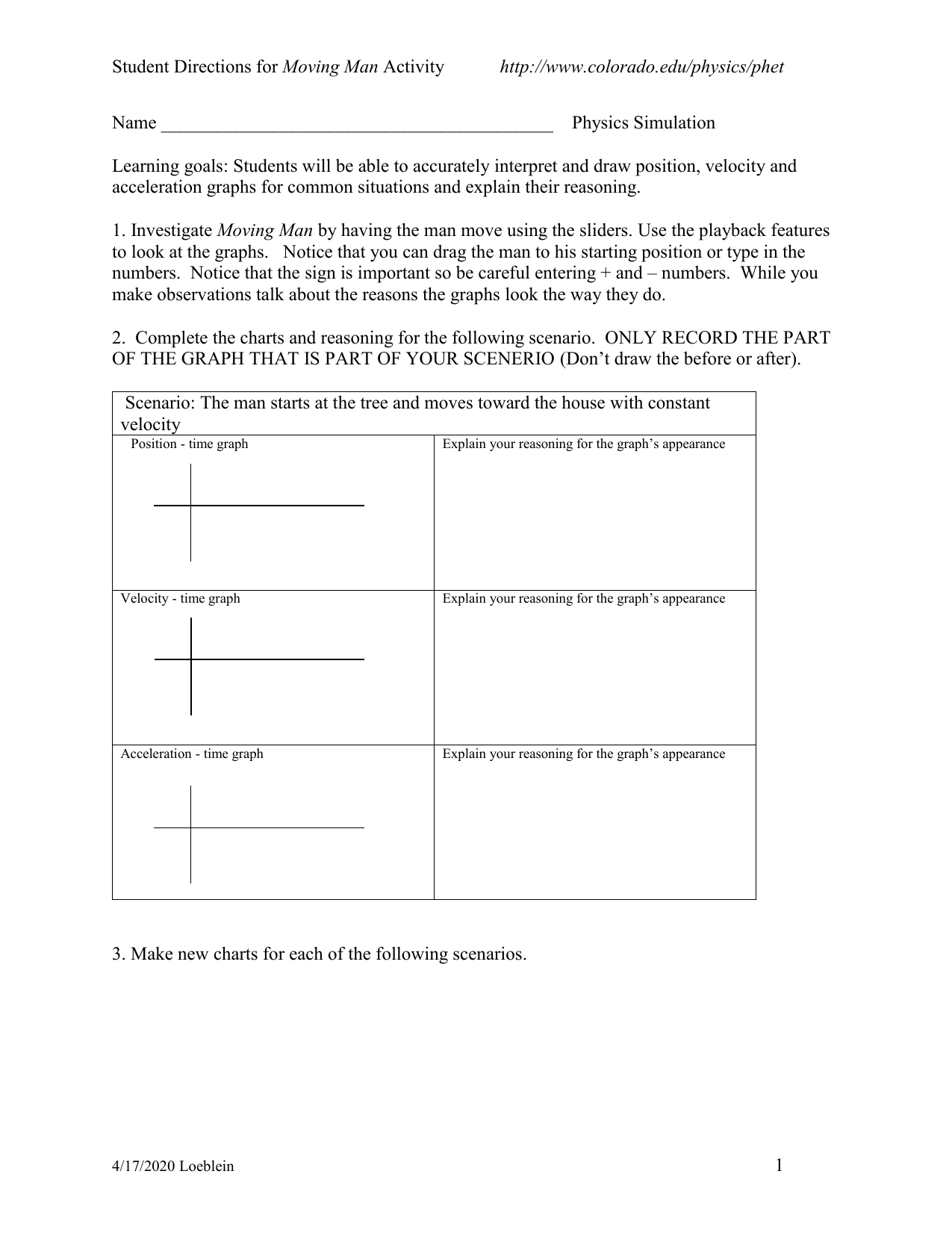
Exploring the fundamentals of physics can be both fascinating and challenging. One of the most effective tools for understanding these concepts is the Phet Moving Man Simulation. This interactive simulation allows users to visualize and experiment with the principles of motion, making complex ideas more accessible and engaging. Whether you are a student, educator, or simply curious about physics, the Phet Moving Man Simulation offers a hands-on approach to learning.
Understanding the Basics of Motion
Before diving into the Phet Moving Man Simulation, it's essential to grasp the basic concepts of motion. Motion is the change in position of an object over time. Key terms to understand include:
- Position: The location of an object in space.
- Velocity: The rate of change of position, including both speed and direction.
- Acceleration: The rate of change of velocity, which can include changes in speed, direction, or both.
These concepts form the foundation of kinematics, the branch of physics that describes the motion of objects without considering the forces that cause them.
Getting Started with the Phet Moving Man Simulation
The Phet Moving Man Simulation is designed to help users understand these concepts through interactive experiments. Here’s how to get started:
1. Launch the Simulation: Open the Phet Moving Man Simulation in your web browser. The interface is user-friendly, with clear controls and visuals.
2. Explore the Controls: Familiarize yourself with the controls. You can adjust the man's position, velocity, and acceleration using sliders and buttons. The simulation also includes a graph that displays the man's position over time.
3. Experiment with Motion: Start by setting the man's initial position and velocity. Observe how the man moves across the screen. You can change the velocity to see how it affects the man's motion. For example, increasing the velocity will make the man move faster.
4. Analyze the Graph: The graph in the simulation shows the man's position over time. This visual representation helps you understand the relationship between position, velocity, and time. You can also see how changes in velocity affect the graph.
5. Introduce Acceleration: To explore acceleration, use the controls to change the man's velocity over time. For example, you can set the man to accelerate or decelerate. Observe how the man's motion changes and how the graph reflects these changes.
6. Compare Different Scenarios: Experiment with different initial conditions and observe the results. For example, compare the motion of the man when he starts with a high velocity versus a low velocity. Also, compare the motion when the man accelerates versus when he decelerates.
💡 Note: The Phet Moving Man Simulation allows you to pause and reset the simulation at any time, making it easy to experiment with different scenarios without starting from scratch.
Key Features of the Phet Moving Man Simulation
The Phet Moving Man Simulation offers several features that enhance the learning experience:
- Interactive Controls: The simulation includes sliders and buttons that allow you to adjust the man's position, velocity, and acceleration in real-time.
- Graphical Representation: The graph shows the man's position over time, providing a visual representation of his motion.
- Customizable Scenarios: You can set different initial conditions and observe how they affect the man's motion.
- Pause and Reset: The simulation can be paused and reset at any time, allowing for easy experimentation.
These features make the Phet Moving Man Simulation a powerful tool for learning about motion.
Advanced Experiments with the Phet Moving Man Simulation
Once you are comfortable with the basics, you can explore more advanced concepts using the Phet Moving Man Simulation. Here are some experiments to try:
1. Constant Velocity: Set the man's initial velocity to a constant value and observe his motion. The graph should show a straight line, indicating constant velocity.
2. Constant Acceleration: Set the man to accelerate at a constant rate. Observe how his velocity changes over time and how the graph reflects this change.
3. Variable Acceleration: Experiment with variable acceleration by changing the man's velocity at different rates. Observe how the graph changes and how the man's motion is affected.
4. Negative Acceleration: Set the man to decelerate by applying negative acceleration. Observe how his velocity decreases over time and how the graph reflects this change.
5. Combining Motion: Combine different types of motion, such as constant velocity and constant acceleration, to see how they interact. For example, set the man to move with constant velocity and then apply acceleration to see how his motion changes.
💡 Note: The Phet Moving Man Simulation allows you to experiment with different types of motion and observe the results in real-time. This makes it an excellent tool for exploring advanced concepts in kinematics.
Using the Phet Moving Man Simulation in Education
The Phet Moving Man Simulation is a valuable resource for educators. It can be used in classrooms to teach students about motion and kinematics in an interactive and engaging way. Here are some ways to incorporate the simulation into your teaching:
- Demonstrations: Use the simulation to demonstrate key concepts in motion, such as velocity and acceleration. Show students how changes in these variables affect the man's motion.
- Hands-On Activities: Encourage students to experiment with the simulation on their own. Provide them with specific tasks, such as setting the man to move with constant velocity or applying constant acceleration.
- Group Work: Divide students into groups and have them work together to explore different scenarios using the simulation. This can help students develop collaborative skills and deepen their understanding of the material.
- Assessments: Use the simulation as part of assessments to evaluate students' understanding of motion and kinematics. Ask students to describe the man's motion in different scenarios and explain the results using the concepts they have learned.
By incorporating the Phet Moving Man Simulation into your teaching, you can make learning about motion more engaging and effective.
Common Misconceptions Addressed by the Phet Moving Man Simulation
The Phet Moving Man Simulation helps address common misconceptions about motion. Here are some misconceptions and how the simulation can help clarify them:
- Misconception: Velocity and Speed are the Same: The simulation shows that velocity includes both speed and direction, while speed is just the magnitude of velocity. By observing the man's motion in different directions, students can see the difference between velocity and speed.
- Misconception: Acceleration Only Means Speeding Up: The simulation demonstrates that acceleration can also mean slowing down or changing direction. By applying negative acceleration or changing the man's direction, students can see how acceleration affects motion in different ways.
- Misconception: Motion is Always in a Straight Line: The simulation allows students to experiment with different types of motion, including curved paths. By observing the man's motion in different scenarios, students can see that motion can occur in various directions and paths.
By addressing these misconceptions, the Phet Moving Man Simulation helps students develop a more accurate understanding of motion and kinematics.
Real-World Applications of Motion
Understanding motion and kinematics has many real-world applications. Here are some examples of how these concepts are used in everyday life:
- Transportation: The principles of motion are essential in designing and operating vehicles, from cars and trains to airplanes and spacecraft.
- Sports: Athletes use their understanding of motion to improve their performance. For example, runners adjust their stride to optimize their speed, and athletes use acceleration to gain an advantage in competitions.
- Engineering: Engineers apply the principles of motion to design machines and structures that move efficiently and safely. For example, they use kinematics to design robots and automated systems.
- Everyday Activities: Even simple activities like walking, running, and throwing a ball involve the principles of motion. Understanding these concepts can help improve coordination and performance in daily tasks.
By exploring these real-world applications, students can see the relevance of motion and kinematics in their lives and careers.
Conclusion
The Phet Moving Man Simulation is a powerful tool for learning about motion and kinematics. It provides an interactive and engaging way to explore the fundamentals of physics, making complex concepts more accessible and understandable. By experimenting with different scenarios and observing the results, users can deepen their understanding of motion and its real-world applications. Whether you are a student, educator, or simply curious about physics, the Phet Moving Man Simulation offers a valuable resource for learning and exploration.
Related Terms:
- moving man phet lab
- moving manphetexperiment
- speed simulation physics
- walking man simulator
- phet motion graphs
- phet simulation speed