Pascal's Triangle is a fascinating mathematical construct that has captivated mathematicians and enthusiasts for centuries. It is a triangular array of the binomial coefficients, which are the coefficients in the binomial theorem. The binomial theorem, in turn, is a fundamental concept in algebra that describes the expansion of powers of a binomial expression. Understanding the relationship between Pascal's Triangle and the Binomial Theorem can provide deep insights into both combinatorics and algebra.
Understanding Pascal’s Triangle
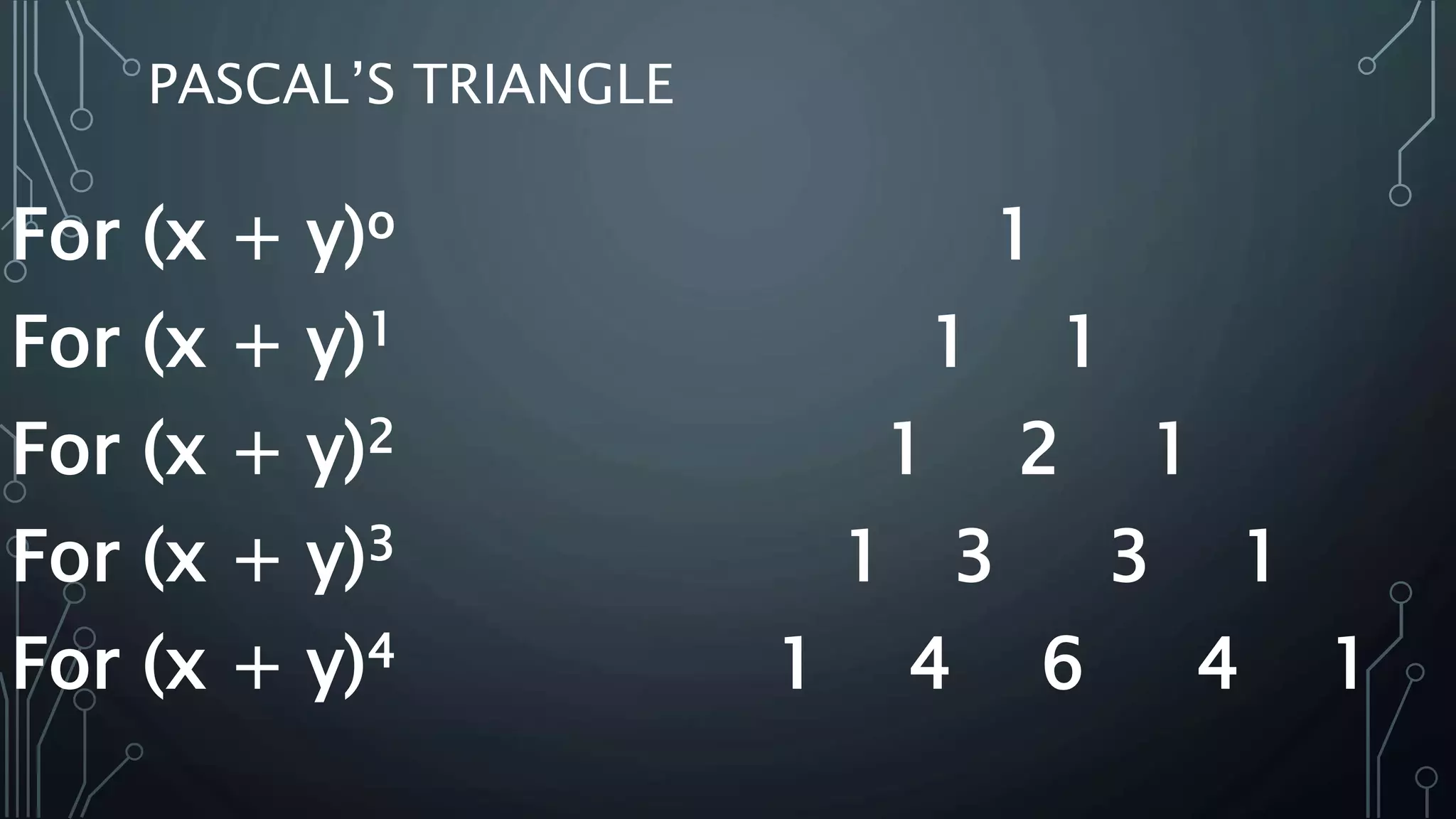
Pascal’s Triangle is named after the French mathematician Blaise Pascal, although it was known to mathematicians in other cultures long before him. The triangle is constructed by starting with a 1 at the top and then building each subsequent row by adding the two numbers directly above it. The first few rows of Pascal’s Triangle look like this:
| 1 | ||||
| 1 | 1 | |||
| 1 | 2 | 1 | ||
| 1 | 3 | 3 | 1 | |
| 1 | 4 | 6 | 4 | 1 |
Each number in the triangle represents a binomial coefficient, which is the coefficient of a term in the expansion of a binomial expression. For example, the number 6 in the fourth row is the coefficient of the term x2y2 in the expansion of (x + y)4.
The Binomial Theorem
The Binomial Theorem provides a way to expand the power of a binomial expression. For any positive integer n, the theorem states that:
(x + y)n = ∑k=0n C(n, k) xn-k yk
where C(n, k) is the binomial coefficient, which can be calculated as:
C(n, k) = n! / (k! (n - k)!)
Here, n! denotes the factorial of n, which is the product of all positive integers up to n.
Connecting Pascal’s Triangle to the Binomial Theorem
The connection between Pascal’s Triangle and the Binomial Theorem lies in the binomial coefficients. Each entry in Pascal’s Triangle is a binomial coefficient, and these coefficients appear in the expansion of a binomial expression according to the Binomial Theorem. For example, consider the expansion of (x + y)3:
(x + y)3 = C(3, 0) x3 y0 + C(3, 1) x2 y1 + C(3, 2) x1 y2 + C(3, 3) x0 y3
This expands to:
(x + y)3 = 1x3 + 3x2y + 3xy2 + 1y3
The coefficients 1, 3, 3, and 1 are the same as the numbers in the third row of Pascal's Triangle. This is not a coincidence; it is a direct result of the Binomial Theorem and the structure of Pascal's Triangle.
Applications of Pascal’s Triangle and the Binomial Theorem
The relationship between Pascal’s Triangle and the Binomial Theorem has numerous applications in mathematics and other fields. Some of the key applications include:
- Combinatorics: Pascal's Triangle is used to calculate combinations and permutations, which are fundamental in combinatorics. The entries in the triangle represent the number of ways to choose k items from a set of n items.
- Probability: The binomial coefficients in Pascal's Triangle are used in probability theory to calculate the likelihood of events occurring a certain number of times in a series of trials.
- Algebra: The Binomial Theorem is used to expand binomial expressions, which is essential in algebra and calculus. It is also used in the derivation of other mathematical theorems and formulas.
- Computer Science: Pascal's Triangle and the Binomial Theorem are used in algorithms for combinatorial problems, such as generating combinations and permutations, and in the analysis of algorithms.
These applications highlight the importance of understanding the relationship between Pascal's Triangle and the Binomial Theorem.
Constructing Pascal’s Triangle
Constructing Pascal’s Triangle is a straightforward process that involves adding the two numbers directly above each position to determine the value of the current position. Here is a step-by-step guide to constructing Pascal’s Triangle:
- Start with a single 1 at the top of the triangle.
- For each subsequent row, place a 1 at the beginning and end of the row.
- For each position between the ends of the row, add the two numbers directly above it from the previous row.
- Repeat this process to generate as many rows as needed.
For example, to construct the fourth row of Pascal's Triangle:
- The first and last numbers are 1.
- The second number is the sum of the two numbers above it: 1 + 3 = 4.
- The third number is the sum of the two numbers above it: 3 + 3 = 6.
- The fourth number is the sum of the two numbers above it: 3 + 1 = 4.
This results in the fourth row: 1, 4, 6, 4, 1.
💡 Note: Each row in Pascal's Triangle corresponds to the coefficients in the expansion of (x + y)n for some integer n. The first row corresponds to n = 0, the second row to n = 1, and so on.
Pascal’s Triangle Binomial Theorem in Action
To see the Binomial Theorem in action using Pascal’s Triangle, let’s consider the expansion of (x + y)4. According to the Binomial Theorem, we have:
(x + y)4 = ∑k=04 C(4, k) x4-k yk
This expands to:
(x + y)4 = C(4, 0) x4 y0 + C(4, 1) x3 y1 + C(4, 2) x2 y2 + C(4, 3) x1 y3 + C(4, 4) x0 y4
Using the binomial coefficients from the fourth row of Pascal's Triangle (1, 4, 6, 4, 1), we get:
(x + y)4 = 1x4 + 4x3y + 6x2y2 + 4xy3 + 1y4
This is the expansion of (x + y)4 using the Binomial Theorem, and the coefficients are directly taken from Pascal's Triangle.
💡 Note: The coefficients in the expansion of (x + y)n are symmetric. This symmetry is reflected in Pascal's Triangle, where each row is symmetric around the center.
Visualizing Pascal’s Triangle
Visualizing Pascal’s Triangle can help in understanding its structure and the relationship with the Binomial Theorem. Below is an image of Pascal’s Triangle with the first few rows:

Each row of the triangle corresponds to the coefficients in the expansion of (x + y)n for some integer n. The symmetry and pattern in the triangle make it a powerful tool for understanding combinatorics and the Binomial Theorem.
By examining the triangle, one can observe that each number is the sum of the two numbers directly above it. This property is crucial in constructing the triangle and understanding the binomial coefficients.
Pascal's Triangle is not only a mathematical curiosity but also a practical tool for solving problems in various fields. Its connection to the Binomial Theorem provides a deep insight into the nature of binomial expansions and combinatorial calculations.
Understanding Pascal's Triangle and the Binomial Theorem is essential for anyone interested in mathematics, as it forms the foundation for many advanced topics in algebra, combinatorics, and probability. The relationship between these two concepts is a testament to the elegance and interconnectedness of mathematical ideas.
In summary, Pascal’s Triangle and the Binomial Theorem are fundamental concepts in mathematics that are deeply interconnected. Pascal’s Triangle provides a visual representation of the binomial coefficients, which are used in the expansion of binomial expressions according to the Binomial Theorem. This relationship has numerous applications in mathematics and other fields, making it a valuable tool for students and professionals alike. By understanding the structure of Pascal’s Triangle and the principles of the Binomial Theorem, one can gain a deeper appreciation for the beauty and utility of mathematical concepts.
Related Terms:
- pascal's triangle explained
- how to solve pascal's triangle
- pascal's triangle for expanding polynomials
- pascal's triangle for expanding binomials
- pascal's triangle binomial expansion examples
- pascal's triangle practice problems