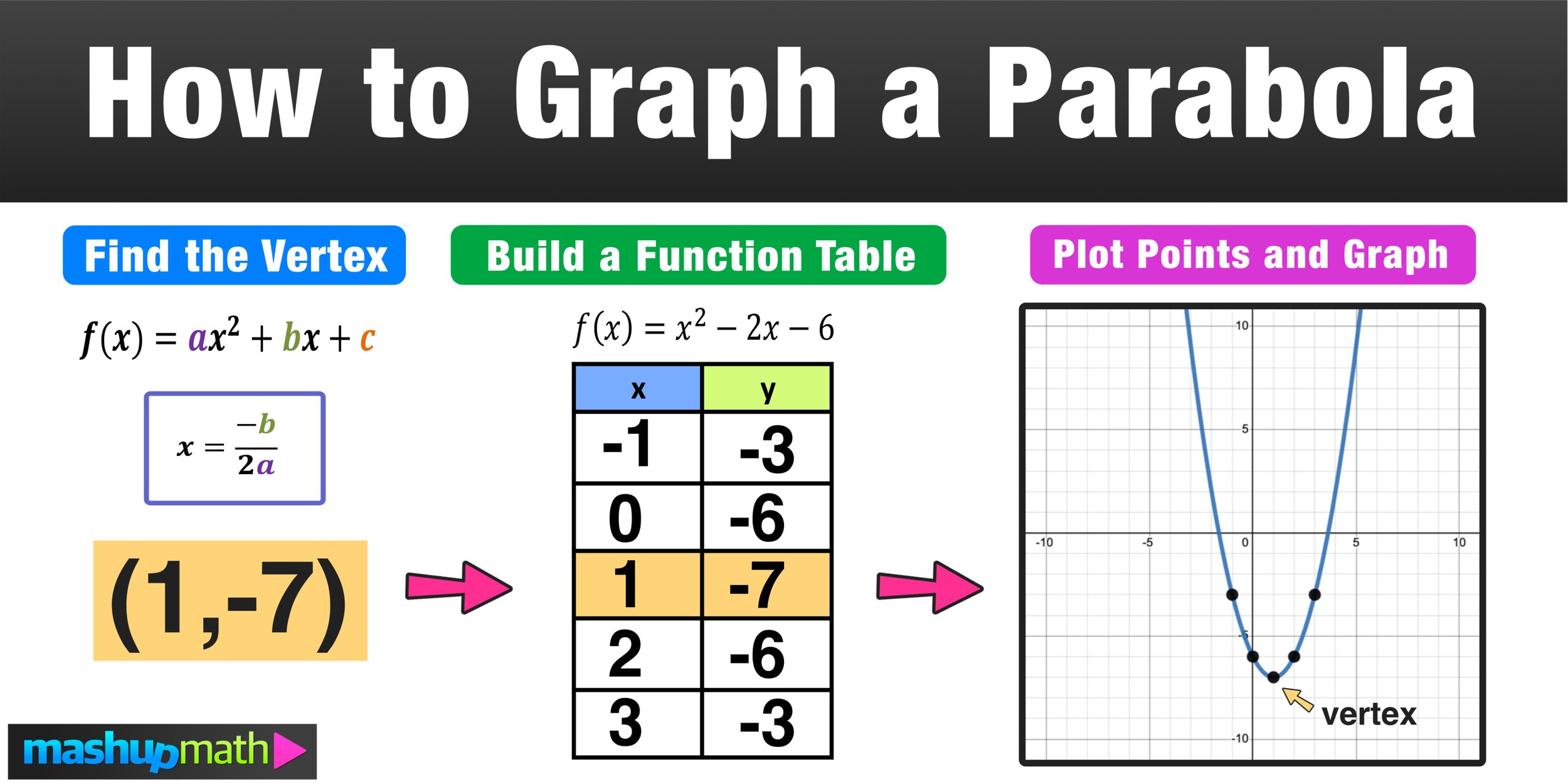
Parabolic functions are ubiquitous in mathematics and physics, describing a wide range of phenomena from the trajectory of a thrown ball to the shape of a satellite dish. Understanding parabolic function examples is crucial for students and professionals alike, as it forms the foundation for more complex mathematical concepts. This post will delve into the intricacies of parabolic functions, providing clear explanations, practical examples, and applications to help you grasp this fundamental topic.
Understanding Parabolic Functions
A parabolic function is a quadratic function that can be represented in the form y = ax2 + bx + c, where a, b, and c are constants and a is not equal to zero. The graph of a parabolic function is a parabola, which is a U-shaped curve. The direction of the parabola (whether it opens upwards or downwards) is determined by the value of a. If a is positive, the parabola opens upwards; if a is negative, it opens downwards.
Basic Properties of Parabolic Functions
To fully understand parabolic function examples, it’s essential to grasp their basic properties:
- Vertex: The vertex of a parabola is the point where the parabola turns. For a parabola in the form y = ax2 + bx + c, the x-coordinate of the vertex is given by x = -b/(2a).
- Axis of Symmetry: The axis of symmetry is a vertical line that passes through the vertex. It divides the parabola into two mirror-image halves.
- Roots: The roots of a parabolic function are the x-values where the graph intersects the x-axis. These are the solutions to the equation ax2 + bx + c = 0.
Parabolic Function Examples
Let’s explore some parabolic function examples to illustrate these concepts.
Example 1: Simple Parabola
Consider the function y = x2. This is the simplest form of a parabolic function.
- The vertex is at the origin (0,0).
- The axis of symmetry is the y-axis.
- The roots are at x = 0.
This parabola opens upwards because the coefficient of x2 is positive.
Example 2: Parabola with a Shift
Now, consider the function y = x2 + 2x + 1. This can be rewritten as y = (x + 1)2.
- The vertex is at (-1,0).
- The axis of symmetry is the line x = -1.
- The roots are at x = -1.
This parabola also opens upwards and is shifted one unit to the left compared to the previous example.
Example 3: Parabola Opening Downwards
Consider the function y = -x2 + 4x + 5. This can be rewritten as y = -(x - 2)2 + 9.
- The vertex is at (2,9).
- The axis of symmetry is the line x = 2.
- The roots can be found by solving -x2 + 4x + 5 = 0, which gives x = -1 and x = 5.
This parabola opens downwards because the coefficient of x2 is negative.
Applications of Parabolic Functions
Parabolic functions have numerous applications in various fields. Here are a few notable examples:
Projectile Motion
In physics, the trajectory of a projectile follows a parabolic path. The height h of the projectile at any time t can be described by the equation h = -gt2/2 + v0t + h0, where g is the acceleration due to gravity, v0 is the initial velocity, and h0 is the initial height.
Optics
Parabolic mirrors are used in telescopes and satellite dishes to focus light or radio waves to a single point. The shape of these mirrors is designed based on parabolic functions to ensure optimal focusing.
Architecture
Parabolic arches are used in construction for their strength and stability. The shape of these arches is derived from parabolic functions, allowing them to distribute weight evenly and resist compression.
Graphing Parabolic Functions
Graphing parabolic functions is a crucial skill for visualizing their behavior. Here are the steps to graph a parabolic function:
- Identify the vertex of the parabola using the formula x = -b/(2a).
- Determine the axis of symmetry, which is the vertical line passing through the vertex.
- Find the roots of the function by solving the equation ax2 + bx + c = 0.
- Plot the vertex and the roots on the coordinate plane.
- Draw the parabola, ensuring it opens upwards if a is positive and downwards if a is negative.
📝 Note: Use a graphing calculator or software for more complex parabolic functions to ensure accuracy.
Solving Parabolic Equations
Solving parabolic equations involves finding the roots of the quadratic function. There are several methods to do this:
Factoring
If the quadratic function can be factored, set each factor equal to zero and solve for x.
Quadratic Formula
The quadratic formula is a general method for solving any quadratic equation. The formula is x = [-b ± √(b2 - 4ac)] / (2a).
Completing the Square
Completing the square involves rewriting the quadratic equation in the form (x - h)2 = k, where h and k are constants. This method is useful for understanding the vertex of the parabola.
Parabolic Function Examples in Real Life
Parabolic functions are not just theoretical constructs; they have practical applications in everyday life. Here are some real-life examples:
Bridge Design
Many bridges are designed using parabolic arches because of their strength and ability to distribute weight evenly. The shape of these arches is derived from parabolic functions, ensuring structural integrity.
Roller Coasters
The paths of roller coasters often follow parabolic curves to create thrilling drops and loops. Engineers use parabolic functions to design these paths, ensuring safety and excitement.
Satellite Dishes
Satellite dishes use parabolic reflectors to focus incoming signals to a single point. The shape of these reflectors is based on parabolic functions, allowing for efficient signal reception.
Advanced Topics in Parabolic Functions
For those interested in delving deeper, there are advanced topics related to parabolic functions:
Conic Sections
Parabolas are one of the conic sections, along with circles, ellipses, and hyperbolas. Understanding conic sections provides a broader perspective on parabolic functions.
Calculus and Parabolic Functions
In calculus, parabolic functions are used to study rates of change and optimization problems. The derivative of a parabolic function gives the slope of the tangent line at any point on the curve.
Parametric Equations
Parabolic functions can also be represented using parametric equations, which describe the coordinates of points on the curve as functions of a parameter.
Parabolic functions are a fundamental concept in mathematics with wide-ranging applications. From simple quadratic equations to complex real-life scenarios, understanding parabolic function examples is essential for anyone studying mathematics or related fields. By grasping the basic properties, graphing techniques, and applications of parabolic functions, you can build a strong foundation for more advanced topics.
Related Terms:
- example of a parabola
- how to solve parabola
- can a parabola be function
- parabola example math
- how do you graph parabolas
- different types of parabolas