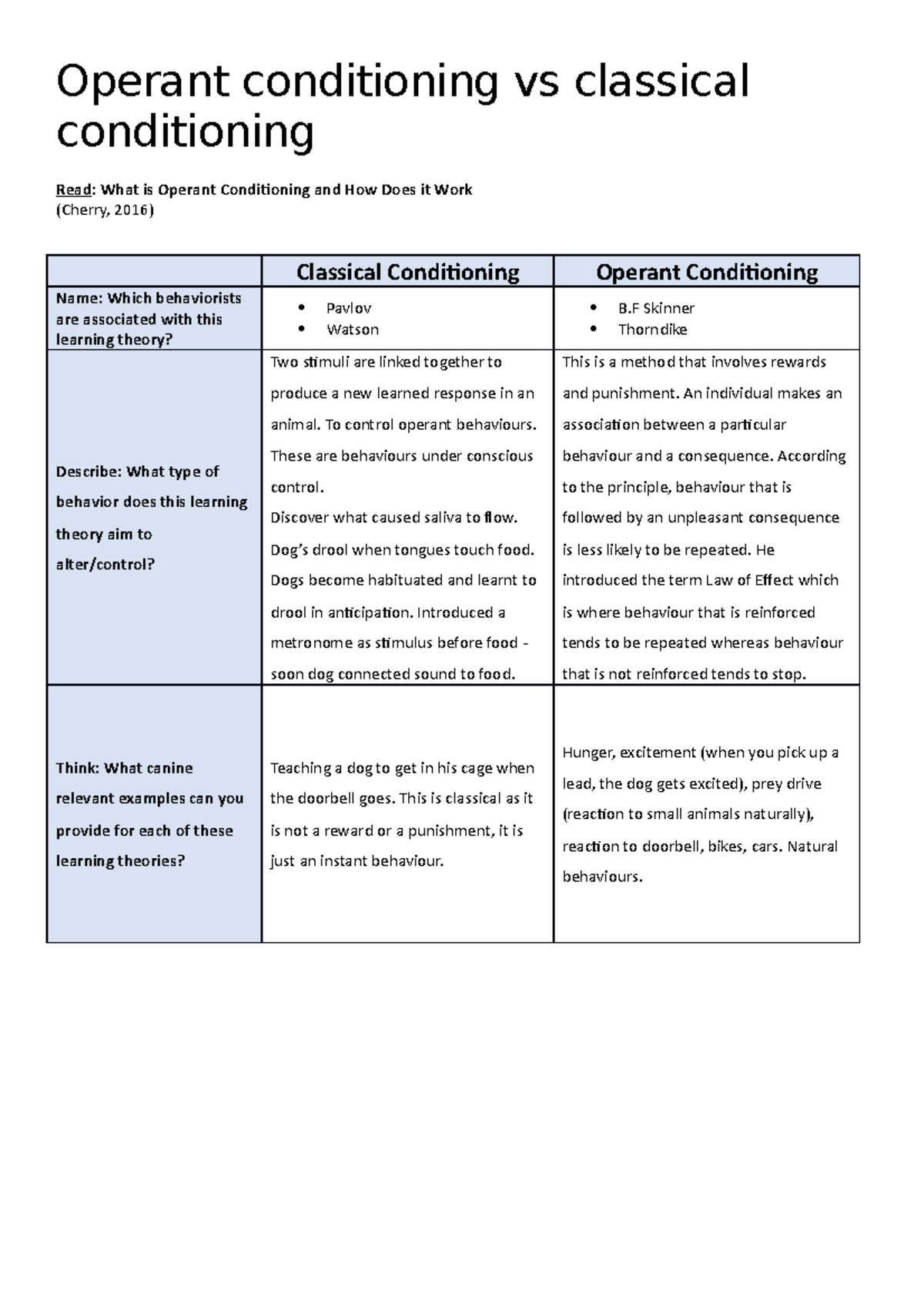
Understanding the intricacies of behavior and learning is a fundamental aspect of psychology. Two of the most influential theories in this field are operant vs classical conditioning. These theories, developed by Ivan Pavlov and B.F. Skinner respectively, provide different perspectives on how behaviors are acquired and modified. This post will delve into the concepts of operant vs classical conditioning, their key differences, and their applications in various fields.
Understanding Classical Conditioning
Classical conditioning, also known as Pavlovian conditioning, is a learning process where a neutral stimulus becomes associated with a response that is already present. This type of conditioning was first demonstrated by Ivan Pavlov through his famous experiments with dogs. Pavlov observed that dogs would salivate in response to the presentation of food. He then paired the presentation of food with the sound of a bell. Over time, the dogs began to salivate at the sound of the bell alone, even when no food was present.
Key components of classical conditioning include:
- Unconditioned Stimulus (US): A stimulus that naturally triggers a response.
- Unconditioned Response (UR): The natural response to the unconditioned stimulus.
- Conditioned Stimulus (CS): A neutral stimulus that becomes associated with the unconditioned stimulus.
- Conditioned Response (CR): The response to the conditioned stimulus after conditioning has occurred.
Classical conditioning is widely used in various applications, including:
- Phobia Treatment: By gradually exposing individuals to feared stimuli in a controlled environment, therapists can help reduce phobic responses.
- Advertising: Marketers often use classical conditioning to associate their products with positive emotions or experiences.
- Medical Treatments: Techniques like systematic desensitization and aversion therapy are based on classical conditioning principles.
Understanding Operant Conditioning
Operant conditioning, developed by B.F. Skinner, focuses on how behaviors are influenced by their consequences. Unlike classical conditioning, which deals with involuntary responses, operant conditioning involves voluntary behaviors. Skinner's experiments with rats and pigeons demonstrated that behaviors could be shaped through reinforcement and punishment.
Key components of operant conditioning include:
- Reinforcement: A consequence that increases the likelihood of a behavior being repeated.
- Punishment: A consequence that decreases the likelihood of a behavior being repeated.
- Positive Reinforcement: Adding a desirable stimulus to increase a behavior.
- Negative Reinforcement: Removing an undesirable stimulus to increase a behavior.
- Positive Punishment: Adding an undesirable stimulus to decrease a behavior.
- Negative Punishment: Removing a desirable stimulus to decrease a behavior.
Operant conditioning has numerous applications, such as:
- Education: Teachers use reinforcement to encourage desired behaviors and punishments to discourage unwanted behaviors.
- Animal Training: Trainers use positive reinforcement to teach animals new behaviors.
- Behavioral Therapy: Therapists use operant conditioning techniques to modify maladaptive behaviors.
Operant Vs Classical Conditioning: Key Differences
While both operant vs classical conditioning are fundamental to understanding behavior, they differ in several key ways:
| Aspect | Classical Conditioning | Operant Conditioning |
|---|---|---|
| Type of Response | Involuntary | Voluntary |
| Learning Process | Association between stimuli | Association between behavior and consequence |
| Key Figures | Ivan Pavlov | B.F. Skinner |
| Examples | Pavlov's dogs salivating to a bell | Skinner's rats pressing a lever for food |
These differences highlight the unique mechanisms through which each type of conditioning operates. Classical conditioning focuses on the automatic responses to stimuli, while operant conditioning emphasizes the role of consequences in shaping behavior.
📝 Note: Understanding these differences is crucial for applying the correct conditioning technique in various scenarios.
Applications of Operant Vs Classical Conditioning
Both operant vs classical conditioning have wide-ranging applications in psychology, education, and everyday life. Here are some specific examples:
Classical Conditioning Applications
Classical conditioning is often used in therapeutic settings to help individuals overcome fears and phobias. For example, systematic desensitization involves gradually exposing a person to a feared stimulus while in a relaxed state. Over time, the person learns to associate the stimulus with relaxation rather than fear.
In advertising, classical conditioning is used to create positive associations with products. For instance, a commercial might pair a product with a pleasant scene or music to evoke positive emotions in the viewer.
Operant Conditioning Applications
Operant conditioning is extensively used in educational settings to reinforce desired behaviors. Teachers might use positive reinforcement, such as praise or rewards, to encourage students to complete their assignments on time. Conversely, negative punishment, such as removing privileges, might be used to discourage disruptive behavior.
In animal training, operant conditioning is the primary method used to teach new behaviors. Trainers use positive reinforcement, such as treats or praise, to encourage animals to perform desired actions. This method is effective for training pets, service animals, and even animals in research settings.
In behavioral therapy, operant conditioning techniques are used to modify maladaptive behaviors. For example, a therapist might use positive reinforcement to encourage a client to engage in healthy behaviors, such as exercise or meditation. Conversely, negative punishment might be used to discourage harmful behaviors, such as substance abuse.
Case Studies: Operant Vs Classical Conditioning in Action
To better understand the practical applications of operant vs classical conditioning, let's examine a few case studies:
Classical Conditioning Case Study: Phobia Treatment
John, a 30-year-old man, has a severe phobia of spiders. He avoids areas where spiders might be present and experiences intense anxiety when he encounters one. His therapist decides to use systematic desensitization, a form of classical conditioning, to help John overcome his phobia.
The therapist creates a hierarchy of spider-related stimuli, ranging from least to most anxiety-provoking. John is taught relaxation techniques and then gradually exposed to each stimulus in the hierarchy while in a relaxed state. Over several sessions, John learns to associate spiders with relaxation rather than fear.
Operant Conditioning Case Study: Animal Training
A dog trainer is working with a puppy named Max to teach him to sit on command. The trainer uses positive reinforcement by giving Max a treat every time he sits when commanded. Initially, Max sits randomly, but over time, he learns to associate the command "sit" with the reward of a treat. Eventually, Max sits on command without the need for a treat.
In both cases, the principles of classical and operant conditioning are applied to achieve specific behavioral outcomes. The therapist uses classical conditioning to modify John's emotional response to spiders, while the trainer uses operant conditioning to teach Max a new behavior.
📝 Note: These case studies illustrate the practical applications of conditioning principles in real-world scenarios.
Challenges and Limitations
While operant vs classical conditioning are powerful tools for understanding and modifying behavior, they also have their challenges and limitations. Some of the key challenges include:
- Generalization: Behaviors learned in one context may not generalize to other contexts. For example, a dog trained to sit in a quiet room may not sit when there are distractions.
- Extinction: Behaviors learned through conditioning can be extinguished if the reinforcing stimulus is removed. For instance, a child who receives a reward for good behavior may stop the behavior if the reward is no longer given.
- Ethical Considerations: The use of punishment in operant conditioning can raise ethical concerns, especially if it involves physical or psychological harm.
Despite these challenges, the principles of operant vs classical conditioning remain foundational to the study of behavior and learning. Researchers and practitioners continue to refine these techniques to enhance their effectiveness and applicability.
In conclusion, operant vs classical conditioning are two fundamental theories in psychology that offer distinct perspectives on how behaviors are acquired and modified. Classical conditioning focuses on the association between stimuli and involuntary responses, while operant conditioning emphasizes the role of consequences in shaping voluntary behaviors. Both theories have wide-ranging applications in therapy, education, and everyday life, and understanding their principles can help individuals and professionals alike to effectively modify behaviors and achieve desired outcomes.
Related Terms:
- operant conditioning vs classical learning
- classical and operant conditioning examples
- compare classical conditioning and operant
- difference classical and operant conditioning
- classical and operant conditioning similarities
- everyday examples of operant conditioning