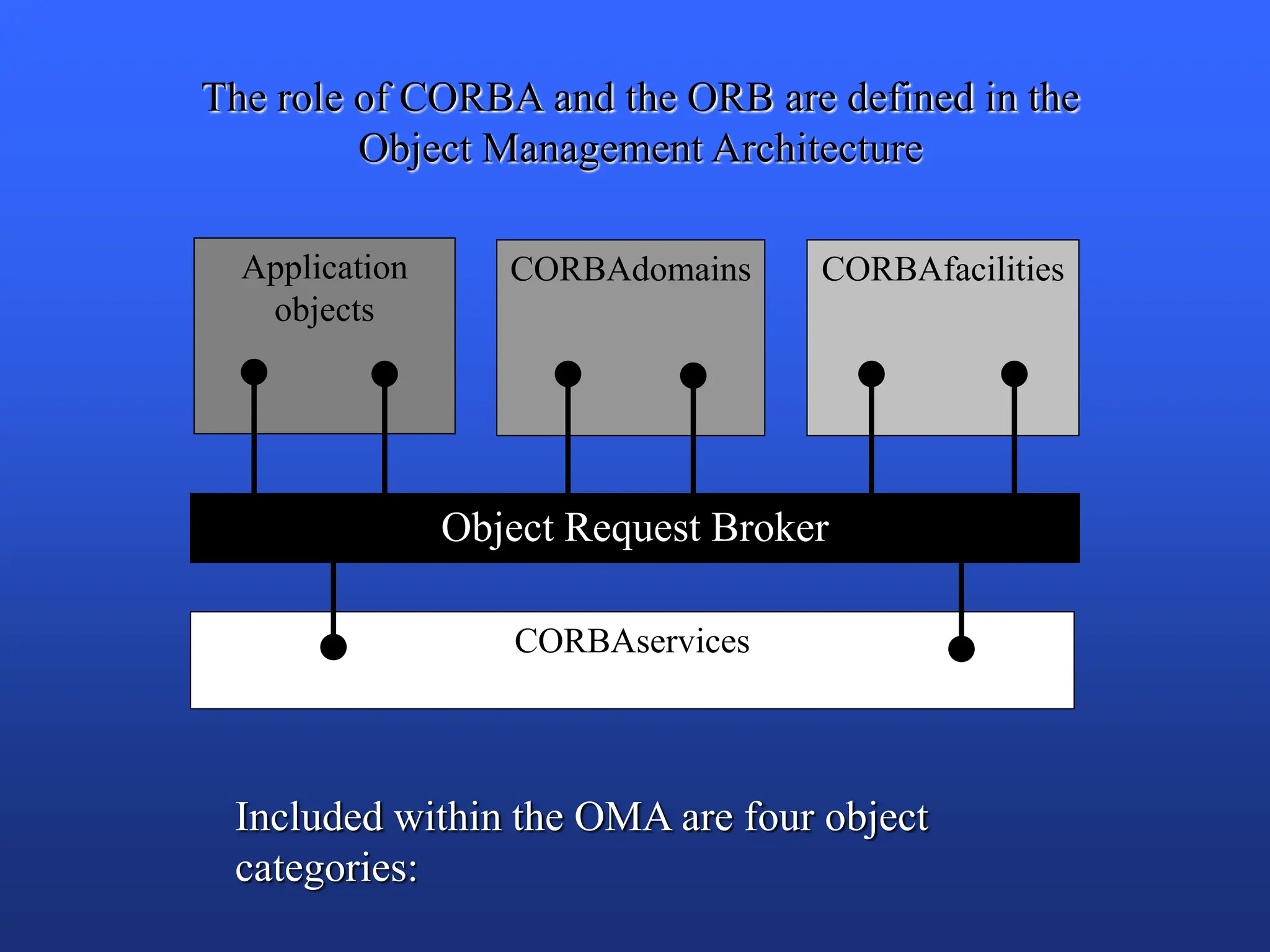
In the realm of distributed computing, the concept of an Object Request Broker (ORB) plays a pivotal role in enabling seamless communication between objects across different address spaces. An ORB acts as a middleware that facilitates the interaction of objects in a distributed environment, allowing them to communicate as if they were in the same address space. This technology is fundamental in the development of scalable and robust distributed systems.
Understanding the Object Request Broker
An Object Request Broker is a software component that enables objects to communicate with each other regardless of their location or the programming language they are written in. The ORB provides a standardized way for objects to request services from other objects, making it easier to build distributed applications. The key components of an ORB include:
- Client: The entity that requests services from the server.
- Server: The entity that provides the requested services.
- Interface Definition Language (IDL): A language used to define the interfaces of the objects that will be communicated over the ORB.
- Stub: A client-side proxy that represents the server object.
- Skeleton: A server-side proxy that represents the client object.
The ORB handles the details of locating the server object, invoking the method, and returning the results to the client. This abstraction allows developers to focus on the business logic rather than the complexities of network communication.
The Role of IDL in ORB
Interface Definition Language (IDL) is a crucial part of the Object Request Broker architecture. IDL is used to define the interfaces of the objects that will be communicated over the ORB. It provides a language-neutral way to describe the operations that can be performed on an object, the parameters for those operations, and the data types involved. The IDL definitions are then compiled into language-specific stubs and skeletons, which are used by the client and server to communicate with each other.
Here is a simple example of an IDL definition:
interface Calculator {
    int add(int a, int b);
    int subtract(int a, int b);
    int multiply(int a, int b);
    int divide(int a, int b);
};
In this example, the Calculator interface defines four operations: add, subtract, multiply, and divide. Each operation takes two integers as parameters and returns an integer result. The IDL definition is then compiled into stubs and skeletons for the client and server, respectively.
How ORB Facilitates Communication
The Object Request Broker facilitates communication between objects through a series of steps:
- The client makes a request to the ORB to invoke a method on a remote object.
- The ORB locates the server object using the object reference provided by the client.
- The ORB marshals the request parameters into a format that can be transmitted over the network.
- The ORB sends the request to the server object.
- The server object's skeleton receives the request and unmarshals the parameters.
- The server object executes the requested method and returns the result.
- The server object's skeleton marshals the result and sends it back to the client's stub.
- The client's stub unmarshals the result and returns it to the client.
This process is transparent to the client and server, allowing them to communicate as if they were in the same address space.
Benefits of Using an Object Request Broker
Using an Object Request Broker offers several benefits in the development of distributed systems:
- Language Independence: ORB allows objects written in different programming languages to communicate with each other. This is achieved through the use of IDL, which provides a language-neutral way to define object interfaces.
- Location Transparency: ORB hides the details of object location from the client. The client can invoke methods on remote objects as if they were local, making the system easier to develop and maintain.
- Scalability: ORB enables the development of scalable distributed systems by allowing objects to be distributed across multiple machines. This can improve performance and reliability.
- Interoperability: ORB promotes interoperability between different systems and platforms. Objects can communicate with each other regardless of the underlying hardware or software.
- Reusability: ORB encourages the reuse of existing objects and components. Objects can be easily integrated into new systems, reducing development time and cost.
These benefits make ORB a powerful tool for building distributed applications that are scalable, robust, and easy to maintain.
Challenges and Limitations
While the Object Request Broker offers many advantages, it also presents several challenges and limitations:
- Complexity: ORB can be complex to implement and use, requiring a deep understanding of distributed systems and network communication.
- Performance Overhead: The marshaling and unmarshaling of request parameters and results can introduce performance overhead, especially in high-latency networks.
- Security Concerns: ORB can be vulnerable to security threats, such as unauthorized access and data tampering. It is important to implement appropriate security measures to protect the system.
- Standardization Issues: Different ORB implementations may have different features and behaviors, making it difficult to achieve interoperability between systems.
Despite these challenges, ORB remains a valuable technology for building distributed systems, and ongoing research and development continue to address these issues.
Common Use Cases of ORB
The Object Request Broker is used in a variety of applications and industries. Some common use cases include:
- Enterprise Applications: ORB is used to build enterprise-level applications that require distributed computing, such as customer relationship management (CRM) systems and enterprise resource planning (ERP) systems.
- Telecommunications: ORB is used in telecommunications systems to enable communication between different network elements, such as switches and routers.
- Financial Services: ORB is used in financial services to build distributed trading systems and risk management systems.
- Healthcare: ORB is used in healthcare systems to enable communication between different medical devices and systems, such as electronic health records (EHR) and medical imaging systems.
- Scientific Computing: ORB is used in scientific computing to enable distributed processing of large datasets, such as in climate modeling and astrophysics.
These use cases demonstrate the versatility and power of ORB in enabling distributed computing across various domains.
Future Trends in ORB Technology
The field of Object Request Broker technology is continually evolving, driven by advancements in distributed computing and network technologies. Some future trends in ORB technology include:
- Cloud Integration: As more applications move to the cloud, ORB technology will need to adapt to support cloud-based distributed systems. This includes integrating with cloud platforms and services, such as container orchestration and serverless computing.
- Microservices Architecture: ORB will play a crucial role in enabling communication between microservices in a distributed architecture. This includes supporting lightweight and scalable communication protocols, such as gRPC and REST.
- Edge Computing: With the rise of edge computing, ORB will need to support communication between edge devices and cloud services. This includes optimizing for low-latency and high-reliability communication.
- Security Enhancements: As security concerns continue to grow, ORB technology will need to incorporate advanced security features, such as encryption, authentication, and authorization.
These trends highlight the ongoing importance of ORB technology in the development of distributed systems and the need for continued innovation and adaptation.
🔒 Note: While ORB technology offers many benefits, it is important to carefully consider the specific requirements and constraints of your application before choosing an ORB solution.
In conclusion, the Object Request Broker is a fundamental technology in the field of distributed computing, enabling seamless communication between objects across different address spaces. Its ability to provide language independence, location transparency, scalability, interoperability, and reusability makes it a powerful tool for building robust and scalable distributed systems. Despite the challenges and limitations, ORB continues to evolve and adapt to meet the needs of modern distributed computing environments, making it an essential component in the development of enterprise-level applications, telecommunications systems, financial services, healthcare systems, and scientific computing. As the field of distributed computing continues to grow, ORB technology will play a crucial role in enabling the next generation of distributed systems.
Related Terms:
- ibm request broker