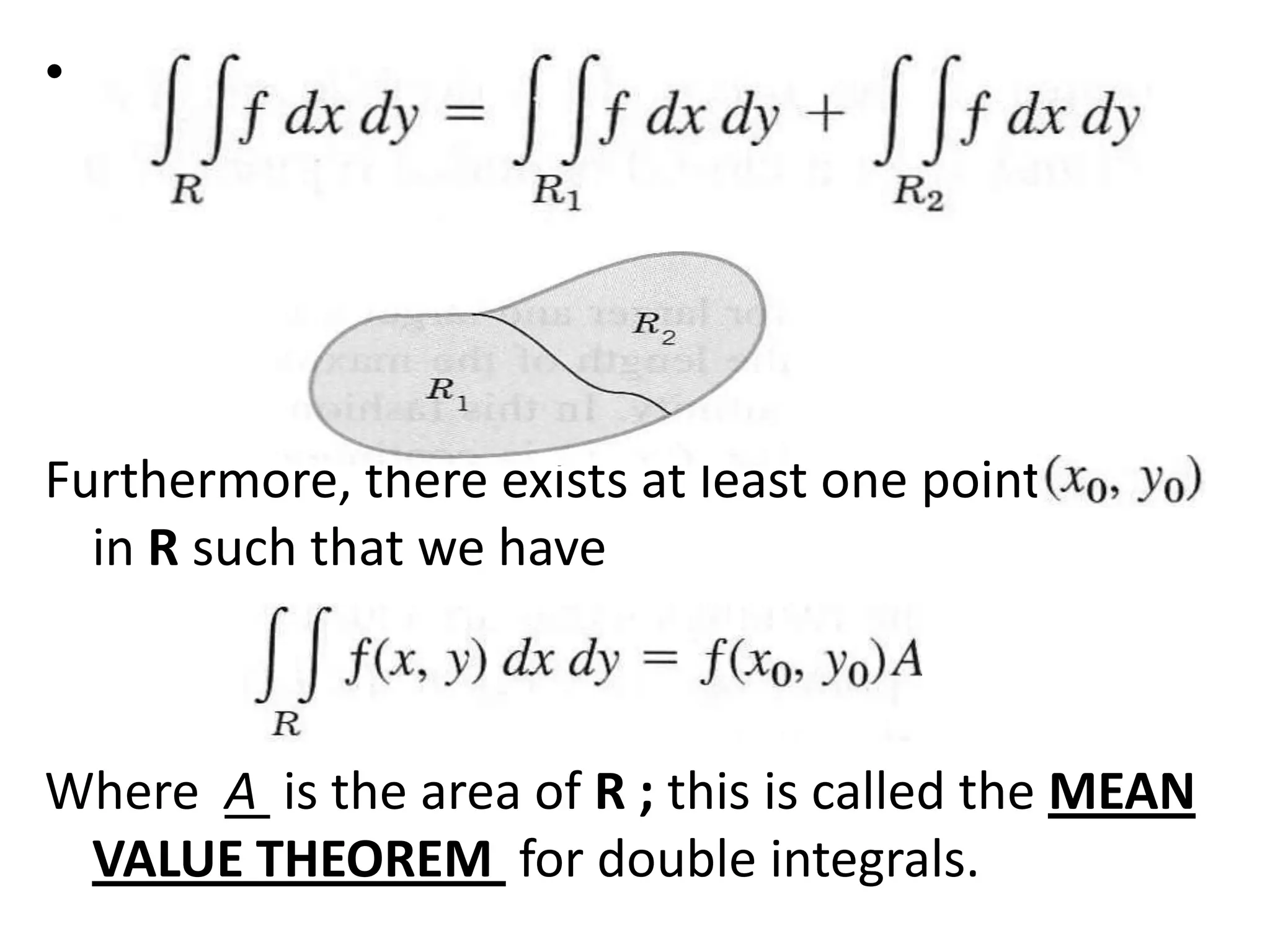
The Mean Value Integral Theorem is a fundamental concept in calculus and mathematical analysis, providing a powerful tool for understanding the behavior of functions over intervals. This theorem extends the idea of the Mean Value Theorem from differential calculus to integral calculus, offering insights into the average value of a function over a given range. By exploring the Mean Value Integral Theorem, we can gain a deeper understanding of how functions behave and how to apply this knowledge to various mathematical and real-world problems.
Understanding the Mean Value Integral Theorem
The Mean Value Integral Theorem states that if a function f(x) is continuous on a closed interval [a, b], then there exists a number c in the interval (a, b) such that the value of the function at c is equal to the average value of the function over the interval. Mathematically, this can be expressed as:
f(c) = (1/(b-a)) ∫ from a to b f(x) dx
This theorem is crucial because it allows us to find a point within an interval where the function's value is representative of its average value over that interval. This concept is particularly useful in fields such as physics, engineering, and economics, where understanding average values is essential.
Applications of the Mean Value Integral Theorem
The Mean Value Integral Theorem has numerous applications across various disciplines. Some of the key areas where this theorem is applied include:
- Physics: In physics, the theorem is used to calculate average values of physical quantities over time or space. For example, it can be used to find the average velocity of an object over a given time interval.
- Engineering: Engineers use the Mean Value Integral Theorem to analyze the behavior of systems and processes. It helps in determining average values of parameters such as temperature, pressure, and voltage over specific intervals.
- Economics: In economics, the theorem is applied to calculate average costs, revenues, and profits over different periods. This information is crucial for making informed business decisions.
- Mathematics: Beyond its practical applications, the Mean Value Integral Theorem is a cornerstone of mathematical analysis. It is used to prove other important theorems and to develop a deeper understanding of the properties of functions.
Proof of the Mean Value Integral Theorem
The proof of the Mean Value Integral Theorem involves several steps and relies on the properties of continuous functions and integrals. Here is a detailed proof:
1. Define the Average Value: Let f(x) be a continuous function on the closed interval [a, b]. The average value of f(x) over this interval is given by:
M = (1/(b-a)) ∫ from a to b f(x) dx
2. Define a New Function: Consider a new function g(x) defined as:
g(x) = ∫ from a to x f(t) dt - M(x-a)
3. Evaluate g(x) at the Endpoints: Evaluate g(x) at the endpoints of the interval:
g(a) = ∫ from a to a f(t) dt - M(a-a) = 0
g(b) = ∫ from a to b f(t) dt - M(b-a) = (b-a)M - M(b-a) = 0
4. Apply Rolle's Theorem: Since g(x) is continuous on [a, b] and differentiable on (a, b), and g(a) = g(b) = 0, by Rolle's Theorem, there exists a point c in (a, b) such that g'(c) = 0.
5. Find the Derivative of g(x): The derivative of g(x) is:
g'(x) = f(x) - M
6. Solve for c: Since g'(c) = 0, we have:
f(c) - M = 0
Therefore, f(c) = M, which means there exists a point c in (a, b) such that f(c) is equal to the average value of f(x) over the interval [a, b].
💡 Note: The proof relies on the continuity of f(x) and the properties of integrals and derivatives. It is essential to understand these concepts to fully grasp the proof.
Examples of the Mean Value Integral Theorem
To illustrate the Mean Value Integral Theorem, let's consider a few examples:
Example 1: Average Value of a Linear Function
Consider the function f(x) = 2x + 3 on the interval [1, 4]. We want to find the average value of this function over the interval.
1. Calculate the Integral:
∫ from 1 to 4 (2x + 3) dx = [x^2 + 3x] from 1 to 4 = (16 + 12) - (1 + 3) = 24
2. Calculate the Average Value:
M = (1/(4-1)) ∫ from 1 to 4 (2x + 3) dx = (1/3) * 24 = 8
3. Find the Point c:
We need to find c such that f(c) = 8.
2c + 3 = 8
2c = 5
c = 2.5
Therefore, the average value of f(x) over the interval [1, 4] is 8, and this value is achieved at c = 2.5.
Example 2: Average Value of a Quadratic Function
Consider the function f(x) = x^2 - 4x + 5 on the interval [0, 3]. We want to find the average value of this function over the interval.
1. Calculate the Integral:
∫ from 0 to 3 (x^2 - 4x + 5) dx = [(1/3)x^3 - 2x^2 + 5x] from 0 to 3 = (9 - 18 + 15) - (0 - 0 + 0) = 6
2. Calculate the Average Value:
M = (1/(3-0)) ∫ from 0 to 3 (x^2 - 4x + 5) dx = (1/3) * 6 = 2
3. Find the Point c:
We need to find c such that f(c) = 2.
c^2 - 4c + 5 = 2
c^2 - 4c + 3 = 0
Solving this quadratic equation, we get:
c = 1 or c = 3
Therefore, the average value of f(x) over the interval [0, 3] is 2, and this value is achieved at c = 1 or c = 3.
Comparing the Mean Value Integral Theorem with the Mean Value Theorem
The Mean Value Integral Theorem is closely related to the Mean Value Theorem, but there are key differences between the two. The Mean Value Theorem states that if a function f(x) is continuous on a closed interval [a, b] and differentiable on the open interval (a, b), then there exists a point c in (a, b) such that:
f'(c) = (f(b) - f(a)) / (b - a)
In contrast, the Mean Value Integral Theorem focuses on the average value of the function over the interval, rather than the derivative. The Mean Value Theorem is more about the rate of change of the function, while the Mean Value Integral Theorem is about the average value of the function.
Here is a comparison table to highlight the differences:
| Aspect | Mean Value Theorem | Mean Value Integral Theorem |
|---|---|---|
| Focus | Rate of change (derivative) | Average value (integral) |
| Condition | Continuous on [a, b], differentiable on (a, b) | Continuous on [a, b] |
| Result | f'(c) = (f(b) - f(a)) / (b - a) | f(c) = (1/(b-a)) ∫ from a to b f(x) dx |
💡 Note: Understanding the differences between these two theorems is crucial for applying them correctly in various mathematical and real-world problems.
Advanced Topics and Extensions
The Mean Value Integral Theorem can be extended to more advanced topics in mathematical analysis. Some of these extensions include:
- Multiple Integrals: The theorem can be extended to functions of multiple variables, where the average value is calculated over a multi-dimensional region.
- Vector-Valued Functions: The Mean Value Integral Theorem can be applied to vector-valued functions, where the average value is a vector in a multi-dimensional space.
- Generalized Functions: The theorem can be extended to generalized functions, such as distributions, where the average value is defined in a more abstract sense.
These extensions require a deeper understanding of advanced calculus and mathematical analysis, but they provide powerful tools for solving complex problems in various fields.
In conclusion, the Mean Value Integral Theorem is a fundamental concept in calculus and mathematical analysis, providing a powerful tool for understanding the behavior of functions over intervals. By exploring the theorem’s applications, proof, and extensions, we gain a deeper understanding of how functions behave and how to apply this knowledge to various mathematical and real-world problems. The theorem’s ability to find a point within an interval where the function’s value is representative of its average value makes it an invaluable tool in fields such as physics, engineering, and economics. Understanding the Mean Value Integral Theorem and its applications can enhance our problem-solving skills and provide insights into the behavior of functions in different contexts.
Related Terms:
- average value theorem formula
- find average value of integral
- average value formula calculus ab
- mean value inequality integrals
- average value using integrals
- average value theorem calculus