In the world of finance and economics, the terms macro and micro are often used to describe different levels of analysis. Understanding the distinction between macro and micro economics is crucial for anyone looking to grasp the complexities of economic systems. This blog post will delve into the differences between macro and micro economics, their significance, and how they interplay to shape the economic landscape.
Understanding Macro Economics
Macro economics focuses on the overall performance, structure, and behavior of the economy as a whole. It examines large-scale economic factors such as national income, gross domestic product (GDP), unemployment rates, and inflation. The primary goal of macro economics is to understand how these factors interact and influence the economy on a broad scale.
Key components of macro economics include:
- Gross Domestic Product (GDP): Measures the total value of all goods and services produced within a country's borders in a specific time period.
- Inflation: The rate at which the general level of prices for goods and services rises, leading to a decrease in purchasing power.
- Unemployment: The percentage of the labor force that is jobless and actively seeking employment.
- Fiscal Policy: Government policies that influence the economy through spending and taxation.
- Monetary Policy: Policies implemented by central banks to control the money supply and interest rates.
Macro economics is essential for policymakers, as it provides insights into how to manage economic stability, growth, and development. By analyzing macroeconomic indicators, governments can make informed decisions about fiscal and monetary policies to address issues like economic downturns, inflation, and unemployment.
Exploring Micro Economics
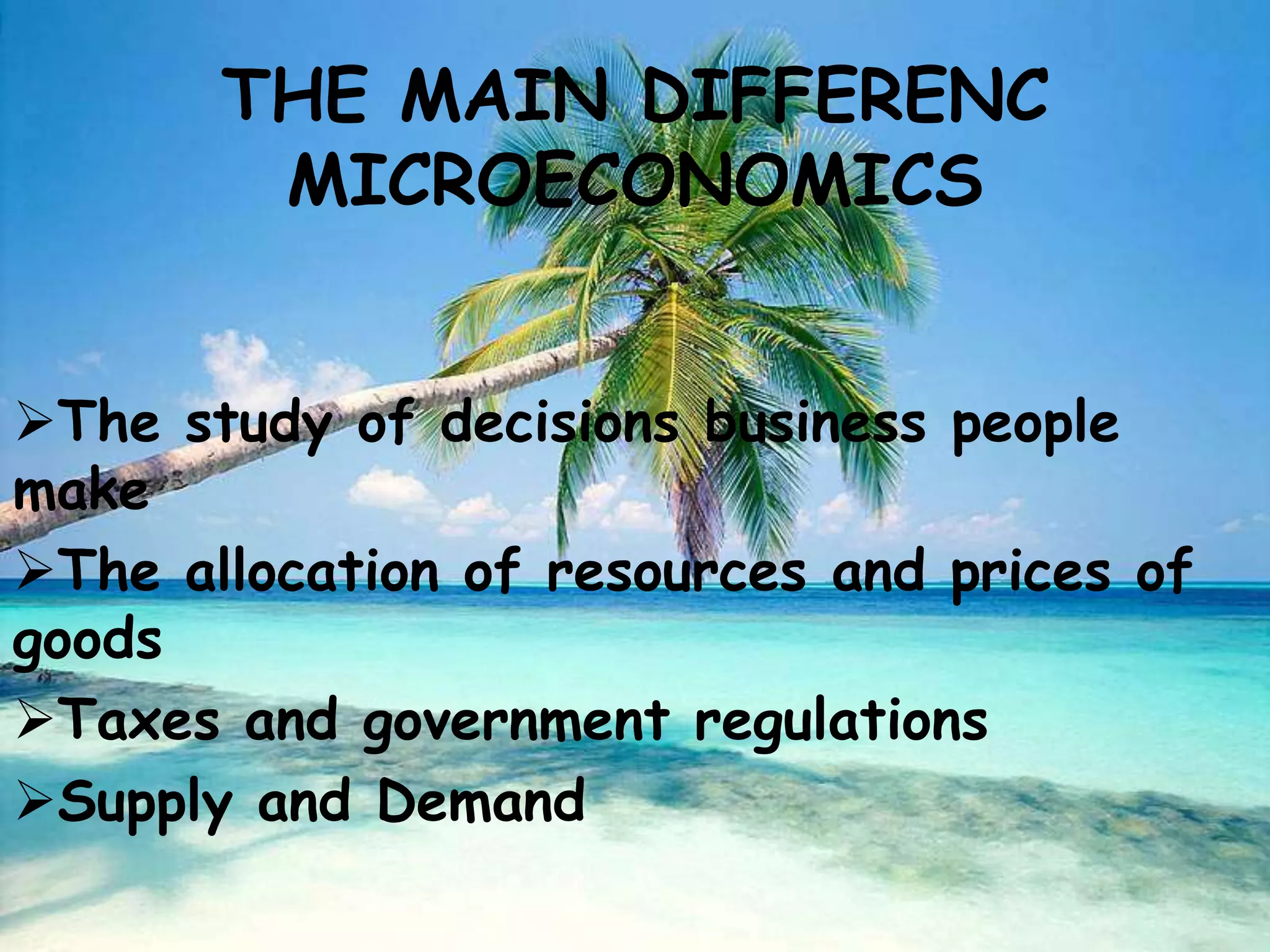
Micro economics, on the other hand, focuses on individual economic units and their interactions within the market. It examines how households and firms make decisions to allocate resources and determine prices. Micro economics is concerned with the behavior of individual consumers and producers, as well as the supply and demand dynamics that drive market outcomes.
Key components of micro economics include:
- Supply and Demand: The relationship between the quantity of a good or service that producers are willing to supply and the quantity that consumers are willing to buy at various prices.
- Elasticity: Measures the responsiveness of the quantity demanded or supplied of a good to changes in its price or other factors.
- Market Structures: Different types of markets, such as perfect competition, monopoly, oligopoly, and monopolistic competition, which influence pricing and output decisions.
- Consumer Theory: Analyzes how consumers make choices based on their preferences and budget constraints.
- Production Theory: Examines how firms decide on the combination of inputs to produce goods and services efficiently.
Micro economics is crucial for understanding how individual economic decisions aggregate to influence market outcomes. It helps businesses make strategic decisions about pricing, production, and resource allocation. For consumers, micro economics provides insights into how to maximize utility and make informed purchasing decisions.
The Interplay Between Macro and Micro Economics
While macro and micro economics focus on different levels of analysis, they are interconnected and influence each other in significant ways. Changes in macroeconomic conditions can have profound effects on microeconomic decisions, and vice versa.
For example, a macroeconomic policy aimed at reducing inflation might involve increasing interest rates. This policy can affect microeconomic decisions by making borrowing more expensive for businesses, leading to reduced investment and hiring. Conversely, microeconomic decisions, such as changes in consumer spending patterns, can aggregate to influence macroeconomic indicators like GDP and inflation.
Understanding the interplay between macro and micro economics is essential for a comprehensive view of the economy. Policymakers need to consider both levels of analysis to develop effective strategies for economic management. For instance, fiscal and monetary policies (macro) can influence individual economic decisions (micro), and changes in consumer behavior (micro) can impact overall economic performance (macro).
Applications of Macro and Micro Economics
Both macro and micro economics have practical applications in various fields, including business, government, and academia. Here are some key applications:
Business Decisions
Businesses use microeconomic principles to make strategic decisions about pricing, production, and resource allocation. For example, understanding supply and demand dynamics can help businesses set optimal prices for their products. Additionally, microeconomic analysis can inform decisions about market entry, expansion, and competitive strategies.
Macroeconomic analysis is also crucial for businesses, as it helps them anticipate economic trends and adjust their strategies accordingly. For instance, a business might delay expansion plans during an economic downturn or invest more during a period of economic growth.
Government Policies
Governments rely on macroeconomic analysis to develop policies aimed at achieving economic stability and growth. Fiscal and monetary policies are designed to influence aggregate demand, control inflation, and manage unemployment. For example, during a recession, governments might implement expansionary fiscal policies, such as increased spending or tax cuts, to stimulate economic activity.
Microeconomic analysis helps governments design policies that promote efficiency and equity in the allocation of resources. For instance, policies aimed at reducing market failures, such as externalities or monopolies, can improve overall economic welfare.
Academic Research
Both macro and micro economics are vital areas of study in academia. Researchers in these fields contribute to our understanding of economic phenomena and develop theories that inform policy and business decisions. For example, microeconomic research might focus on consumer behavior, while macroeconomic research might examine the impact of monetary policy on economic growth.
Academic research in economics often involves empirical analysis, theoretical modeling, and policy evaluation. By conducting rigorous studies, economists can provide insights into complex economic issues and propose solutions to address them.
Challenges in Macro and Micro Economics
Despite their importance, both macro and micro economics face several challenges. Understanding these challenges is crucial for advancing the field and improving economic policy.
Data Availability and Quality
One of the primary challenges in both macro and micro economics is the availability and quality of data. Accurate and reliable data are essential for conducting meaningful analysis and developing effective policies. However, obtaining high-quality data can be difficult, especially in developing countries or for specific economic sectors.
In macro economics, data on GDP, inflation, and unemployment are crucial for policy analysis. In micro economics, data on consumer behavior, firm decisions, and market structures are essential for understanding individual economic decisions. Ensuring the availability and accuracy of these data is a ongoing challenge for economists.
Modeling Complexity
Both macro and micro economics involve complex modeling to understand economic phenomena. However, these models often rely on simplifying assumptions that may not fully capture the reality of economic systems. For example, macroeconomic models might assume perfect competition or rational expectations, which may not hold in real-world scenarios.
In micro economics, models of consumer and firm behavior often assume perfect information and rational decision-making, which may not always be the case. Addressing the complexity of economic systems and developing more realistic models is an ongoing challenge for economists.
Policy Implementation
Implementing effective economic policies based on macro and micro economic analysis can be challenging. Policies often face political, social, and institutional constraints that can limit their effectiveness. For example, fiscal and monetary policies might be constrained by budget deficits, political opposition, or institutional weaknesses.
In micro economics, policies aimed at addressing market failures, such as externalities or monopolies, might face resistance from affected industries or stakeholders. Ensuring the successful implementation of economic policies requires careful consideration of these challenges and the development of strategies to overcome them.
Future Directions in Macro and Micro Economics
As the field of economics continues to evolve, there are several emerging areas of research and application that hold promise for advancing our understanding of economic systems. Some of these future directions include:
Behavioral Economics
Behavioral economics combines insights from psychology and economics to understand how individuals make economic decisions. This field challenges traditional assumptions of rational decision-making and provides a more nuanced understanding of consumer and firm behavior. Behavioral economics has important implications for both macro and micro economic analysis, as it can inform policies aimed at improving economic outcomes.
Environmental Economics
Environmental economics focuses on the economic aspects of environmental issues, such as climate change, pollution, and resource depletion. This field is increasingly important as societies grapple with the challenges of sustainable development. Environmental economics provides insights into how economic policies can be designed to promote environmental sustainability while also achieving economic growth.
Financial Economics
Financial economics examines the behavior of financial markets and institutions, as well as the role of finance in the economy. This field is crucial for understanding the causes and consequences of financial crises, as well as the design of policies to promote financial stability. Financial economics has important implications for both macro and micro economic analysis, as it can inform policies aimed at managing financial risks and promoting economic growth.
Data Science and Economics
The advent of big data and advanced analytics has opened new opportunities for economic research. Data science techniques, such as machine learning and statistical modeling, can be used to analyze large and complex datasets, providing insights into economic phenomena that were previously difficult to study. The integration of data science and economics holds promise for advancing our understanding of economic systems and developing more effective policies.
In the realm of macro and micro economics, data science can be used to analyze economic trends, forecast future outcomes, and evaluate the impact of policies. For example, machine learning algorithms can be used to predict economic indicators, such as GDP growth or inflation, based on historical data. Similarly, statistical modeling can be used to evaluate the effectiveness of fiscal and monetary policies in achieving economic objectives.
Data science techniques can also be applied to microeconomic analysis, providing insights into consumer behavior, firm decisions, and market dynamics. For instance, machine learning algorithms can be used to analyze consumer purchasing patterns, identify market trends, and develop targeted marketing strategies. Similarly, statistical modeling can be used to evaluate the impact of microeconomic policies, such as regulations or subsidies, on economic outcomes.
However, the integration of data science and economics also presents challenges, such as data privacy, ethical considerations, and the need for interdisciplinary expertise. Addressing these challenges will be crucial for realizing the full potential of data science in economics.
In conclusion, macro and micro economics are fundamental to understanding the complexities of economic systems. While macro economics focuses on the overall performance of the economy, micro economics examines individual economic decisions and market interactions. Both levels of analysis are interconnected and influence each other in significant ways. By understanding the interplay between macro and micro economics, policymakers, businesses, and academics can develop effective strategies for economic management and growth. The future of economics lies in integrating emerging fields, such as behavioral economics, environmental economics, financial economics, and data science, to advance our understanding of economic systems and promote sustainable development.
Related Terms:
- is macro or micro bigger
- macro or micro subj
- is macro or micro smaller
- is macro or micro easier
- macro vs micro meaning
- micro to macro meaning