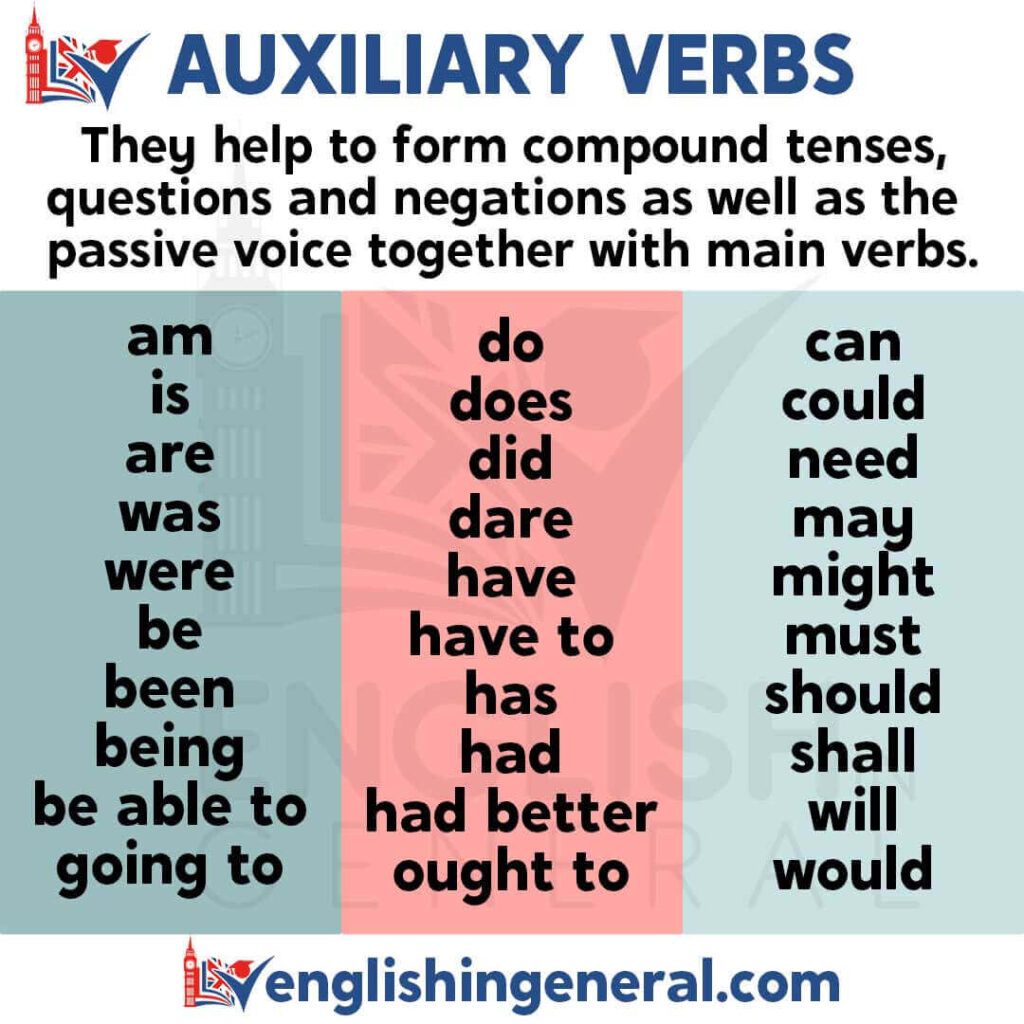
Understanding the intricacies of English grammar can be both fascinating and challenging. One of the fundamental aspects of grammar is the list of helping verbs, also known as auxiliary verbs. These verbs play a crucial role in forming various tenses, voices, and moods in sentences. This post will delve into the world of helping verbs, exploring their types, functions, and importance in English grammar.
What Are Helping Verbs?
Helping verbs, or auxiliary verbs, are verbs that assist the main verb in a sentence by providing additional information about the action, such as tense, voice, or modality. They are essential for constructing complex sentences and conveying nuanced meanings. The primary helping verbs in English include:
- Be
- Do
- Have
- Will
- Shall
- May
- Might
- Must
- Can
- Could
- Would
- Should
Types of Helping Verbs
Helping verbs can be categorized into several types based on their functions. Understanding these categories can help in mastering their usage.
Primary Helping Verbs
The primary helping verbs are be, do, and have. These verbs are used to form various tenses and aspects.
- Be: Used to form continuous tenses and passive voice. Examples include "is," "am," "are," "was," and "were."
- Do: Used to form simple present and past tenses, as well as questions and negatives. Examples include "do," "does," and "did."
- Have: Used to form perfect tenses. Examples include "have," "has," and "had."
Modal Helping Verbs
Modal helping verbs express modality, which includes possibility, probability, permission, obligation, and ability. The modal verbs are:
- Can: Expresses ability or possibility.
- Could: Expresses past ability, possibility, or polite requests.
- May: Expresses possibility or permission.
- Might: Expresses possibility or polite requests.
- Must: Expresses obligation or strong probability.
- Shall: Expresses future tense or formal offers.
- Should: Expresses advice, obligation, or expectation.
- Will: Expresses future tense or willingness.
- Would: Expresses past habit, polite requests, or hypothetical situations.
Functions of Helping Verbs
Helping verbs serve various functions in a sentence. They help to form different tenses, voices, and moods, making the language more expressive and nuanced.
Forming Tenses
Helping verbs are essential for forming different tenses in English. Here are some examples:
- Present Continuous: "She is reading a book."
- Past Perfect: "He had finished his homework before dinner."
- Future Simple: "They will arrive tomorrow."
Forming Passive Voice
Helping verbs are used to form the passive voice, where the subject receives the action. For example:
- Present Passive: "The cake is being baked by her."
- Past Passive: "The letter was written by him."
Forming Questions and Negatives
Helping verbs are crucial for forming questions and negatives. For example:
- Question: "Do you like coffee?"
- Negative: "She does not want to go."
Importance of Helping Verbs
Helping verbs are indispensable in English grammar. They provide the necessary structure and context for sentences, making communication clear and precise. Without helping verbs, it would be challenging to express complex ideas and nuances in language.
For example, consider the sentence "She has been studying for hours." Without the helping verbs "has" and "been," the sentence would lose its temporal context and aspect, making it less informative.
Common Mistakes with Helping Verbs
Despite their importance, helping verbs can be tricky to use correctly. Here are some common mistakes to avoid:
- Incorrect Tense: Using the wrong helping verb for the intended tense. For example, "She has went to the store" should be "She has gone to the store."
- Misuse of Modals: Using modal verbs incorrectly. For example, "He can to swim" should be "He can swim."
- Omission of Helping Verbs: Forgetting to include necessary helping verbs. For example, "She reading a book" should be "She is reading a book."
📝 Note: Paying attention to the context and the main verb in the sentence can help avoid these common mistakes.
Practice Exercises
To master the use of helping verbs, practice is essential. Here are some exercises to help you improve:
Fill in the Blanks
Complete the following sentences with the correct helping verbs:
| Sentence | Correct Helping Verb |
|---|---|
| She ______ going to the market. | is |
| They ______ finished their project. | have |
| He ______ to the store yesterday. | went |
| We ______ to the beach next weekend. | will |
Correct the Sentences
Identify and correct the mistakes in the following sentences:
- She has went to the store.
- He can to swim.
- They are going to the park yesterday.
- We will to visit our grandparents.
📝 Note: Reviewing the corrected sentences can help reinforce the correct usage of helping verbs.
Mastering the list of helping verbs is a crucial step in improving your English grammar skills. By understanding their types, functions, and importance, you can enhance your ability to communicate effectively and express complex ideas with clarity and precision. With practice and attention to detail, you can avoid common mistakes and use helping verbs confidently in your writing and speaking.
Related Terms:
- is can a helping verb
- is being a helping verb
- list all the helping verbs
- is helping verb
- 23 helping verbs list
- list of helping verbs printable