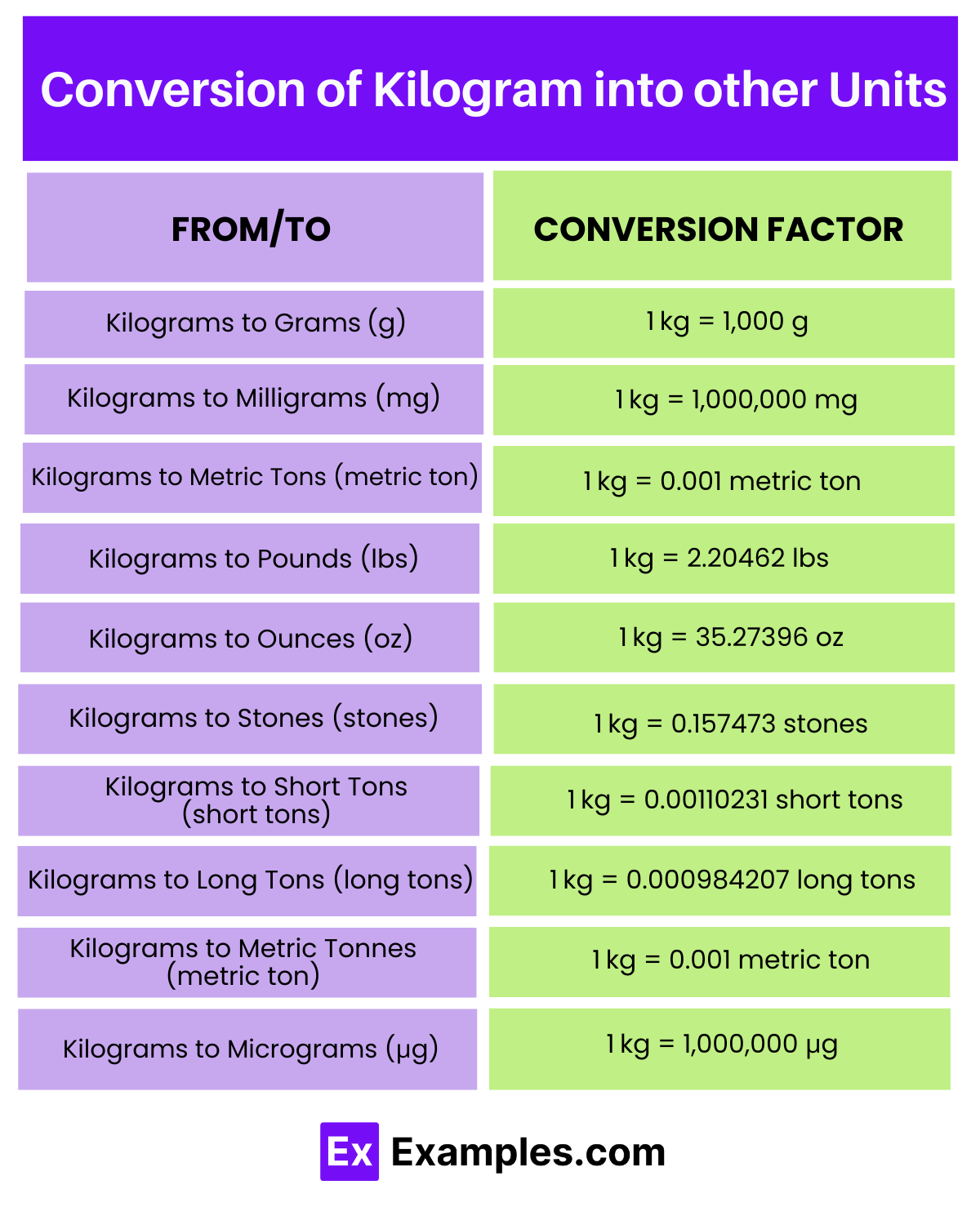
Understanding the conversion between kilograms (kg) and liters (L) is crucial in various fields, including chemistry, cooking, and everyday measurements. While these units measure different quantities—mass and volume, respectively—they often need to be interconverted for practical purposes. This guide will delve into the intricacies of converting kg in L, providing a comprehensive overview of the process, its applications, and the underlying principles.
Understanding Kilograms and Liters
Before diving into the conversion process, it is essential to understand what kilograms and liters represent.
Kilograms (kg) are a unit of mass in the International System of Units (SI). One kilogram is equivalent to 1,000 grams. Mass is a measure of the amount of matter in an object and is distinct from weight, which is the force exerted by gravity on an object.
Liters (L) are a unit of volume in the metric system. One liter is equivalent to 1,000 milliliters or 1 cubic decimeter. Volume is a measure of the three-dimensional space occupied by an object or substance.
The Relationship Between Mass and Volume
The relationship between mass and volume is governed by density, which is defined as mass per unit volume. The formula for density (ρ) is:
ρ = m / V
where:
- ρ is the density
- m is the mass
- V is the volume
Density is a crucial factor in converting kg in L because it varies for different substances. For example, the density of water is approximately 1 kg/L at room temperature, meaning 1 liter of water weighs about 1 kilogram. However, other substances have different densities, which must be considered during conversion.
Converting Kilograms to Liters
To convert kilograms to liters, you need to know the density of the substance in question. The general formula for converting mass to volume is:
V = m / ρ
where:
- V is the volume in liters
- m is the mass in kilograms
- ρ is the density in kg/L
Here is a step-by-step guide to converting kg in L:
- Identify the mass in kilograms (m).
- Determine the density of the substance in kg/L (ρ).
- Use the formula V = m / ρ to calculate the volume in liters.
📝 Note: Ensure that the units are consistent. If the density is given in different units, convert it to kg/L before performing the calculation.
Examples of Converting Kilograms to Liters
Let's consider a few examples to illustrate the conversion process.
Example 1: Converting Kilograms of Water to Liters
The density of water is approximately 1 kg/L. If you have 5 kg of water, the volume in liters can be calculated as follows:
V = m / ρ
V = 5 kg / 1 kg/L
V = 5 L
Therefore, 5 kg of water is equivalent to 5 liters.
Example 2: Converting Kilograms of Oil to Liters
The density of oil varies, but let's assume it is 0.85 kg/L. If you have 10 kg of oil, the volume in liters can be calculated as follows:
V = m / ρ
V = 10 kg / 0.85 kg/L
V ≈ 11.76 L
Therefore, 10 kg of oil is approximately 11.76 liters.
Example 3: Converting Kilograms of Mercury to Liters
The density of mercury is approximately 13.5 kg/L. If you have 20 kg of mercury, the volume in liters can be calculated as follows:
V = m / ρ
V = 20 kg / 13.5 kg/L
V ≈ 1.48 L
Therefore, 20 kg of mercury is approximately 1.48 liters.
Converting Liters to Kilograms
Conversely, to convert liters to kilograms, you can use the formula:
m = V * ρ
where:
- m is the mass in kilograms
- V is the volume in liters
- ρ is the density in kg/L
Here is a step-by-step guide to converting liters to kilograms:
- Identify the volume in liters (V).
- Determine the density of the substance in kg/L (ρ).
- Use the formula m = V * ρ to calculate the mass in kilograms.
📝 Note: Ensure that the units are consistent. If the density is given in different units, convert it to kg/L before performing the calculation.
Examples of Converting Liters to Kilograms
Let's consider a few examples to illustrate the conversion process.
Example 1: Converting Liters of Water to Kilograms
The density of water is approximately 1 kg/L. If you have 5 liters of water, the mass in kilograms can be calculated as follows:
m = V * ρ
m = 5 L * 1 kg/L
m = 5 kg
Therefore, 5 liters of water is equivalent to 5 kilograms.
Example 2: Converting Liters of Oil to Kilograms
The density of oil varies, but let's assume it is 0.85 kg/L. If you have 10 liters of oil, the mass in kilograms can be calculated as follows:
m = V * ρ
m = 10 L * 0.85 kg/L
m = 8.5 kg
Therefore, 10 liters of oil is equivalent to 8.5 kilograms.
Example 3: Converting Liters of Mercury to Kilograms
The density of mercury is approximately 13.5 kg/L. If you have 2 liters of mercury, the mass in kilograms can be calculated as follows:
m = V * ρ
m = 2 L * 13.5 kg/L
m = 27 kg
Therefore, 2 liters of mercury is equivalent to 27 kilograms.
Applications of Kilograms to Liters Conversion
The conversion between kg in L is essential in various fields, including:
- Chemistry: In chemical reactions, the mass of reactants and products is often measured in kilograms, while volumes are measured in liters. Accurate conversions are crucial for stoichiometric calculations.
- Cooking: Recipes often specify ingredients by weight (kilograms) or volume (liters). Converting between these units ensures precise measurements and consistent results.
- Industrial Processes: In manufacturing and industrial settings, materials are often measured by weight or volume. Accurate conversions are necessary for inventory management, quality control, and process optimization.
- Environmental Science: In environmental studies, the concentration of pollutants is often measured in kilograms per liter. Accurate conversions are essential for assessing environmental impact and compliance with regulations.
Common Densities of Substances
Here is a table of common densities for various substances, which can be useful for quick conversions:
| Substance | Density (kg/L) |
|---|---|
| Water | 1 |
| Milk | 1.03 |
| Gasoline | 0.75 |
| Diesel | 0.83 |
| Mercury | 13.5 |
| Alcohol (Ethanol) | 0.79 |
| Honey | 1.36 |
| Olive Oil | 0.92 |
| Air (at room temperature) | 0.0012 |
📝 Note: Densities can vary based on temperature and pressure. The values provided are approximate and may differ under different conditions.
Practical Tips for Accurate Conversions
To ensure accurate conversions between kg in L, consider the following tips:
- Use Reliable Density Values: Always use accurate and up-to-date density values for the substances you are working with. Densities can vary based on temperature, pressure, and purity.
- Consistent Units: Ensure that all units are consistent throughout the conversion process. Convert all measurements to the same unit system (e.g., SI units) before performing calculations.
- Double-Check Calculations: Verify your calculations to avoid errors. Use calculators or software tools designed for unit conversions to minimize mistakes.
- Consider Temperature and Pressure: For substances sensitive to temperature and pressure changes, account for these factors when determining density. Use appropriate correction factors if necessary.
- Use Conversion Tables: Refer to conversion tables or charts for quick and accurate conversions. These resources can save time and reduce the risk of errors.
Understanding the conversion between kg in L is fundamental in various scientific, industrial, and everyday applications. By mastering the principles and techniques outlined in this guide, you can accurately convert between mass and volume, ensuring precise measurements and reliable results. Whether you are a chemist, a cook, or an engineer, the ability to convert kg in L is an invaluable skill that enhances your proficiency and accuracy in your field.
Related Terms:
- 1 kilograms to liters
- 1 kg equal to litre
- kg in litre
- 1 kg equals liter
- 1.5 kg in litres
- kg to l in inches