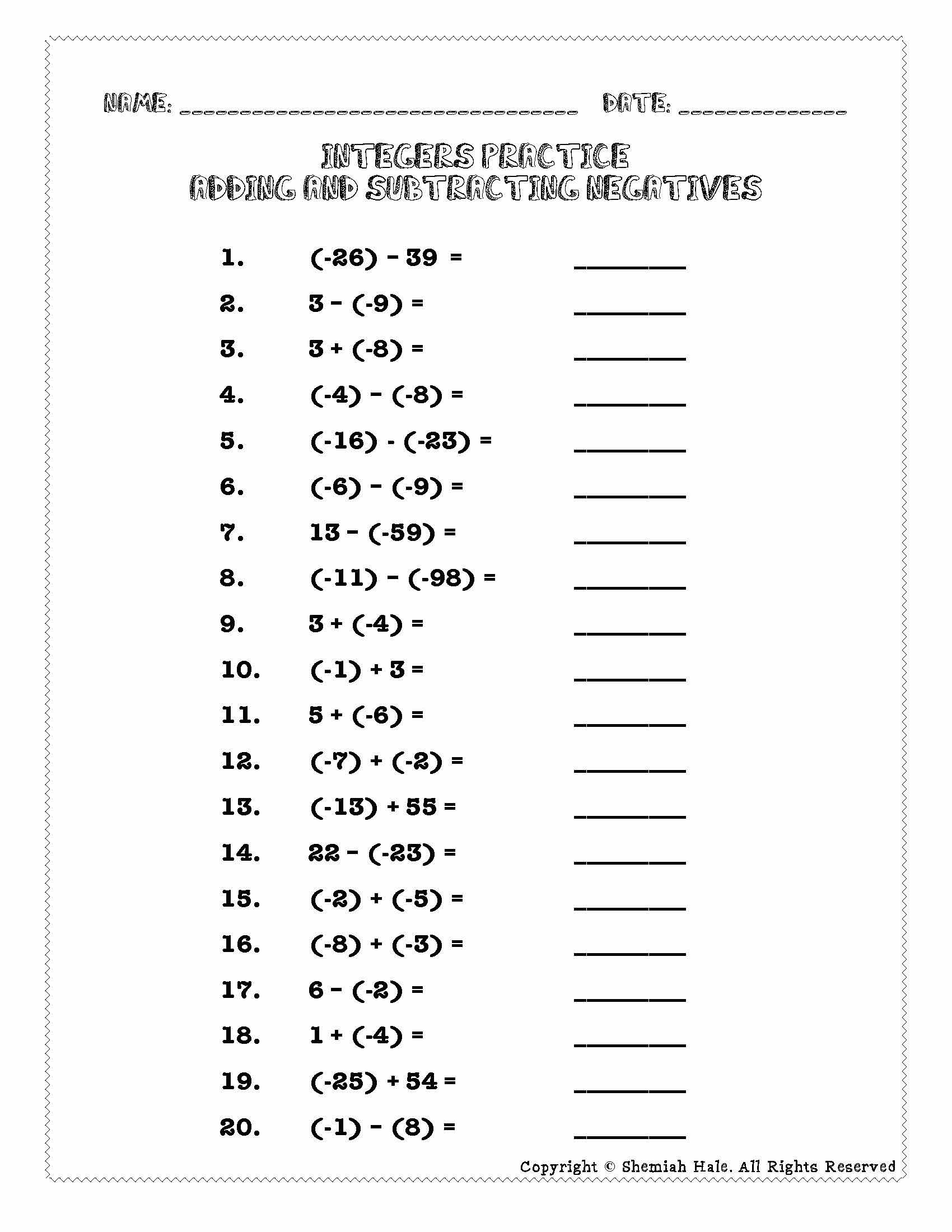
Mathematics is a fundamental discipline that underpins many aspects of our daily lives and scientific endeavors. One of the most basic concepts in mathematics is the understanding of integers. Integers are whole numbers that can be positive, negative, or zero. A common question that arises in discussions about integers is, "Is 1 an integer?" The answer to this question is straightforward: yes, 1 is indeed an integer. This blog post will delve into the properties of integers, the significance of the number 1, and various applications of integers in different fields.
Understanding Integers
Integers are a set of numbers that include all positive whole numbers, their negatives, and zero. They are denoted by the symbol Z and can be represented as:
Z = {…, -3, -2, -1, 0, 1, 2, 3, …}
Integers are essential in mathematics because they form the basis for more complex number systems, such as rational and irrational numbers. They are used in various mathematical operations, including addition, subtraction, multiplication, and division.
Properties of Integers
Integers possess several key properties that make them unique and useful in mathematical calculations. Some of these properties include:
- Closure Property: The sum, difference, and product of any two integers is also an integer.
- Commutative Property: Changing the order of integers in addition or multiplication does not change the result.
- Associative Property: The way in which integers are grouped in addition or multiplication does not change the result.
- Distributive Property: Multiplication distributes over addition.
- Identity Property: There exists an integer (0 for addition and 1 for multiplication) that, when combined with any integer, leaves that integer unchanged.
- Inverse Property: For every integer, there is an additive inverse (a number that, when added to the original number, results in zero).
Is 1 an Integer?
The question “Is 1 an integer?” is often asked by those new to the study of mathematics. The answer is yes, 1 is an integer. In fact, 1 is the smallest positive integer and plays a crucial role in various mathematical concepts. For example, 1 is the multiplicative identity, meaning that any number multiplied by 1 remains unchanged. This property is fundamental in algebra and number theory.
Significance of the Number 1
The number 1 holds a special place in mathematics and beyond. Here are some reasons why 1 is significant:
- Multiplicative Identity: As mentioned earlier, 1 is the multiplicative identity. This means that for any integer a, a × 1 = a.
- Base of the Decimal System: The decimal system, which is the most commonly used number system, is based on powers of 10. However, the concept of “one” is fundamental to understanding place values and the structure of the decimal system.
- Unit of Measurement: In many scientific and engineering contexts, 1 is used as a unit of measurement. For example, 1 meter is the standard unit of length in the metric system.
- Logical Foundation: In logic and computer science, 1 is often used to represent true or on, while 0 represents false or off. This binary system is the foundation of digital electronics.
Applications of Integers
Integers are used in a wide range of fields, from pure mathematics to applied sciences and engineering. Some of the key applications of integers include:
- Computer Science: Integers are fundamental to programming and data structures. They are used to represent data types, indices, and various algorithms.
- Cryptography: Integers play a crucial role in cryptographic algorithms, which are used to secure data and communications. For example, the RSA encryption algorithm relies on the properties of large integers.
- Physics: Integers are used to represent discrete quantities, such as the number of particles or the quantum states of a system.
- Economics: Integers are used to represent quantities of goods, prices, and other economic variables. They are essential in financial modeling and economic analysis.
Integers in Everyday Life
Integers are not just confined to academic and scientific contexts; they are also integral to our everyday lives. Here are some examples of how integers are used in daily activities:
- Counting: Integers are used for counting objects, such as the number of apples in a basket or the number of people in a room.
- Timekeeping: Integers are used to measure time, such as the number of hours in a day or the number of seconds in a minute.
- Money: Integers are used to represent monetary values, such as the number of dollars or cents in a transaction.
- Measurement: Integers are used to measure lengths, weights, and other physical quantities. For example, 1 meter is a standard unit of length.
Special Types of Integers
In addition to the basic set of integers, there are several special types of integers that have unique properties and applications. Some of these include:
- Prime Numbers: Prime numbers are integers greater than 1 that have no divisors other than 1 and themselves. Examples include 2, 3, 5, 7, and 11.
- Composite Numbers: Composite numbers are integers that have more than two factors. Examples include 4, 6, 8, 9, and 10.
- Even and Odd Numbers: Even numbers are integers that are divisible by 2, while odd numbers are integers that are not divisible by 2.
- Perfect Numbers: Perfect numbers are integers that are equal to the sum of their proper divisors. The smallest perfect number is 6, as 1 + 2 + 3 = 6.
Integers in Programming
Integers are a fundamental data type in programming. They are used to represent whole numbers and are essential for various operations and algorithms. Here is a simple example of how integers are used in a programming language like Python:
In Python, you can define an integer variable and perform various operations on it. For example:
x = 1


y = x + 2  # Addition
z = x * 3  # Multiplication


print(“x + 2 =”, y)
print(“x * 3 =”, z)
In this example, the variable x is assigned the value 1, which is an integer. The program then performs addition and multiplication operations on x and prints the results.
💡 Note: Integers in programming are often represented using different data types, such as int in Python or int32 in C++. The specific data type used can affect the range and precision of the integer values.
Integers in Cryptography
Cryptography is the science of securing information by transforming it into an unreadable format. Integers play a crucial role in many cryptographic algorithms. One of the most well-known cryptographic algorithms is the RSA algorithm, which relies on the properties of large integers. Here is a brief overview of how integers are used in the RSA algorithm:
- Key Generation: The RSA algorithm generates a pair of keys (public and private) using large prime numbers. These keys are used to encrypt and decrypt messages.
- Encryption: The public key is used to encrypt a message, transforming it into an unreadable format. The encrypted message can only be decrypted using the corresponding private key.
- Decryption: The private key is used to decrypt the message, transforming it back into its original readable format.
Integers are essential in the RSA algorithm because they provide the mathematical foundation for generating keys and performing encryption and decryption operations.
Integers in Physics
In physics, integers are used to represent discrete quantities and states. For example, in quantum mechanics, integers are used to represent the quantum numbers that describe the state of a particle. Here are some examples of how integers are used in physics:
- Quantum Numbers: Quantum numbers are integers that describe the state of a particle in a quantum system. They include the principal quantum number, angular momentum quantum number, magnetic quantum number, and spin quantum number.
- Particle Counting: Integers are used to count the number of particles in a system, such as the number of electrons in an atom or the number of photons in a beam of light.
- Discrete Energy Levels: Integers are used to represent the discrete energy levels of a system, such as the energy levels of an electron in an atom.
Integers are essential in physics because they provide a precise and unambiguous way to represent discrete quantities and states.
Integers in Economics
In economics, integers are used to represent quantities of goods, prices, and other economic variables. They are essential in financial modeling and economic analysis. Here are some examples of how integers are used in economics:
- Quantity of Goods: Integers are used to represent the quantity of goods produced, consumed, or traded. For example, the number of units of a product sold in a month.
- Prices: Integers are used to represent the prices of goods and services. For example, the price of a stock or the cost of a product.
- Economic Indicators: Integers are used to represent economic indicators, such as the unemployment rate or the gross domestic product (GDP).
Integers are essential in economics because they provide a precise and unambiguous way to represent economic variables and perform calculations.
Integers are a fundamental concept in mathematics and have wide-ranging applications in various fields. Understanding the properties and significance of integers, including the fact that 1 is indeed an integer, is crucial for anyone studying mathematics or applying mathematical principles in their work. Whether in computer science, cryptography, physics, economics, or everyday life, integers play a vital role in our understanding of the world around us.
Related Terms:
- is 0 a positive integer
- is 0 an integer
- is 1 a positive integer
- is 2 an integer
- what is an integer example
- is 1 an integer number