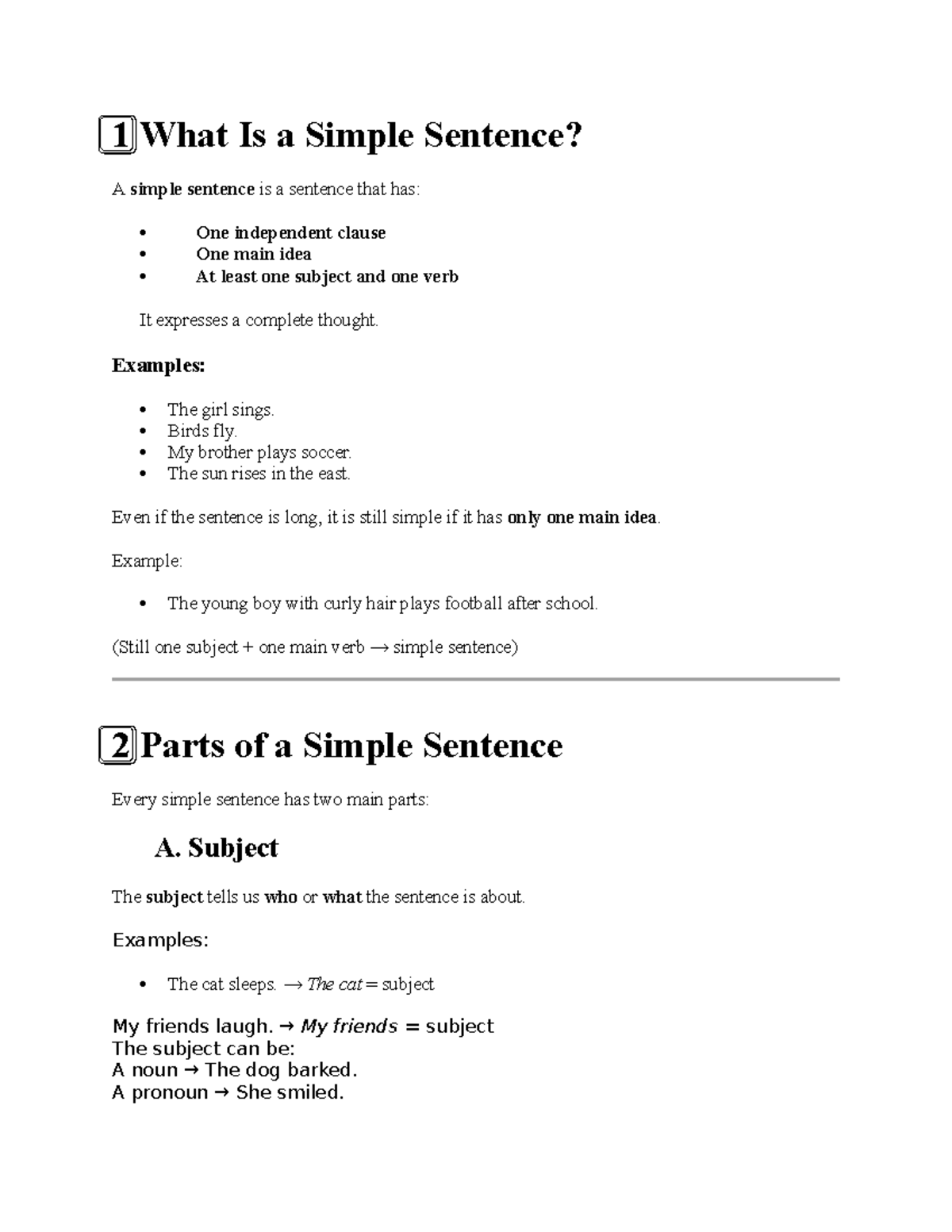
Understanding the structure of sentences is fundamental to mastering the English language. One of the key components of sentence structure is the independent clause. Independent clauses are essential building blocks that can stand alone as complete sentences. This post will delve into the intricacies of independent clauses, providing numerous independent clauses examples to illustrate their usage and importance.
What is an Independent Clause?
An independent clause is a group of words that contains both a subject and a predicate and can express a complete thought. Unlike dependent clauses, which rely on independent clauses to form a complete sentence, independent clauses can stand alone. For example, consider the sentence: "She went to the store." This sentence is a single independent clause because it has a subject ("She") and a predicate ("went to the store") and expresses a complete thought.
Identifying Independent Clauses
To identify independent clauses, look for the following elements:
- Subject: The person, place, thing, or idea that the sentence is about.
- Predicate: The verb or verb phrase that tells something about the subject.
- Complete Thought: The clause must express a complete idea that can stand alone.
For example, in the sentence "The cat chased the mouse," "The cat" is the subject, "chased the mouse" is the predicate, and the entire clause expresses a complete thought.
Independent Clauses Examples
Let's explore some independent clauses examples to better understand their structure and usage:
- "She reads books every night."
- "The dog barked loudly."
- "They will arrive soon."
- "We went to the park."
- "He enjoys playing soccer."
Each of these examples is a complete sentence that can stand alone because it contains a subject, a predicate, and expresses a complete thought.
Combining Independent Clauses
Independent clauses can be combined to form compound and complex sentences. Understanding how to combine these clauses effectively can enhance your writing and communication skills.
Compound Sentences
A compound sentence consists of two or more independent clauses joined by a coordinating conjunction (for, and, nor, but, or, yet, so). For example:
- "She went to the store, and she bought some groceries."
- "He studied hard, but he did not pass the exam."
- "They will arrive soon, so we should start preparing."
In each of these examples, two independent clauses are combined using a coordinating conjunction.
Complex Sentences
A complex sentence contains one independent clause and at least one dependent clause. The dependent clause cannot stand alone as a complete sentence. For example:
- "Although it was raining, she went to the park."
- "Because he was tired, he went to bed early."
- "If you study hard, you will pass the exam."
In these examples, the dependent clauses ("Although it was raining," "Because he was tired," "If you study hard") cannot stand alone, but they are combined with independent clauses to form complete sentences.
Punctuation with Independent Clauses
Proper punctuation is crucial when working with independent clauses. Here are some guidelines:
- Period: Use a period to separate two independent clauses when they are written as separate sentences. For example, "She went to the store. He bought some groceries."
- Comma and Coordinating Conjunction: Use a comma followed by a coordinating conjunction to join two independent clauses. For example, "She went to the store, and he bought some groceries."
- Semicolon: Use a semicolon to join two closely related independent clauses. For example, "She went to the store; he bought some groceries."
Correct punctuation ensures that your sentences are clear and easy to understand.
Common Mistakes with Independent Clauses
When working with independent clauses, it's easy to make mistakes. Here are some common errors to avoid:
- Fragments: Avoid writing sentence fragments, which are incomplete sentences. For example, "She went to the store, bought some groceries." This sentence is a fragment because it lacks a complete thought.
- Run-on Sentences: Avoid run-on sentences, which occur when two or more independent clauses are joined without proper punctuation. For example, "She went to the store he bought some groceries." This sentence is a run-on because it lacks the necessary punctuation to separate the clauses.
- Comma Splits: Avoid using a comma to split an independent clause incorrectly. For example, "She went to the store, and bought some groceries." This sentence is incorrect because the comma should not split the independent clause.
By being aware of these common mistakes, you can improve your sentence structure and clarity.
📝 Note: Always proofread your writing to ensure that your independent clauses are correctly structured and punctuated.
Practical Applications of Independent Clauses
Understanding and using independent clauses effectively can enhance various aspects of your writing and communication. Here are some practical applications:
- Essay Writing: Independent clauses help in constructing clear and coherent paragraphs. Each paragraph should contain at least one independent clause to express a complete thought.
- Business Communication: Clear and concise sentences are essential in business communication. Using independent clauses ensures that your messages are easily understood.
- Creative Writing: Independent clauses can be used to create varied sentence structures, making your writing more engaging and dynamic.
- Academic Writing: In academic writing, independent clauses help in presenting arguments and evidence clearly and logically.
By mastering the use of independent clauses, you can improve the quality and effectiveness of your writing in various contexts.
Advanced Techniques with Independent Clauses
Once you are comfortable with the basics of independent clauses, you can explore more advanced techniques to enhance your writing. Here are some advanced strategies:
- Parallel Structure: Use parallel structure to create balanced and rhythmic sentences. For example, "She likes to read, to write, and to paint."
- Inverted Sentences: Invert the subject and predicate to create emphasis or variety. For example, "To the store she went, and groceries she bought."
- Ellipsis: Use ellipsis to omit repeated words or phrases in a series of independent clauses. For example, "She went to the store, he to the park, and they to the beach."
These advanced techniques can add depth and sophistication to your writing.
Here is a table summarizing the different types of sentences and their structures:
| Type of Sentence | Structure | Example |
|---|---|---|
| Simple Sentence | One independent clause | She went to the store. |
| Compound Sentence | Two or more independent clauses joined by a coordinating conjunction | She went to the store, and he bought some groceries. |
| Complex Sentence | One independent clause and at least one dependent clause | Although it was raining, she went to the park. |
| Compound-Complex Sentence | Two or more independent clauses and at least one dependent clause | Although it was raining, she went to the park, and he stayed home. |
Understanding these structures can help you create a variety of sentence types in your writing.
Mastering the use of independent clauses is a fundamental skill that can significantly enhance your writing and communication abilities. By understanding the structure and usage of independent clauses, you can create clear, concise, and engaging sentences that effectively convey your ideas. Whether you are writing essays, business reports, or creative stories, the ability to use independent clauses correctly is essential for success.
Related Terms:
- examples of dependent clauses
- dependent clause
- example of two independent clauses
- independent and dependent clauses examples
- example of a independent clause
- 10 example of independent clause