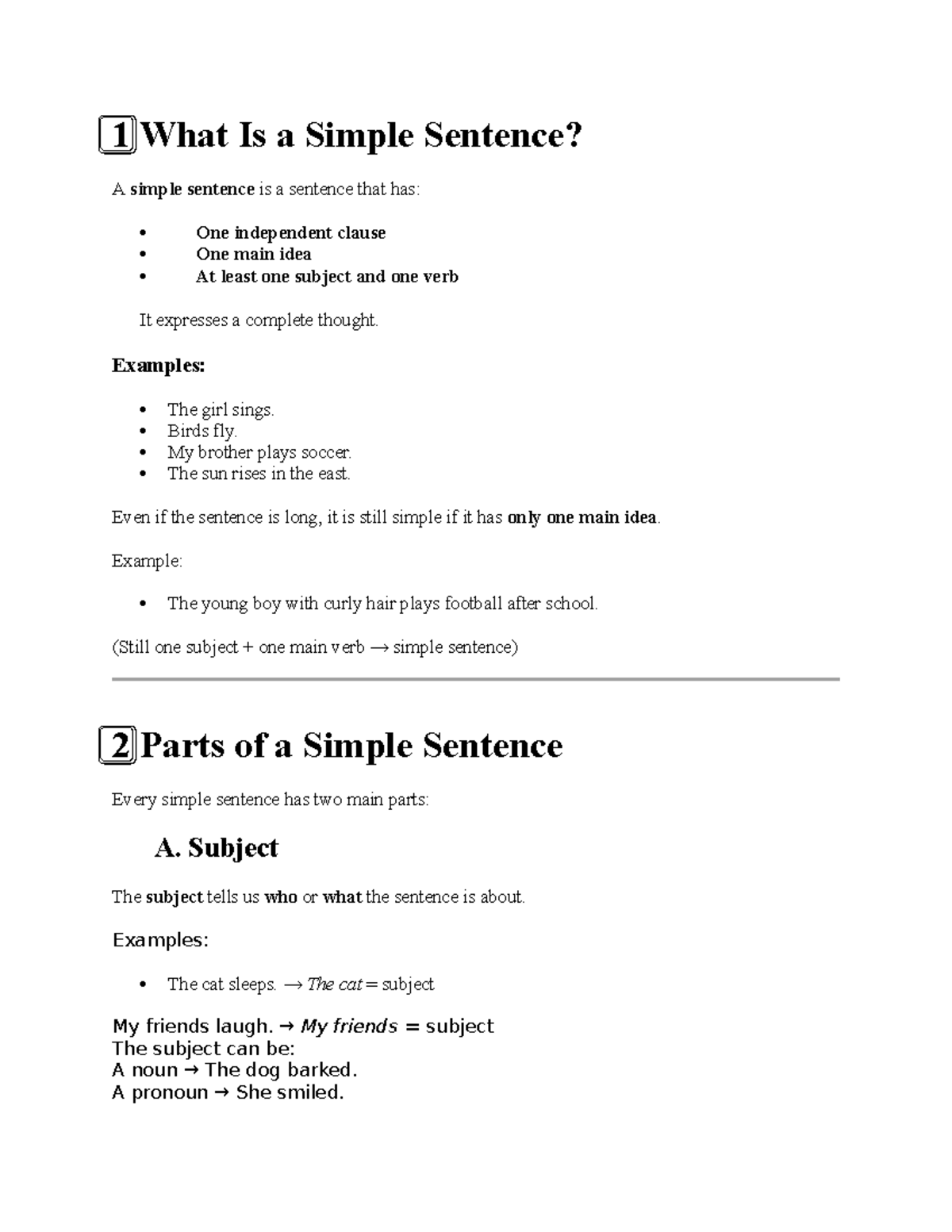
Understanding the structure of sentences is fundamental to mastering the English language. One of the key components of sentence structure is the independent clause. Independent clauses are essential building blocks that can stand alone as complete sentences. This post will delve into the intricacies of independent clauses, providing numerous independent clause examples to illustrate their usage and importance.
What is an Independent Clause?
An independent clause is a group of words that contains both a subject and a predicate and can express a complete thought. Unlike dependent clauses, which rely on independent clauses to form a complete sentence, independent clauses can stand alone. They are the backbone of any sentence, providing the main idea or action.
Identifying Independent Clauses
To identify an independent clause, look for the following elements:
- A subject: This is the noun or pronoun that performs the action.
- A predicate: This includes the verb and provides information about the subject’s action or state.
- A complete thought: The clause should convey a full idea that can stand on its own.
For example, consider the sentence: “She walked to the store.” Here, “She” is the subject, “walked to the store” is the predicate, and the sentence conveys a complete thought.
Independent Clause Examples
Let’s explore some independent clause examples to better understand their structure and usage:
- “The cat chased the mouse.”
- “He will arrive at the airport tomorrow.”
- “They enjoyed the concert.”
- “She reads books every night.”
- “We went to the park.”
Each of these examples is a complete sentence that can stand alone. They all contain a subject and a predicate, expressing a full thought.
Combining Independent Clauses
Independent clauses can be combined to form compound and complex sentences. Understanding how to combine these clauses effectively can enhance your writing and communication skills.
Compound Sentences
A compound sentence consists of two or more independent clauses joined by a coordinating conjunction (for, and, nor, but, or, yet, so). For example:
- “She studied hard, and she passed the exam.”
- “He wanted to go to the beach, but it started to rain.”
- “They arrived early, so they got the best seats.”
In each of these examples, two independent clauses are connected by a coordinating conjunction, forming a compound sentence.
Complex Sentences
A complex sentence contains one independent clause and at least one dependent clause. The dependent clause cannot stand alone as a complete sentence. For example:
- “Because it was raining, we stayed indoors.”
- “She will call you when she arrives.”
- “Although he was tired, he finished his work.”
In these examples, the dependent clauses (“Because it was raining,” “when she arrives,” “Although he was tired”) rely on the independent clauses to form complete sentences.
Punctuation with Independent Clauses
Proper punctuation is crucial when working with independent clauses, especially when combining them into compound or complex sentences. Here are some guidelines:
- Use a comma before a coordinating conjunction when joining two independent clauses: “She studied hard, and she passed the exam.”
- Use a comma after a dependent clause that introduces an independent clause: “Because it was raining, we stayed indoors.”
- Do not use a comma between two independent clauses joined by a semicolon: “She studied hard; she passed the exam.”
Common Mistakes with Independent Clauses
Even experienced writers can make mistakes when dealing with independent clauses. Here are some common errors to avoid:
- Fragments: Ensure that each independent clause expresses a complete thought. Avoid sentence fragments that lack a subject or predicate.
- Run-on sentences: Be cautious of run-on sentences, which occur when two or more independent clauses are joined without proper punctuation. For example: “She studied hard she passed the exam.”
- Comma splices: Avoid comma splices, which occur when a comma is used to join two independent clauses without a coordinating conjunction. For example: “She studied hard, she passed the exam.”
📝 Note: To avoid these mistakes, always ensure that each independent clause can stand alone as a complete sentence and use appropriate punctuation when combining clauses.
Practical Applications of Independent Clauses
Understanding and correctly using independent clauses is essential in various contexts, including academic writing, professional communication, and creative writing. Here are some practical applications:
- Academic Writing: In essays and research papers, independent clauses help structure arguments and present information clearly.
- Professional Communication: In emails, reports, and presentations, independent clauses ensure that your messages are concise and easy to understand.
- Creative Writing: In fiction and poetry, independent clauses can be used to create rhythm, vary sentence structure, and enhance storytelling.
Exercises to Improve Understanding
To improve your understanding of independent clauses, try the following exercises:
- Identify the independent clauses in a paragraph from a book or article.
- Write a paragraph using only independent clauses.
- Combine independent clauses to form compound and complex sentences.
- Edit sentences to correct common mistakes related to independent clauses.
By practicing these exercises, you can enhance your ability to recognize and use independent clauses effectively.
Advanced Techniques with Independent Clauses
Once you are comfortable with the basics of independent clauses, you can explore advanced techniques to elevate your writing. These techniques include:
- Using varied sentence structures to create a dynamic rhythm in your writing.
- Employing transitional phrases to connect independent clauses smoothly.
- Incorporating dependent clauses to add depth and complexity to your sentences.
For example, consider the following sentence: "Although she was exhausted, she continued to work on her project, determined to finish it before the deadline." This sentence combines an independent clause with a dependent clause and a transitional phrase, creating a rich and engaging structure.
Conclusion
Independent clauses are the foundation of effective communication and writing. By understanding their structure and usage, you can create clear, concise, and engaging sentences. Whether you are writing academically, professionally, or creatively, mastering independent clauses will enhance your ability to convey your ideas effectively. Practice identifying and combining independent clauses to improve your language skills and become a more confident writer.
Related Terms:
- two independent clause examples
- independent clause examples sentence
- noun clause examples
- independent clause and dependent examples
- dependent clause definition
- independent clause meaning