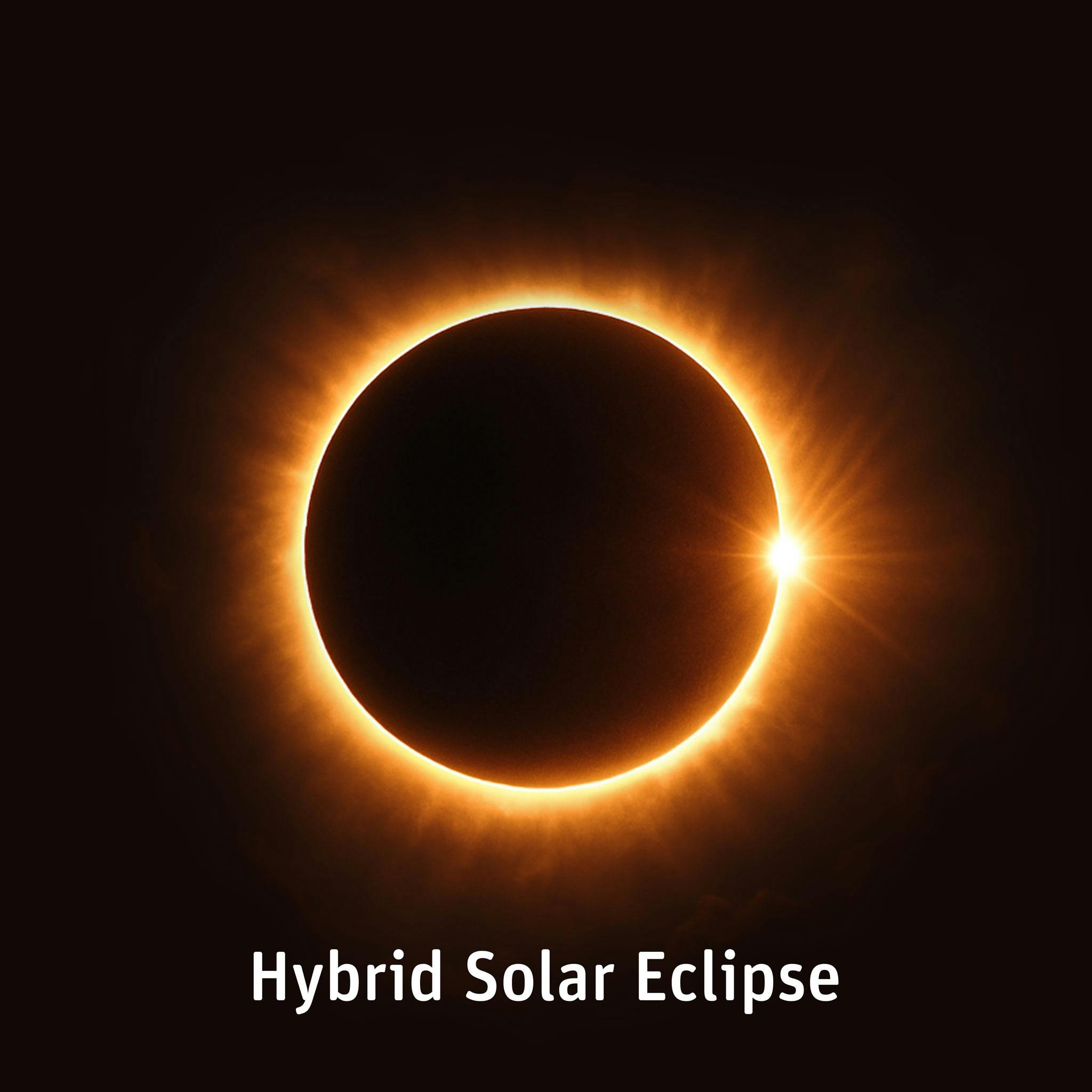
Witnessing a celestial event is always a thrilling experience, and one of the most captivating phenomena is a Hybrid Solar Eclipse. This rare occurrence combines elements of both a total and an annular solar eclipse, making it a unique and awe-inspiring sight. Understanding the intricacies of a Hybrid Solar Eclipse involves delving into the science behind eclipses, the different types, and the specific conditions that make this event so extraordinary.
Understanding Solar Eclipses
A solar eclipse occurs when the Moon passes between the Sun and Earth, casting a shadow on the Earth's surface. There are three main types of solar eclipses: total, partial, and annular. Each type offers a different viewing experience and has distinct characteristics.
Total Solar Eclipse
A total solar eclipse happens when the Moon completely covers the Sun's disk, revealing the Sun's corona—the outer atmosphere. This type of eclipse is visible from a narrow path on Earth's surface, known as the path of totality. During totality, the sky darkens, and stars may become visible. It is a breathtaking experience that draws astronomers and enthusiasts from around the world.
Annular Solar Eclipse
An annular solar eclipse occurs when the Moon is too far away from Earth to completely cover the Sun. As a result, a ring of sunlight, known as an annulus, remains visible around the Moon. This type of eclipse is also visible from a specific path on Earth, but the Sun's corona is not visible. Instead, viewers see a bright ring of light surrounding the Moon.
Partial Solar Eclipse
A partial solar eclipse happens when only a part of the Sun is obscured by the Moon. This type of eclipse can be seen from a broader area on Earth and does not require viewers to be in a specific path. However, it is less dramatic than total or annular eclipses.
The Unique Nature of a Hybrid Solar Eclipse
A Hybrid Solar Eclipse is a rare and fascinating event that combines elements of both total and annular eclipses. This phenomenon occurs when the curvature of the Earth causes the eclipse to transition from annular to total or vice versa along its path. The specific conditions that lead to a Hybrid Solar Eclipse make it a unique and highly anticipated event for astronomers and eclipse chasers.
Conditions for a Hybrid Solar Eclipse
Several factors contribute to the occurrence of a Hybrid Solar Eclipse:
- The distance between the Earth and the Moon: The Moon's orbit around Earth is elliptical, meaning its distance from Earth varies. When the Moon is at its farthest point (apogee), it appears smaller in the sky, leading to an annular eclipse. Conversely, when the Moon is at its closest point (perigee), it appears larger, resulting in a total eclipse.
- The curvature of the Earth: The Earth's curvature can cause the eclipse to transition from annular to total or vice versa along its path. This happens because the angle at which the Moon's shadow hits the Earth's surface changes as it moves across the globe.
- The alignment of the Sun, Moon, and Earth: For a solar eclipse to occur, the Sun, Moon, and Earth must be aligned in a straight line. The specific alignment determines whether the eclipse will be total, annular, or hybrid.
Viewing a Hybrid Solar Eclipse
Watching a Hybrid Solar Eclipse is an unforgettable experience, but it requires careful planning and preparation. Here are some tips for viewing this rare event:
Safety Precautions
Viewing a solar eclipse directly can be dangerous for your eyes. Always use proper eye protection, such as eclipse glasses or a solar filter for your telescope or binoculars. Never look directly at the Sun without proper protection, as it can cause permanent eye damage.
🔍 Note: Ensure your eclipse glasses are certified and meet the ISO 12312-2 international safety standard.
Choosing a Viewing Location
Selecting the right location is crucial for viewing a Hybrid Solar Eclipse. The path of the eclipse will determine where you can see the total or annular phases. Use eclipse maps and resources to find the best viewing spots along the path. Keep in mind that weather conditions can also affect visibility, so choose a location with a high probability of clear skies.
Equipment for Viewing
While eclipse glasses are essential for safe viewing, you may also want to use additional equipment to enhance your experience:
- Binoculars or a telescope with a solar filter: These can provide a closer look at the eclipse and reveal details of the Sun's surface and corona.
- Camera with a solar filter: If you're interested in photography, a camera with a solar filter can help you capture stunning images of the eclipse.
- Tripod: A stable tripod is essential for keeping your camera or binoculars steady during the eclipse.
Historical Hybrid Solar Eclipses
Hybrid Solar Eclipses are relatively rare, occurring about once every decade. Here are a few notable examples from history:
| Date | Path of Totality | Notes |
|---|---|---|
| April 20, 1882 | Central Africa, Indian Ocean | This eclipse was one of the first to be well-documented and studied by astronomers. |
| October 24, 1995 | South Pacific, South America | This eclipse was visible from remote locations, making it challenging for many to observe. |
| November 3, 2013 | Atlantic Ocean, Africa | This eclipse was widely observed and photographed, providing valuable data for astronomers. |
Upcoming Hybrid Solar Eclipses
If you're eager to witness a Hybrid Solar Eclipse, mark your calendar for the following upcoming events:
| Date | Path of Totality |
|---|---|
| April 20, 2023 | Australia, Southeast Asia |
| November 14, 2031 | South Pacific, South America |
Scientific Significance of Hybrid Solar Eclipses
Hybrid Solar Eclipses offer unique opportunities for scientific research. Astronomers study these events to gain insights into the Sun's corona, solar wind, and other phenomena. The transition from annular to total or vice versa provides valuable data on the Sun's atmosphere and its interaction with the Earth.
During a Hybrid Solar Eclipse, scientists can observe:
- The Sun's corona: The outer atmosphere of the Sun, visible only during total eclipses, provides insights into solar activity and magnetic fields.
- Solar prominences: Large, bright features extending outward from the Sun's surface, often visible during eclipses.
- Baily's beads: Bright spots of sunlight that shine through valleys on the Moon's surface just before or after totality.
These observations help scientists better understand the Sun's behavior and its impact on Earth's climate and technology.
Additionally, Hybrid Solar Eclipses provide opportunities for citizen science projects. Amateur astronomers and enthusiasts can contribute to scientific research by collecting data and sharing their observations with professional astronomers.
For example, during the November 3, 2013, Hybrid Solar Eclipse, citizen scientists around the world participated in projects to measure the Sun's corona and study its effects on Earth's atmosphere. These collaborative efforts help advance our understanding of the Sun and its interactions with our planet.
In conclusion, a Hybrid Solar Eclipse is a rare and captivating celestial event that combines elements of both total and annular eclipses. Understanding the science behind these eclipses, the conditions that lead to their occurrence, and the best ways to view them can enhance your appreciation for this extraordinary phenomenon. Whether you’re an amateur astronomer or a casual observer, witnessing a Hybrid Solar Eclipse is an experience you won’t soon forget. The unique combination of total and annular phases, along with the scientific insights gained from studying these events, makes them a highlight of the astronomical calendar. So, mark your calendars for the next Hybrid Solar Eclipse and prepare to be amazed by the wonders of the cosmos.
Related Terms:
- what is the rarest eclipse
- next hybrid solar eclipse
- hybrid solar eclipse definition
- partial lunar eclipse
- last hybrid solar eclipse
- types of lunar eclipses