Light is a fundamental aspect of our daily lives, illuminating our world and making it possible to see and interact with our surroundings. From the warmth of the sun to the glow of a candle, light plays a crucial role in various natural and artificial processes. Understanding the Facts About Light can provide insights into its properties, behaviors, and applications. This exploration will delve into the science behind light, its types, and its impact on our world.
What is Light?
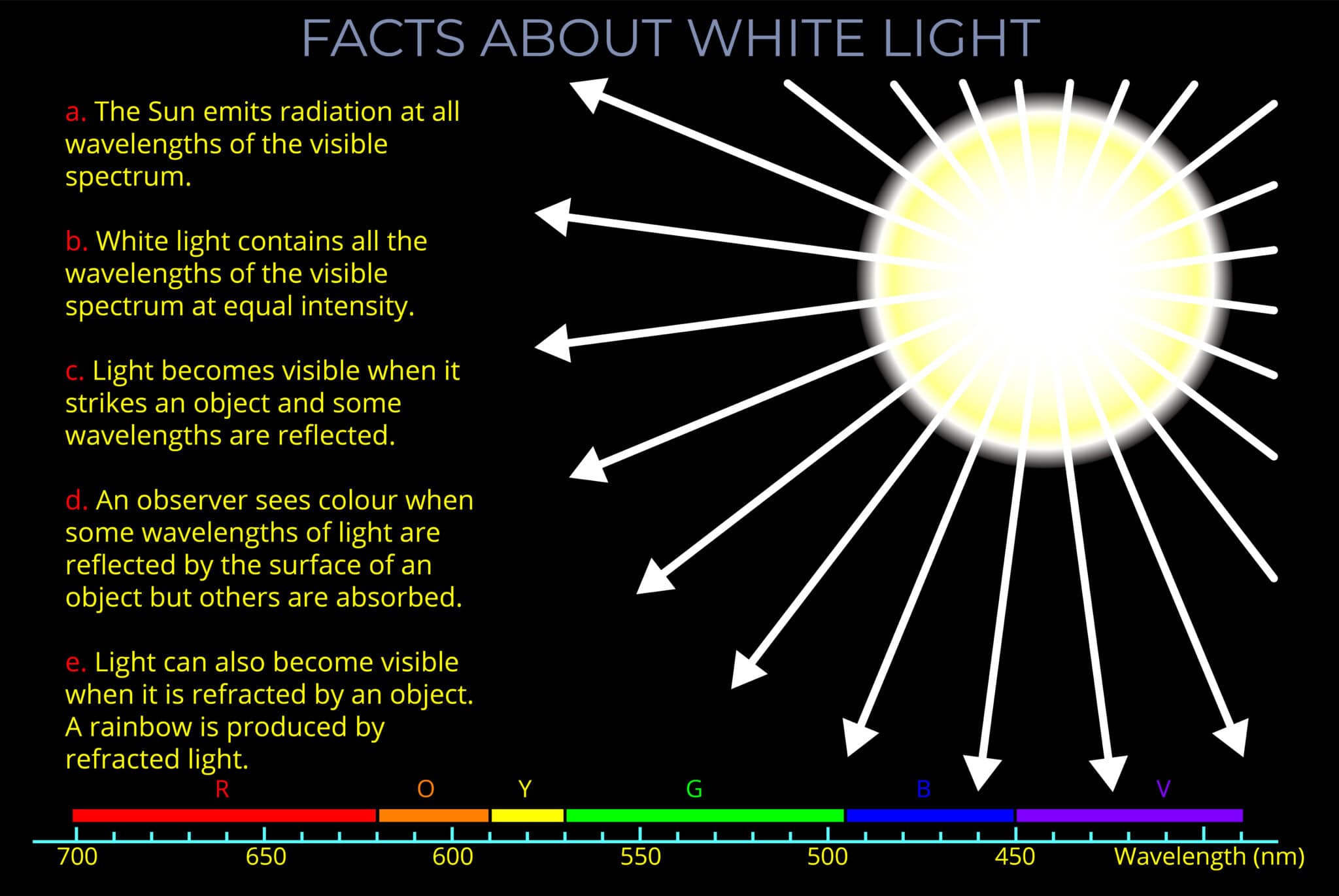
Light is a form of electromagnetic radiation that is visible to the human eye. It travels in waves and particles, known as photons, and is characterized by its wavelength and frequency. The visible spectrum of light ranges from about 400 nanometers (violet) to 700 nanometers (red). Beyond this range, there are other types of electromagnetic radiation, such as ultraviolet and infrared, which are not visible to the human eye but have significant applications.
Properties of Light
Light exhibits several key properties that define its behavior and interactions with matter. These properties include:
- Reflection: The bouncing back of light when it hits a surface. This property is utilized in mirrors and reflective surfaces.
- Refraction: The bending of light as it passes through different mediums. This is why a straw appears bent when placed in a glass of water.
- Diffraction: The spreading out of light waves as they pass through a narrow opening or around an obstacle.
- Interference: The interaction of two or more light waves, resulting in a pattern of constructive and destructive interference.
- Polarization: The alignment of light waves in a specific direction, which can be used to reduce glare in sunglasses and cameras.
Types of Light
Light can be categorized into different types based on its source and properties. Some of the most common types include:
- Natural Light: Light emitted by natural sources such as the sun, stars, and fireflies.
- Artificial Light: Light produced by man-made sources like light bulbs, LEDs, and fluorescent tubes.
- Incandescent Light: Light produced by heating a filament until it glows, as in traditional light bulbs.
- Fluorescent Light: Light produced by exciting a gas to emit photons, commonly used in fluorescent tubes and compact fluorescent lamps (CFLs).
- LED Light: Light produced by semiconductors that emit photons when an electric current is passed through them. LEDs are highly efficient and long-lasting.
The Electromagnetic Spectrum
The electromagnetic spectrum encompasses all types of electromagnetic radiation, including visible light. It ranges from low-energy radio waves to high-energy gamma rays. The visible spectrum, which is a small portion of the electromagnetic spectrum, is what we perceive as light. The table below illustrates the different regions of the electromagnetic spectrum:
| Type of Radiation | Wavelength Range | Frequency Range |
|---|---|---|
| Radio Waves | 1 mm to 100 km | 300 GHz to 3 kHz |
| Microwaves | 1 mm to 1 m | 300 GHz to 300 MHz |
| Infrared | 700 nm to 1 mm | 430 THz to 300 GHz |
| Visible Light | 400 nm to 700 nm | 750 THz to 400 THz |
| Ultraviolet | 10 nm to 400 nm | 30 PHz to 750 THz |
| X-Rays | 0.01 nm to 10 nm | 30 EHz to 30 PHz |
| Gamma Rays | Less than 0.01 nm | More than 30 EHz |
Applications of Light
Light has numerous applications in various fields, from everyday use to advanced scientific research. Some of the key applications include:
- Illumination: Providing light for visibility in homes, offices, and public spaces.
- Communication: Used in fiber-optic cables for high-speed data transmission.
- Medicine: Utilized in medical imaging, laser surgery, and phototherapy.
- Agriculture: Employed in greenhouses to enhance plant growth through artificial lighting.
- Entertainment: Used in stage lighting, film production, and special effects.
The Science Behind Light
Understanding the science behind light involves delving into the principles of optics and quantum mechanics. Key concepts include:
- Wave-Particle Duality: Light exhibits both wave-like and particle-like properties, depending on the context. This duality is a fundamental aspect of quantum mechanics.
- Photoelectric Effect: The emission of electrons from a material when light is shone on it. This phenomenon is the basis for solar panels and photodetectors.
- Lasers: Devices that produce coherent light, meaning the light waves are in phase and have the same frequency. Lasers are used in a wide range of applications, from surgery to telecommunications.
💡 Note: The photoelectric effect was a pivotal discovery that led to the development of quantum theory, revolutionizing our understanding of light and matter.
Light and Human Vision
Human vision relies on the detection of light by the eyes. The retina, located at the back of the eye, contains photoreceptor cells called rods and cones. Rods are responsible for low-light vision, while cones are responsible for color vision. The brain processes the signals from these cells to create a visual image. Understanding the Facts About Light and how it interacts with the eye is crucial for developing technologies that enhance vision, such as corrective lenses and retinal implants.
Light Pollution
While light is essential for our daily activities, excessive and improper use of artificial light can lead to light pollution. Light pollution affects not only our ability to see the stars but also has significant environmental and health impacts. It can disrupt the natural rhythms of wildlife, affect plant growth, and even impact human health by altering sleep patterns. Mitigating light pollution involves using efficient lighting solutions and minimizing unnecessary illumination.
Light pollution can be categorized into several types, including:
- Skyglow: The brightening of the night sky over populated areas due to scattered light.
- Light Trespass: Light that spills over into areas where it is not wanted, such as into neighboring properties.
- Glare: Excessive brightness that causes visual discomfort or reduced visibility.
- Clutter: The excessive grouping of light sources, often seen in commercial and residential areas.
Addressing light pollution requires a combination of technological solutions and policy changes. Some effective strategies include:
- Using energy-efficient lighting technologies, such as LEDs, which reduce energy consumption and light pollution.
- Implementing lighting controls, such as timers and motion sensors, to ensure lights are only on when needed.
- Designing lighting fixtures that direct light downward, reducing skyglow and light trespass.
- Promoting awareness and education about the impacts of light pollution and the benefits of responsible lighting practices.
By adopting these strategies, we can create a more sustainable and environmentally friendly approach to lighting, benefiting both humans and the natural world.
Light is a fascinating and essential aspect of our world, with a wide range of applications and impacts. From illuminating our surroundings to enabling advanced technologies, the Facts About Light highlight its importance in various fields. By understanding the properties, types, and applications of light, we can appreciate its role in our daily lives and work towards more sustainable and efficient use of this vital resource.
Related Terms:
- 10 facts about light waves
- 10 interesting facts about light
- 10 fun facts about light
- 10 cool facts about light
- 15 facts about light energy
- 5 interesting facts about light