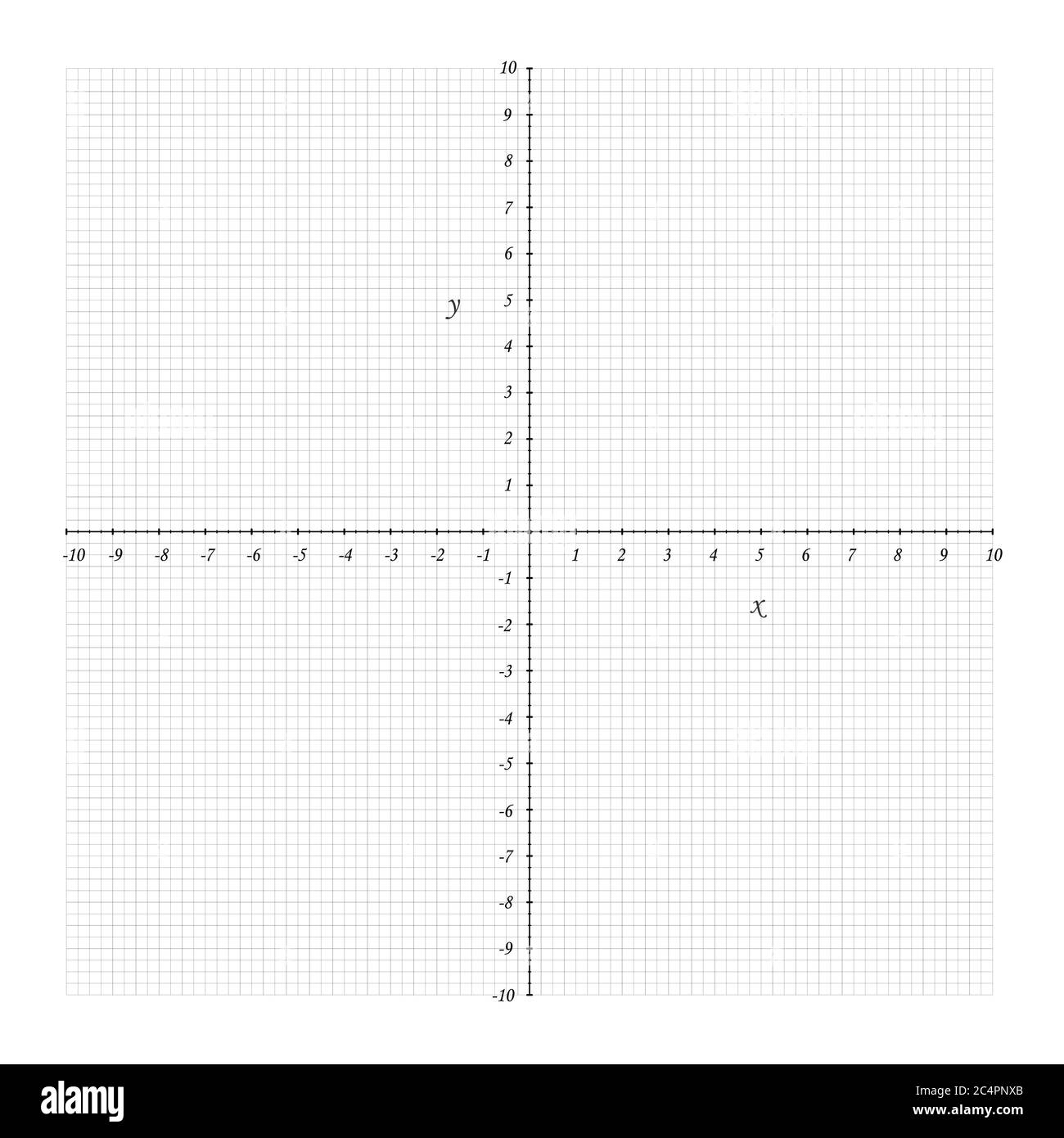
Understanding the concept of an Empty Coordinate Plane is fundamental in the study of mathematics, particularly in geometry and algebra. This plane serves as a foundational tool for visualizing and solving problems involving two-dimensional space. By grasping the basics of the coordinate plane, students and professionals alike can navigate more complex mathematical concepts with ease.
What is an Empty Coordinate Plane?
The Empty Coordinate Plane is a two-dimensional space defined by two perpendicular lines, known as axes. These axes intersect at a point called the origin. The horizontal line is called the x-axis, and the vertical line is called the y-axis. The plane is “empty” in the sense that it does not contain any plotted points or shapes, providing a blank canvas for mathematical exploration.
Components of the Coordinate Plane
The coordinate plane is composed of several key components:
- Origin: The point where the x-axis and y-axis intersect, typically denoted as (0, 0).
- X-axis: The horizontal line that extends infinitely in both directions. It is used to measure the horizontal distance from the origin.
- Y-axis: The vertical line that extends infinitely in both directions. It is used to measure the vertical distance from the origin.
- Quadrants: The four sections created by the intersection of the x-axis and y-axis. These are labeled I, II, III, and IV, moving counterclockwise from the top right.
Understanding Quadrants
The coordinate plane is divided into four quadrants, each with unique characteristics:
| Quadrant | Sign of x-coordinate | Sign of y-coordinate |
|---|---|---|
| I | Positive | Positive |
| II | Negative | Positive |
| III | Negative | Negative |
| IV | Positive | Negative |
Each quadrant has specific properties that help in identifying the location of a point. For example, in Quadrant I, both the x and y coordinates are positive, while in Quadrant III, both coordinates are negative.
Plotting Points on the Coordinate Plane
To plot a point on the Empty Coordinate Plane, you need to understand the coordinates (x, y). The x-coordinate determines the horizontal position, and the y-coordinate determines the vertical position. Here are the steps to plot a point:
- Identify the x-coordinate and move horizontally from the origin.
- Identify the y-coordinate and move vertically from the origin.
- Mark the point where the horizontal and vertical lines intersect.
📝 Note: Remember that the order of coordinates matters. The first number is always the x-coordinate, and the second number is the y-coordinate.
Applications of the Coordinate Plane
The Empty Coordinate Plane has numerous applications in various fields, including:
- Geometry: Used to visualize shapes, lines, and angles.
- Algebra: Helps in solving equations and inequalities graphically.
- Physics: Used to represent motion, forces, and other physical quantities.
- Engineering: Essential for designing and analyzing structures and systems.
- Computer Graphics: Fundamental for rendering images and animations.
Graphing Functions on the Coordinate Plane
One of the most powerful uses of the coordinate plane is graphing functions. By plotting the values of a function, you can visualize its behavior and properties. Here are the steps to graph a function:
- Choose a range of x-values to evaluate the function.
- Calculate the corresponding y-values for each x-value.
- Plot the points (x, y) on the coordinate plane.
- Connect the points to form the graph of the function.
For example, consider the function f(x) = x2. To graph this function, you would:
- Choose x-values such as -2, -1, 0, 1, 2.
- Calculate the y-values: (-2)2 = 4, (-1)2 = 1, 02 = 0, 12 = 1, 22 = 4.
- Plot the points (-2, 4), (-1, 1), (0, 0), (1, 1), (2, 4).
- Connect the points to form a parabola.
📝 Note: The choice of x-values can affect the accuracy and detail of the graph. It's important to select a range that captures the essential features of the function.
Transformations on the Coordinate Plane
Transformations are operations that change the position, size, or shape of an object on the coordinate plane. Common transformations include:
- Translation: Moving an object to a new location without changing its size or shape.
- Rotation: Turning an object around a fixed point.
- Reflection: Flipping an object over a line (axis of reflection).
- Scaling: Changing the size of an object.
These transformations are essential in fields such as computer graphics, where objects need to be manipulated in real-time. Understanding how to perform these transformations on the Empty Coordinate Plane is crucial for mastering more advanced topics in mathematics and related disciplines.
For example, to translate a point (x, y) by (a, b), you simply add the translation values to the original coordinates:
- New x-coordinate = x + a
- New y-coordinate = y + b
This results in the new point (x + a, y + b).
📝 Note: Transformations can be combined to create more complex changes. For instance, you can translate an object and then rotate it to achieve a specific orientation.
Conclusion
The Empty Coordinate Plane is a versatile and essential tool in mathematics, providing a visual framework for understanding and solving problems in two-dimensional space. By mastering the basics of the coordinate plane, including plotting points, graphing functions, and performing transformations, students and professionals can tackle more complex mathematical concepts with confidence. Whether in geometry, algebra, physics, engineering, or computer graphics, the coordinate plane serves as a foundational element that enhances our ability to analyze and interpret mathematical data.
Related Terms:
- coordinate plane graph 10x10
- 10 x coordinate plane printable
- blank coordinate plane printable
- coordinate plane quadrant 1 printable
- coordinate plane graph printable free
- blank coordinate plane 10 x