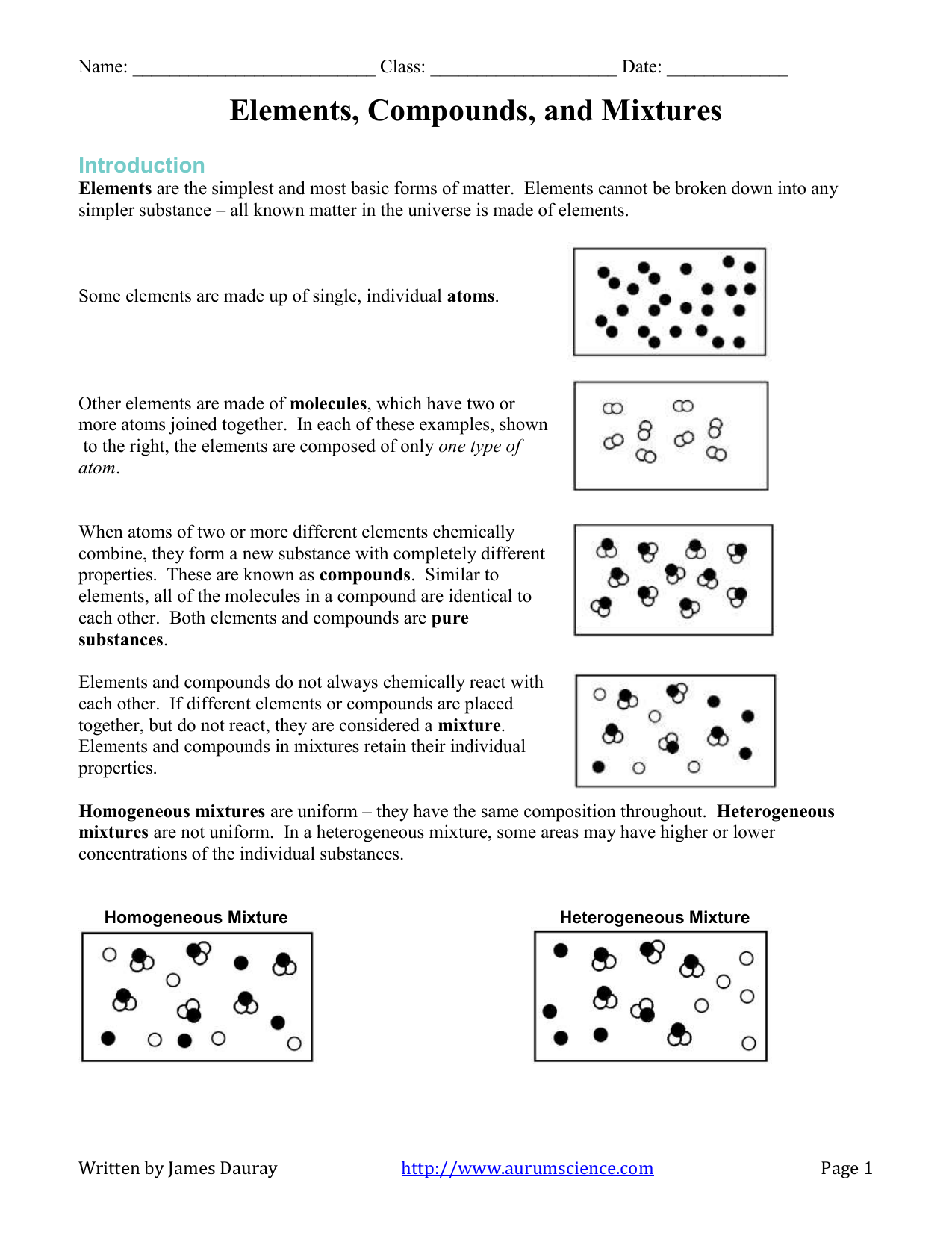
Understanding the distinction between an element and compound is fundamental in the study of chemistry. These concepts form the backbone of chemical knowledge, helping us comprehend the composition and behavior of matter at a molecular level. This blog post delves into the definitions, properties, and differences between elements and compounds, providing a comprehensive overview for both beginners and those looking to refresh their knowledge.
What is an Element?
An element is a pure substance that consists of atoms with the same number of protons. Elements are the building blocks of all matter and cannot be broken down into simpler substances through chemical means. The periodic table of elements lists all known elements, each identified by a unique symbol and atomic number.
Elements can be categorized into several types based on their properties:
- Metals: Elements like gold, silver, and copper that are typically shiny, malleable, and good conductors of heat and electricity.
- Non-metals: Elements such as oxygen, nitrogen, and sulfur that are generally brittle, poor conductors of heat and electricity, and can be gases, liquids, or solids at room temperature.
- Metalloids: Elements like silicon and germanium that exhibit properties intermediate between metals and non-metals.
Each element has a unique set of chemical and physical properties that determine its behavior in reactions and its uses in various applications.
What is a Compound?
A compound is a substance formed when two or more elements are chemically combined in fixed proportions. Compounds have distinct properties that differ from those of their constituent elements. For example, water (H2O) is a compound made from hydrogen and oxygen, but it has properties entirely different from either of these elements.
Compounds can be classified into various types based on their composition and bonding:
- Molecular Compounds: Formed by the sharing of electrons between atoms (covalent bonding). Examples include water (H2O) and carbon dioxide (CO2).
- Ionic Compounds: Formed by the transfer of electrons from one atom to another, resulting in positively and negatively charged ions. Examples include sodium chloride (NaCl) and calcium carbonate (CaCO3).
- Acids and Bases: Compounds that release hydrogen ions (H+) or hydroxide ions (OH-) in water. Examples include hydrochloric acid (HCl) and sodium hydroxide (NaOH).
Compounds play a crucial role in chemistry, biology, and industry, as they form the basis for many materials and substances we use daily.
Key Differences Between Elements and Compounds
Understanding the differences between elements and compounds is essential for grasping the fundamentals of chemistry. Here are some key distinctions:
| Aspect | Element | Compound |
|---|---|---|
| Composition | Consists of atoms of the same type | Consists of atoms of different types |
| Properties | Unique properties determined by the type of atom | Properties differ from those of constituent elements |
| Chemical Formula | Represented by a single symbol (e.g., H for hydrogen) | Represented by a combination of symbols (e.g., H2O for water) |
| Examples | Gold (Au), Oxygen (O2), Copper (Cu) | Water (H2O), Sodium Chloride (NaCl), Carbon Dioxide (CO2) |
These differences highlight the fundamental nature of elements and compounds and their roles in chemical reactions and material science.
Examples of Elements and Compounds
To further illustrate the concepts of elements and compounds, let's look at some examples:
Elements
1. Hydrogen (H): The simplest and most abundant element in the universe. It is a gas at room temperature and is highly flammable.
2. Oxygen (O): A gas that is essential for respiration in living organisms. It is highly reactive and forms oxides with many elements.
3. Gold (Au): A precious metal known for its luster and resistance to corrosion. It is often used in jewelry and electronics.
Compounds
1. Water (H2O): A molecular compound essential for life. It is formed by the combination of two hydrogen atoms and one oxygen atom.
2. Sodium Chloride (NaCl): An ionic compound commonly known as table salt. It is formed by the reaction of sodium (Na) and chlorine (Cl).
3. Carbon Dioxide (CO2): A molecular compound that is a byproduct of respiration and combustion. It is a greenhouse gas that contributes to global warming.
📝 Note: The examples provided are just a few of the many elements and compounds that exist. Each has unique properties and applications in various fields.
Importance of Elements and Compounds in Daily Life
Elements and compounds are integral to our daily lives, playing crucial roles in various aspects of modern society. Here are some key areas where they are essential:
- Health and Medicine: Many elements and compounds are used in medical treatments and diagnostics. For example, oxygen is used in respiratory therapies, and compounds like aspirin are used for pain relief.
- Industry and Manufacturing: Elements like iron and aluminum are used in construction and manufacturing. Compounds like plastics and polymers are used in a wide range of products, from packaging to electronics.
- Agriculture: Elements like nitrogen, phosphorus, and potassium are essential nutrients for plant growth. Compounds like fertilizers are used to enhance soil fertility and crop yields.
- Energy: Elements like uranium are used in nuclear power generation, while compounds like hydrocarbons are used as fuels in various forms of energy production.
Understanding the properties and behaviors of elements and compounds is vital for advancing these fields and developing new technologies.
Chemical Reactions Involving Elements and Compounds
Chemical reactions involve the transformation of elements and compounds into new substances. These reactions can be categorized into various types based on the changes that occur:
- Synthesis Reactions: Two or more substances combine to form a single product. For example, the reaction between hydrogen and oxygen to form water:
2H2 + O2 → 2H2O
- Decomposition Reactions: A single compound breaks down into two or more simpler substances. For example, the decomposition of water into hydrogen and oxygen:
2H2O → 2H2 + O2
- Single Displacement Reactions: One element replaces another in a compound. For example, the reaction between zinc and copper sulfate:
Zn + CuSO4 → ZnSO4 + Cu
- Double Displacement Reactions: Two compounds exchange ions to form two new compounds. For example, the reaction between sodium chloride and silver nitrate:
NaCl + AgNO3 → AgCl + NaNO3
These reactions illustrate how elements and compounds interact to form new substances, driving the processes that shape our world.
📝 Note: Chemical reactions are governed by the laws of conservation of mass and energy, ensuring that the total mass and energy remain constant before and after the reaction.
Applications of Elements and Compounds
Elements and compounds have a wide range of applications in various fields, from medicine to technology. Here are some notable examples:
Medicine
1. Pharmaceuticals: Many medications are compounds designed to treat specific ailments. For example, penicillin is a compound used to fight bacterial infections.
2. Diagnostic Tools: Elements like iodine are used in medical imaging to visualize internal structures.
Technology
1. Electronics: Elements like silicon and germanium are used in the production of semiconductors, which are essential for electronic devices.
2. Batteries: Compounds like lithium cobalt oxide are used in rechargeable batteries, powering everything from smartphones to electric vehicles.
Environment
1. Pollution Control: Elements like carbon and compounds like carbon dioxide are monitored to understand and mitigate environmental pollution.
2. Renewable Energy: Elements like silicon are used in solar panels to convert sunlight into electricity, promoting sustainable energy solutions.
These applications highlight the versatility and importance of elements and compounds in modern society.
In conclusion, understanding the distinction between an element and compound is crucial for grasping the fundamentals of chemistry. Elements are pure substances with unique properties, while compounds are formed by the chemical combination of elements and have distinct properties. Both play vital roles in various fields, from medicine to technology, and their interactions through chemical reactions drive the processes that shape our world. By exploring the properties, examples, and applications of elements and compounds, we gain a deeper appreciation for the complexity and beauty of the chemical world.
Related Terms:
- differentiate between element and compound
- differences between elements and compound
- elements compounds and mixtures examples
- what elements are considered compounds
- diff between element and compound
- difference of compound and element