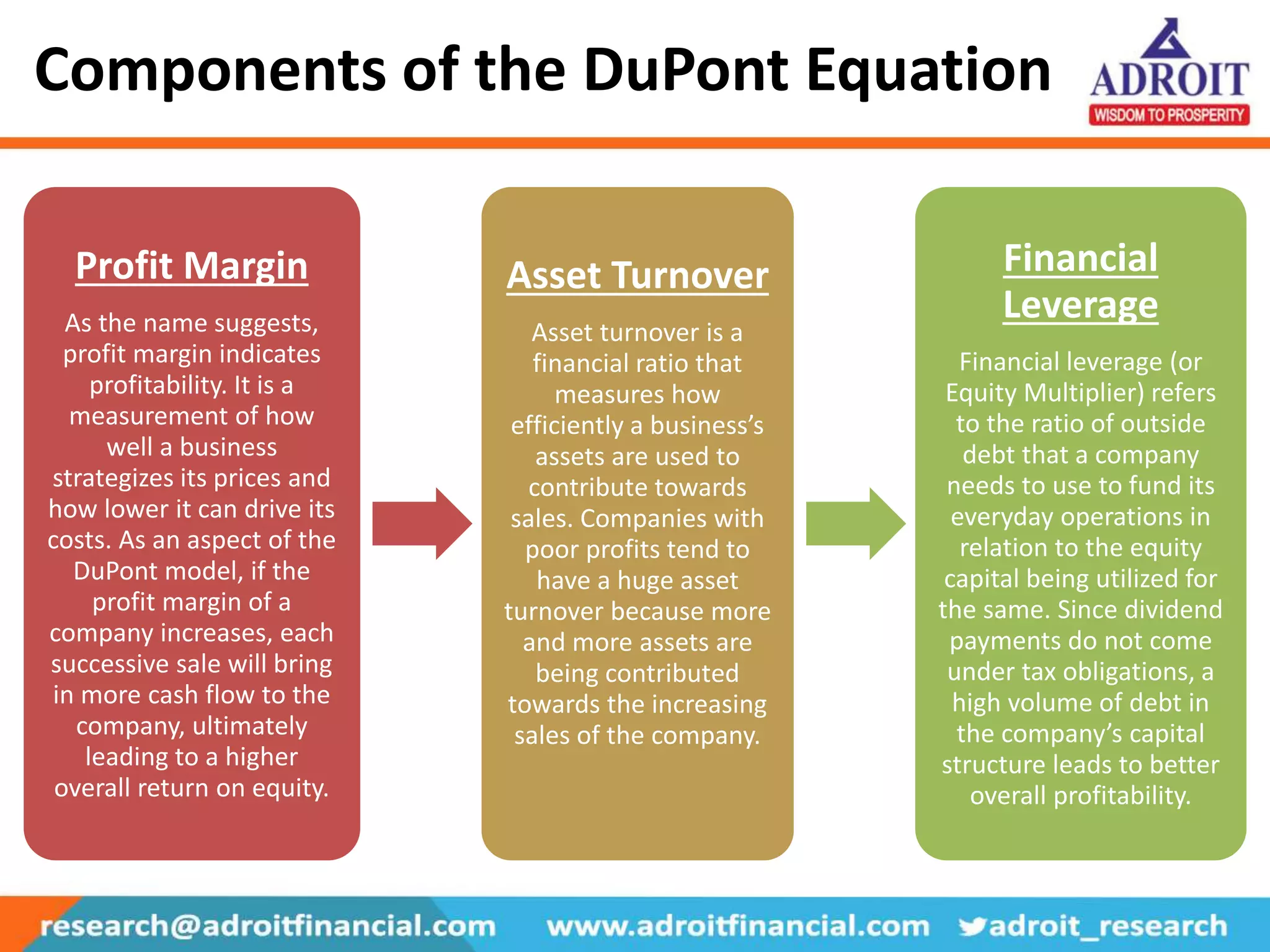
In the realm of data analysis and decision-making, the Du Pont Analysis stands out as a powerful tool for evaluating a company's financial performance. This method, named after the Du Pont Corporation, provides a comprehensive framework for understanding the key drivers of return on equity (ROE). By breaking down ROE into its constituent parts, Du Pont Analysis offers insights that can guide strategic decisions and improve overall financial health.
Understanding Du Pont Analysis
Du Pont Analysis is a financial metric that decomposes ROE into three main components: profit margin, asset turnover, and equity multiplier. This breakdown helps analysts and investors understand how efficiently a company is using its assets and equity to generate profits. The formula for Du Pont Analysis is as follows:
ROE = Profit Margin × Asset Turnover × Equity Multiplier
Components of Du Pont Analysis
To fully grasp the Du Pont Analysis, it's essential to understand each of its components:
Profit Margin
The profit margin, also known as net profit margin, measures the percentage of revenue that translates into profit. It is calculated as:
Profit Margin = Net Income / Revenue
A higher profit margin indicates that a company is more efficient in converting sales into profits. This metric is crucial for assessing a company's operational efficiency and pricing strategy.
Asset Turnover
Asset turnover measures how efficiently a company uses its assets to generate sales. It is calculated as:
Asset Turnover = Revenue / Total Assets
A higher asset turnover ratio suggests that the company is effectively utilizing its assets to drive revenue. This metric is particularly important for capital-intensive industries where asset management is critical.
Equity Multiplier
The equity multiplier, also known as the financial leverage ratio, indicates how much of the company's assets are financed by equity versus debt. It is calculated as:
Equity Multiplier = Total Assets / Total Equity
A higher equity multiplier means the company is using more debt to finance its assets, which can amplify both returns and risks. This metric is essential for understanding the company's capital structure and financial risk.
Calculating Du Pont Analysis
To perform a Du Pont Analysis, follow these steps:
- Gather the necessary financial data, including net income, revenue, total assets, and total equity.
- Calculate the profit margin using the formula: Profit Margin = Net Income / Revenue.
- Calculate the asset turnover using the formula: Asset Turnover = Revenue / Total Assets.
- Calculate the equity multiplier using the formula: Equity Multiplier = Total Assets / Total Equity.
- Multiply the three components to find the ROE: ROE = Profit Margin × Asset Turnover × Equity Multiplier.
📝 Note: Ensure that the financial data used is accurate and up-to-date for reliable results.
Interpreting Du Pont Analysis
Interpreting the results of a Du Pont Analysis involves understanding how each component contributes to the overall ROE. Here are some key points to consider:
- Profit Margin: A high profit margin indicates strong operational efficiency and pricing power. However, a very high margin might suggest limited growth opportunities.
- Asset Turnover: A high asset turnover ratio indicates efficient use of assets. However, extremely high turnover might indicate underinvestment in assets, which could hinder long-term growth.
- Equity Multiplier: A high equity multiplier suggests significant use of debt, which can amplify returns but also increase financial risk. A low equity multiplier indicates a more conservative capital structure.
By analyzing these components, investors and analysts can gain insights into a company's financial health and make informed decisions.
Comparative Analysis
Du Pont Analysis is particularly useful for comparative analysis, allowing investors to compare the financial performance of different companies within the same industry. Here’s how you can conduct a comparative analysis:
- Select a group of companies within the same industry for comparison.
- Gather the financial data for each company, including net income, revenue, total assets, and total equity.
- Calculate the profit margin, asset turnover, and equity multiplier for each company.
- Compare the results to identify which companies are performing better in terms of operational efficiency, asset utilization, and financial leverage.
Here is an example of how the data might look in a table format:
| Company | Profit Margin | Asset Turnover | Equity Multiplier | ROE |
|---|---|---|---|---|
| Company A | 10% | 2.0 | 1.5 | 30% |
| Company B | 12% | 1.8 | 1.6 | 34.56% |
| Company C | 8% | 2.2 | 1.4 | 24.64% |
From this table, it is clear that Company B has the highest ROE, primarily due to a higher profit margin and equity multiplier. This comparative analysis helps investors identify which companies are more efficient and financially sound.
Limitations of Du Pont Analysis
While Du Pont Analysis is a valuable tool, it has its limitations:
- Historical Data: The analysis relies on historical financial data, which may not accurately predict future performance.
- Industry Variations: Different industries have varying standards for profit margins, asset turnover, and equity multipliers, making direct comparisons challenging.
- Qualitative Factors: The analysis does not account for qualitative factors such as management quality, market position, and competitive advantages.
Despite these limitations, Du Pont Analysis remains a powerful tool for understanding a company's financial performance and making informed investment decisions.
Du Pont Analysis is a versatile tool that can be applied in various contexts, from evaluating individual companies to comparing industry peers. By breaking down ROE into its constituent parts, this method provides a comprehensive view of a company's financial health and operational efficiency. Whether you are an investor, analyst, or business owner, understanding and applying Du Pont Analysis can significantly enhance your decision-making capabilities.
In summary, Du Pont Analysis offers a detailed breakdown of ROE, highlighting the key drivers of financial performance. By examining profit margin, asset turnover, and equity multiplier, investors and analysts can gain valuable insights into a company’s efficiency, asset utilization, and financial leverage. This analysis is particularly useful for comparative studies within the same industry, helping to identify which companies are performing better. While it has its limitations, Du Pont Analysis remains an essential tool for anyone looking to make informed financial decisions.