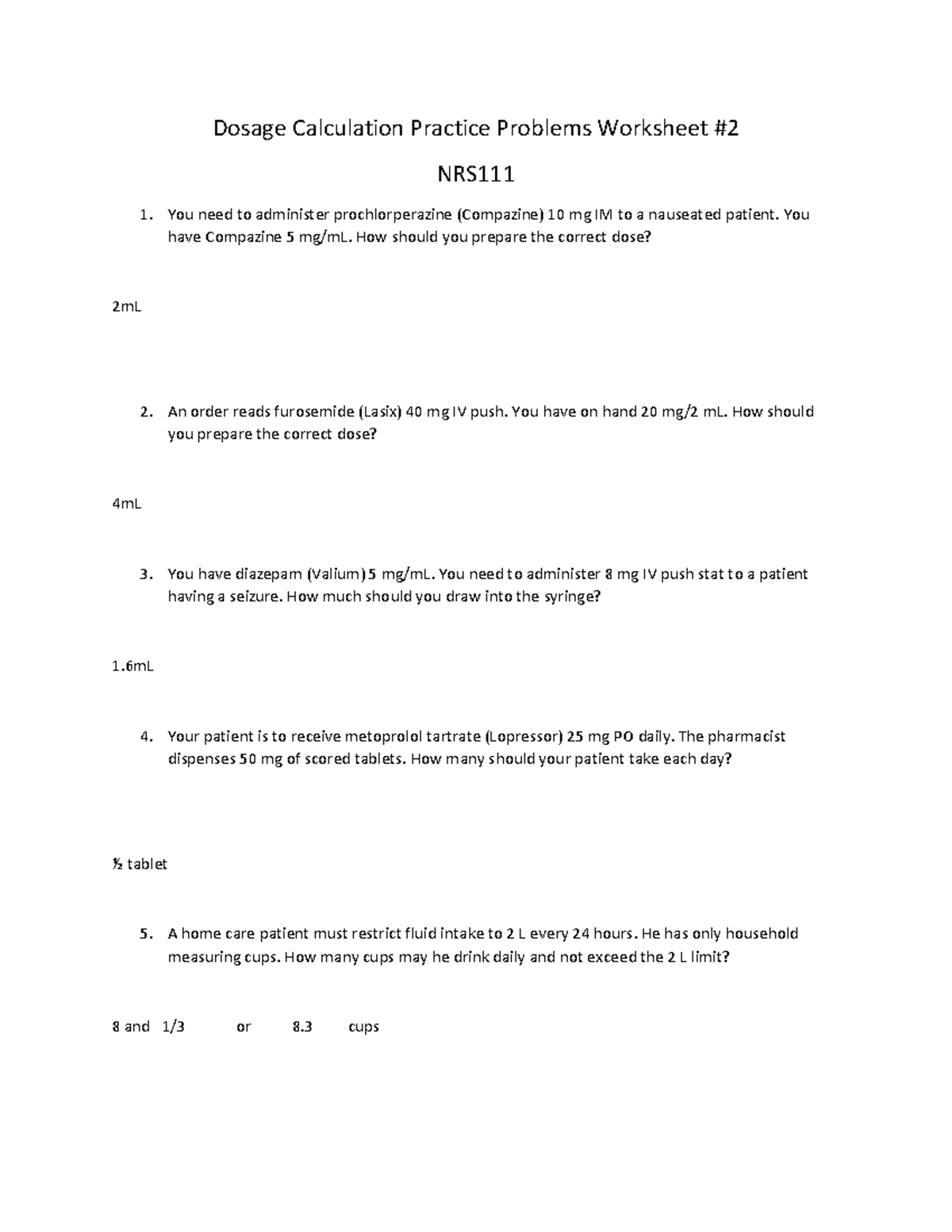
Mastering dosage calculation is a critical skill for healthcare professionals, ensuring patient safety and effective treatment. Whether you are a nursing student, a pharmacist, or a medical professional, practicing dosage calculation problems is essential for honing your skills. This blog post will guide you through various aspects of dosage calculation, providing practical examples and tips to enhance your understanding and proficiency.
Understanding Dosage Calculation
Dosage calculation involves determining the correct amount of medication to administer to a patient based on their weight, age, and other factors. Accurate dosage calculation is crucial to avoid underdosing or overdosing, which can have serious health implications. The process typically involves converting units, using formulas, and applying critical thinking skills.
Basic Principles of Dosage Calculation
Before diving into dosage calculation practice problems, it’s important to understand the basic principles:
- Units of Measurement: Familiarize yourself with different units such as milligrams (mg), micrograms (mcg), milliliters (mL), and grams (g).
- Conversion Factors: Know how to convert between different units. For example, 1 gram = 1000 milligrams.
- Formulas: Understand common formulas used in dosage calculation, such as the formula for calculating the dose based on body weight.
Common Dosage Calculation Formulas
Here are some commonly used formulas in dosage calculation:
- Weight-Based Dosage: Dose (mg) = Weight (kg) × Dosage (mg/kg)
- Body Surface Area (BSA) Dosage: Dose (mg) = BSA (m²) × Dosage (mg/m²)
- Volume-Based Dosage: Volume (mL) = Desired Dose (mg) / Concentration (mg/mL)
Dosage Calculation Practice Problems
Practicing dosage calculation problems is the best way to improve your skills. Here are some examples to get you started:
Problem 1: Weight-Based Dosage
A patient weighs 70 kg and requires a medication with a dosage of 5 mg/kg. Calculate the total dose.
Solution:
Dose (mg) = Weight (kg) × Dosage (mg/kg)
Dose (mg) = 70 kg × 5 mg/kg
Dose (mg) = 350 mg
Problem 2: Body Surface Area (BSA) Dosage
A patient has a BSA of 1.8 m² and requires a medication with a dosage of 100 mg/m². Calculate the total dose.
Solution:
Dose (mg) = BSA (m²) × Dosage (mg/m²)
Dose (mg) = 1.8 m² × 100 mg/m²
Dose (mg) = 180 mg
Problem 3: Volume-Based Dosage
A medication is available in a concentration of 20 mg/mL. The prescribed dose is 40 mg. Calculate the volume to be administered.
Solution:
Volume (mL) = Desired Dose (mg) / Concentration (mg/mL)
Volume (mL) = 40 mg / 20 mg/mL
Volume (mL) = 2 mL
Advanced Dosage Calculation Practice Problems
As you become more comfortable with basic dosage calculations, you can move on to more complex problems. These may involve multiple steps, conversions, or special considerations.
Problem 4: Multi-Step Dosage Calculation
A patient weighs 55 kg and requires a medication with a dosage of 7 mg/kg. The medication is available in a concentration of 15 mg/mL. Calculate the volume to be administered.
Solution:
First, calculate the total dose:
Dose (mg) = Weight (kg) × Dosage (mg/kg)
Dose (mg) = 55 kg × 7 mg/kg
Dose (mg) = 385 mg
Next, calculate the volume:
Volume (mL) = Desired Dose (mg) / Concentration (mg/mL)
Volume (mL) = 385 mg / 15 mg/mL
Volume (mL) = 25.67 mL
Problem 5: Conversion and Dosage Calculation
A patient requires 0.5 mg of a medication. The medication is available in a concentration of 250 mcg/mL. Calculate the volume to be administered.
Solution:
First, convert the desired dose from milligrams to micrograms:
0.5 mg = 500 mcg
Next, calculate the volume:
Volume (mL) = Desired Dose (mcg) / Concentration (mcg/mL)
Volume (mL) = 500 mcg / 250 mcg/mL
Volume (mL) = 2 mL
Tips for Effective Dosage Calculation
Here are some tips to help you improve your dosage calculation skills:
- Practice Regularly: Consistently practice dosage calculation problems to build your confidence and accuracy.
- Use Mnemonic Devices: Mnemonic devices can help you remember formulas and conversion factors. For example, “King Henry Died By Drinking Chocolate Milk” can help you remember the metric prefixes (kilo, hecto, deca, base, deci, centi, milli).
- Double-Check Your Work: Always double-check your calculations to ensure accuracy. This can help prevent errors that could harm patients.
- Seek Feedback: If possible, have a mentor or colleague review your calculations to provide feedback and identify areas for improvement.
Common Mistakes to Avoid
Even experienced healthcare professionals can make mistakes in dosage calculation. Here are some common errors to avoid:
- Incorrect Unit Conversion: Ensure you are converting units correctly. For example, 1 gram is not the same as 1 milligram.
- Misreading Prescriptions: Double-check the prescription to ensure you are administering the correct medication and dose.
- Rounding Errors: Be cautious when rounding numbers. Rounding too early in the calculation process can lead to significant errors.
- Ignoring Patient Factors: Always consider the patient’s weight, age, and other factors when calculating the dose.
📝 Note: Always verify your calculations with a colleague or supervisor to ensure accuracy and patient safety.
Dosage Calculation Practice Problems for Different Scenarios
Dosage calculation practice problems can vary based on the scenario and the type of medication. Here are some examples for different situations:
Pediatric Dosage Calculation
Pediatric dosage calculations often require special considerations due to the smaller size and different physiology of children. Here is an example:
A child weighs 20 kg and requires a medication with a dosage of 10 mg/kg. Calculate the total dose.
Solution:
Dose (mg) = Weight (kg) × Dosage (mg/kg)
Dose (mg) = 20 kg × 10 mg/kg
Dose (mg) = 200 mg
Geriatric Dosage Calculation
Geriatric patients may require adjusted dosages due to changes in metabolism and organ function. Here is an example:
A 75-year-old patient requires a medication with a dosage of 5 mg/kg. The patient weighs 60 kg. Calculate the total dose, considering that the dosage should be reduced by 20% due to age-related factors.
Solution:
First, calculate the total dose without the reduction:
Dose (mg) = Weight (kg) × Dosage (mg/kg)
Dose (mg) = 60 kg × 5 mg/kg
Dose (mg) = 300 mg
Next, apply the 20% reduction:
Reduced Dose (mg) = Total Dose (mg) × (1 - 0.20)
Reduced Dose (mg) = 300 mg × 0.80
Reduced Dose (mg) = 240 mg
Critical Care Dosage Calculation
In critical care settings, dosage calculations may need to be adjusted based on the patient’s condition and response to treatment. Here is an example:
A critically ill patient requires a medication with a dosage of 15 mg/kg. The patient weighs 80 kg. Calculate the total dose, considering that the dosage should be increased by 10% due to the patient’s critical condition.
Solution:
First, calculate the total dose without the increase:
Dose (mg) = Weight (kg) × Dosage (mg/kg)
Dose (mg) = 80 kg × 15 mg/kg
Dose (mg) = 1200 mg
Next, apply the 10% increase:
Increased Dose (mg) = Total Dose (mg) × (1 + 0.10)
Increased Dose (mg) = 1200 mg × 1.10
Increased Dose (mg) = 1320 mg
Dosage Calculation Practice Problems for Different Medications
Different medications may require different dosage calculation methods. Here are some examples for various types of medications:
Oral Medications
Oral medications are typically administered in tablet or liquid form. Here is an example:
A patient requires 250 mg of an oral medication. The medication is available in tablets of 125 mg each. Calculate the number of tablets to be administered.
Solution:
Number of Tablets = Desired Dose (mg) / Tablet Strength (mg)
Number of Tablets = 250 mg / 125 mg
Number of Tablets = 2
Injectable Medications
Injectable medications require precise dosage calculations to ensure accuracy. Here is an example:
A patient requires 500 mg of an injectable medication. The medication is available in a concentration of 200 mg/mL. Calculate the volume to be administered.
Solution:
Volume (mL) = Desired Dose (mg) / Concentration (mg/mL)
Volume (mL) = 500 mg / 200 mg/mL
Volume (mL) = 2.5 mL
Intravenous (IV) Medications
IV medications are administered directly into the bloodstream, requiring careful dosage calculations. Here is an example:
A patient requires an IV infusion of 1000 mg of a medication over 4 hours. The medication is available in a concentration of 500 mg/100 mL. Calculate the infusion rate in mL/hour.
Solution:
First, calculate the total volume to be infused:
Total Volume (mL) = Desired Dose (mg) / Concentration (mg/mL)
Total Volume (mL) = 1000 mg / 500 mg/100 mL
Total Volume (mL) = 200 mL
Next, calculate the infusion rate:
Infusion Rate (mL/hour) = Total Volume (mL) / Infusion Time (hours)
Infusion Rate (mL/hour) = 200 mL / 4 hours
Infusion Rate (mL/hour) = 50 mL/hour
Dosage Calculation Practice Problems for Special Populations
Special populations, such as pregnant women, patients with renal or hepatic impairment, and those with allergies, may require adjusted dosages. Here are some examples:
Pregnant Women
Pregnant women may require adjusted dosages due to changes in physiology and potential risks to the fetus. Here is an example:
A pregnant woman requires a medication with a dosage of 8 mg/kg. The woman weighs 65 kg. Calculate the total dose, considering that the dosage should be reduced by 15% due to pregnancy.
Solution:
First, calculate the total dose without the reduction:
Dose (mg) = Weight (kg) × Dosage (mg/kg)
Dose (mg) = 65 kg × 8 mg/kg
Dose (mg) = 520 mg
Next, apply the 15% reduction:
Reduced Dose (mg) = Total Dose (mg) × (1 - 0.15)
Reduced Dose (mg) = 520 mg × 0.85
Reduced Dose (mg) = 442 mg
Patients with Renal Impairment
Patients with renal impairment may require adjusted dosages due to reduced kidney function. Here is an example:
A patient with renal impairment requires a medication with a dosage of 12 mg/kg. The patient weighs 70 kg. Calculate the total dose, considering that the dosage should be reduced by 30% due to renal impairment.
Solution:
First, calculate the total dose without the reduction:
Dose (mg) = Weight (kg) × Dosage (mg/kg)
Dose (mg) = 70 kg × 12 mg/kg
Dose (mg) = 840 mg
Next, apply the 30% reduction:
Reduced Dose (mg) = Total Dose (mg) × (1 - 0.30)
Reduced Dose (mg) = 840 mg × 0.70
Reduced Dose (mg) = 588 mg
Patients with Hepatic Impairment
Patients with hepatic impairment may require adjusted dosages due to reduced liver function. Here is an example:
A patient with hepatic impairment requires a medication with a dosage of 10 mg/kg. The patient weighs 60 kg. Calculate the total dose, considering that the dosage should be reduced by 25% due to hepatic impairment.
Solution:
First, calculate the total dose without the reduction:
Dose (mg) = Weight (kg) × Dosage (mg/kg)
Dose (mg) = 60 kg × 10 mg/kg
Dose (mg) = 600 mg
Next, apply the 25% reduction:
Reduced Dose (mg) = Total Dose (mg) × (1 - 0.25)
Reduced Dose (mg) = 600 mg × 0.75
Reduced Dose (mg) = 450 mg
Dosage Calculation Practice Problems for Different Routes of Administration
Different routes of administration may require different dosage calculations. Here are some examples:
Oral Route
The oral route is the most common method of administering medications. Here is an example:
A patient requires 300 mg of an oral medication. The medication is available in tablets of 100 mg each. Calculate the number of tablets to be administered.
Solution:
Number of Tablets = Desired Dose (mg) / Tablet Strength (mg)
Number of Tablets = 300 mg / 100 mg
Number of Tablets = 3
Intramuscular (IM) Route
The IM route involves injecting medication into the muscle. Here is an example:
A patient requires 400 mg of an IM medication. The medication is available in a concentration of 200 mg/mL. Calculate the volume to be administered.
Solution:
Volume (mL) = Desired Dose (mg) / Concentration (mg/mL)
Volume (mL) = 400 mg / 200 mg/mL
Volume (mL) = 2 mL
Subcutaneous (SC) Route
The SC route involves injecting medication under the skin. Here is an example:
A patient requires 200 mg of an SC medication. The medication is available in a concentration of 100 mg/mL. Calculate the volume to be administered.
Solution:
Volume (mL) = Desired Dose (mg) / Concentration (mg/mL)
Volume (mL) = 200 mg / 100 mg/mL
Volume (mL) = 2 mL
Topical Route
The topical route involves applying medication directly to the skin. Here is an example:
A patient requires a topical cream with a dosage of 5 mg/cm². The area to be treated is 20 cm². Calculate the total dose.
Solution:
Dose (mg) = Area (cm²) × Dosage (mg/cm²)
Dose (mg) = 20 cm² × 5 mg/cm²
Dose (mg) = 100 mg
Dosage Calculation Practice Problems for Different Dosage Forms
Different dosage forms may require different dosage calculations. Here
Related Terms:
- safe dosage calculations practice problems
- simple dosage calculations practice problems
- dosage calculations practice problems pdf
- dosage calculations nursing practice problems
- dosage calculations practice problems free
- Related searches dosage calculations formula