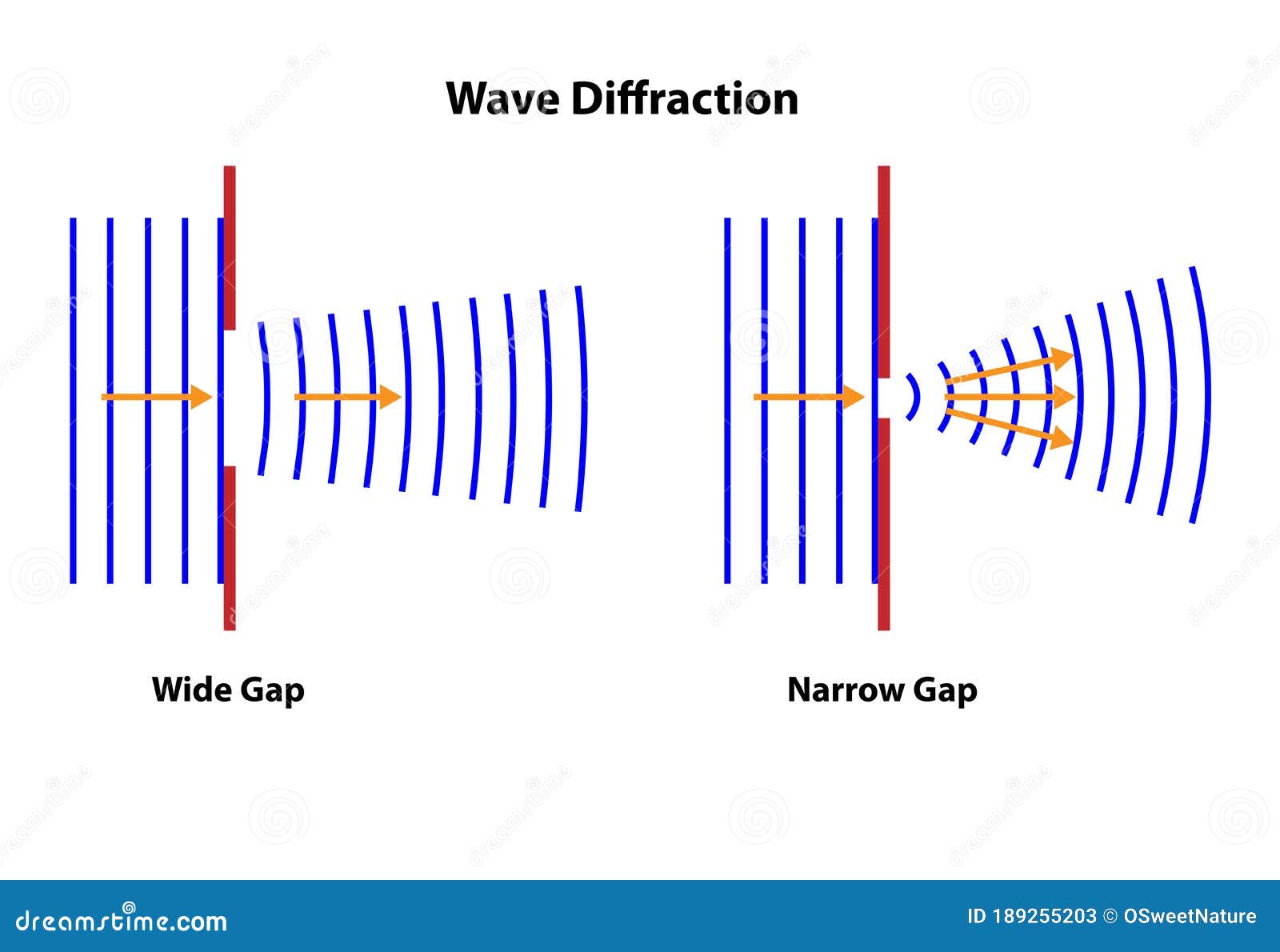
Waves are a fundamental aspect of physics, and understanding their behavior is crucial for various scientific and engineering applications. One of the most fascinating phenomena associated with waves is the diffraction of a wave. This occurs when a wave encounters an obstacle or passes through an aperture, causing it to bend and spread out. Diffraction is a key concept in wave optics and has significant implications in fields such as acoustics, seismology, and telecommunications.
Understanding Wave Diffraction
Diffraction of a wave is a phenomenon where waves spread out and bend around obstacles or through apertures. This behavior is particularly noticeable when the size of the obstacle or aperture is comparable to the wavelength of the wave. The degree of diffraction depends on several factors, including the wavelength of the wave, the size of the obstacle or aperture, and the distance from the obstacle or aperture to the observation point.
To better understand diffraction, it's essential to grasp the basic principles of wave behavior. Waves can be categorized into two main types: transverse waves and longitudinal waves. Transverse waves, such as light and water waves, oscillate perpendicular to the direction of propagation. Longitudinal waves, like sound waves, oscillate parallel to the direction of propagation. Diffraction can occur in both types of waves, but it is often more pronounced in transverse waves.
Factors Affecting Diffraction
Several factors influence the diffraction of a wave. Understanding these factors is crucial for predicting and controlling wave behavior in various applications.
- Wavelength: The wavelength of a wave is the distance between two successive crests or troughs. Shorter wavelengths tend to diffract less than longer wavelengths. For example, visible light has a shorter wavelength than radio waves, so visible light diffracts less than radio waves.
- Obstacle or Aperture Size: The size of the obstacle or aperture relative to the wavelength of the wave affects the degree of diffraction. When the size of the obstacle or aperture is comparable to the wavelength, diffraction is more pronounced. If the size is much larger than the wavelength, diffraction is minimal.
- Distance from the Obstacle or Aperture: The distance from the obstacle or aperture to the observation point also influences diffraction. As the distance increases, the diffracted waves spread out more, leading to a broader diffraction pattern.
Applications of Diffraction
Diffraction of a wave has numerous applications in various fields. Some of the most notable applications include:
- Optics: In optics, diffraction is used to design lenses, mirrors, and other optical components. Diffraction gratings, for example, are used to disperse light into its constituent wavelengths, enabling the study of spectral lines and the analysis of light sources.
- Acoustics: In acoustics, diffraction is crucial for understanding how sound waves propagate around obstacles and through openings. This knowledge is applied in the design of concert halls, theaters, and other acoustic spaces to optimize sound quality.
- Seismology: In seismology, diffraction of seismic waves helps scientists study the Earth's interior. By analyzing the diffraction patterns of seismic waves, geologists can infer the structure and composition of the Earth's crust and mantle.
- Telecommunications: In telecommunications, diffraction is a key factor in the design of antennas and wireless communication systems. Understanding how radio waves diffract around obstacles and through apertures is essential for optimizing signal strength and coverage.
Diffraction Patterns
Diffraction patterns are the visual representations of how waves spread out and bend around obstacles or through apertures. These patterns can be observed in various experiments and natural phenomena. Some common diffraction patterns include:
- Single-Slit Diffraction: When a wave passes through a single slit, it produces a diffraction pattern consisting of a central bright fringe flanked by alternating dark and bright fringes. The width of the central fringe is inversely proportional to the width of the slit.
- Double-Slit Diffraction: When a wave passes through two closely spaced slits, it produces an interference pattern superimposed on a diffraction pattern. This phenomenon, known as double-slit interference, is a classic example of wave behavior and has been instrumental in the development of quantum mechanics.
- Circular Aperture Diffraction: When a wave passes through a circular aperture, it produces a diffraction pattern known as the Airy disk. This pattern consists of a central bright spot surrounded by concentric rings of decreasing intensity.
Diffraction patterns can be analyzed using mathematical models and simulations. One of the most commonly used models is the Fraunhofer diffraction model, which assumes that the observation point is far from the aperture or obstacle. This model simplifies the analysis of diffraction patterns and is widely used in optics and acoustics.
Experimental Setup for Observing Diffraction
Observing diffraction patterns in a controlled environment can provide valuable insights into wave behavior. Here is a step-by-step guide to setting up a simple experiment to observe single-slit diffraction:
- Gather the necessary materials: a laser pointer, a single-slit aperture (such as a razor blade or a thin wire), a screen or white paper, and a dark room.
- Set up the laser pointer and the single-slit aperture in a dark room. Ensure that the laser beam passes through the slit and hits the screen or white paper.
- Adjust the distance between the slit and the screen to observe the diffraction pattern. The pattern will consist of a central bright fringe flanked by alternating dark and bright fringes.
- Measure the width of the central fringe and the distance between the fringes. Use these measurements to calculate the wavelength of the laser light.
🔍 Note: Ensure that the laser pointer is used safely and that the experiment is conducted in a controlled environment to avoid any potential hazards.
Mathematical Analysis of Diffraction
Mathematical analysis is essential for understanding the behavior of diffracted waves. The diffraction pattern of a single slit can be described using the following equation:
I(θ) = I0 * (sin(β) / β)²
where I(θ) is the intensity of the diffracted wave at an angle θ, I0 is the intensity of the incident wave, and β is given by β = (πa sin(θ)) / λ, where a is the width of the slit and λ is the wavelength of the wave.
This equation shows that the intensity of the diffracted wave depends on the angle θ and the width of the slit. The central fringe corresponds to the maximum intensity, while the alternating dark and bright fringes correspond to the minima and maxima of the intensity function.
Diffraction in Everyday Life
Diffraction of a wave is not just a phenomenon observed in laboratory settings; it also plays a significant role in everyday life. Some examples include:
- Rainbows: Rainbows are formed due to the diffraction and reflection of sunlight by raindrops. The different colors of the rainbow correspond to different wavelengths of light, which are diffracted at different angles.
- Sound Propagation: Sound waves diffract around obstacles, allowing us to hear sounds even when the source is not in direct line of sight. This is why we can hear someone speaking from around a corner.
- Radio Waves: Radio waves diffract around buildings and other obstacles, enabling wireless communication over long distances. This is why we can receive radio signals even when the transmitter is not in direct line of sight.
Understanding diffraction in everyday life can help us appreciate the complex interplay of waves and their environment. It also highlights the importance of wave behavior in various technological applications.
Diffraction of a wave is a fundamental phenomenon that has wide-ranging applications in science and technology. By understanding the principles of diffraction, we can design better optical systems, improve acoustic spaces, study the Earth's interior, and optimize wireless communication systems. Whether in the laboratory or in everyday life, diffraction plays a crucial role in shaping our understanding of the world around us.
Diffraction of a wave is a fundamental phenomenon that has wide-ranging applications in science and technology. By understanding the principles of diffraction, we can design better optical systems, improve acoustic spaces, study the Earth’s interior, and optimize wireless communication systems. Whether in the laboratory or in everyday life, diffraction plays a crucial role in shaping our understanding of the world around us.
Related Terms:
- diffraction around a corner
- how does wavelength affect diffraction
- diffraction of waves diagram
- why does diffraction happen
- what is mean by diffraction
- how to draw diffraction