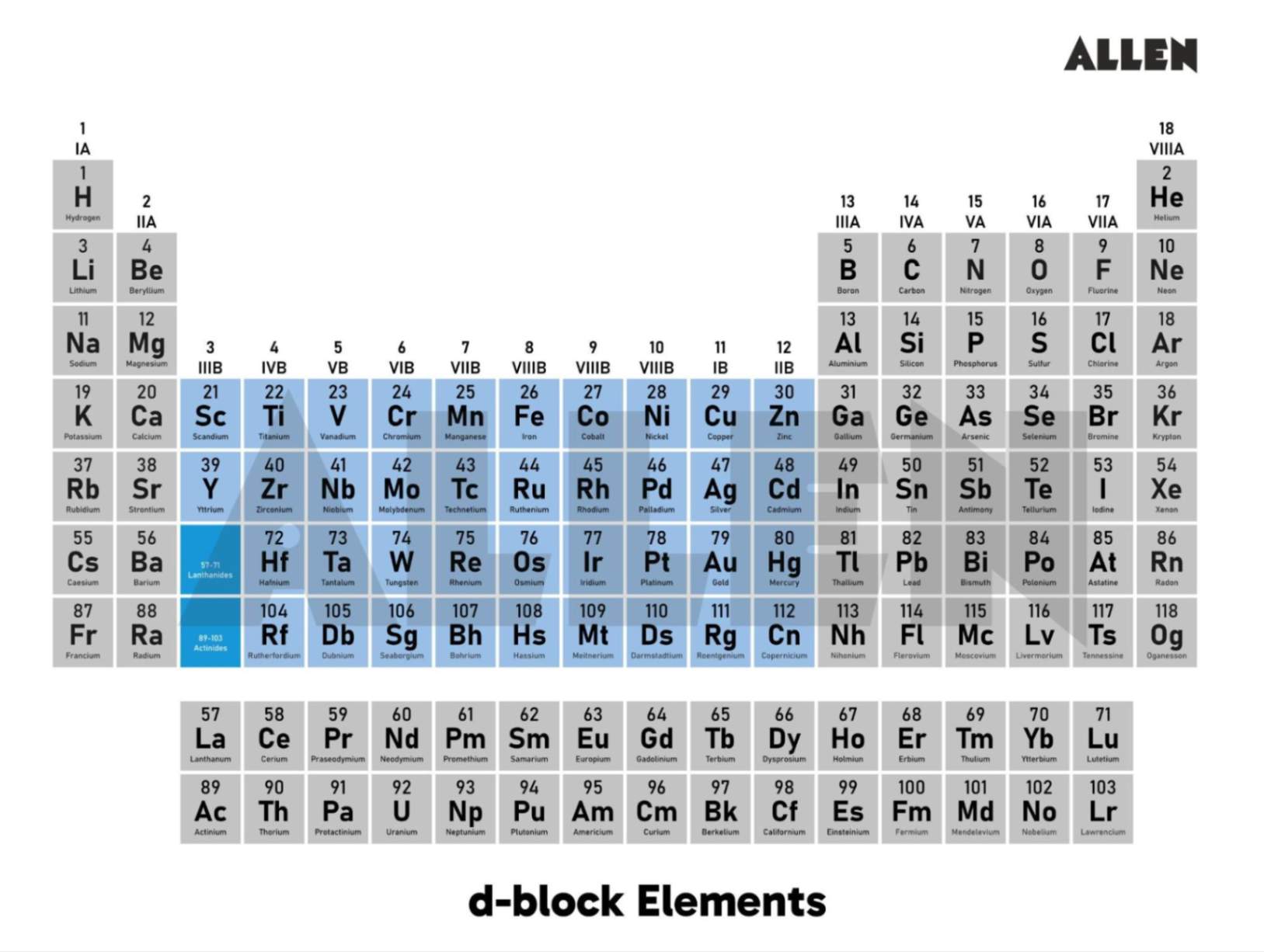
D Block Elements, also known as transition metals, are a group of elements in the periodic table that exhibit unique chemical and physical properties. These elements are located in the middle of the periodic table, spanning from groups 3 to 12. They are called "transition" metals because they represent a transition between the main group elements and the inner transition metals. D Block Elements are characterized by their partially filled d-orbitals, which contribute to their distinctive properties and wide range of applications.
Understanding D Block Elements
D Block Elements are crucial in various industries due to their versatility and unique characteristics. These elements include familiar metals like iron, copper, and zinc, as well as less common ones like titanium and platinum. The d-orbitals in these elements allow for a variety of oxidation states and coordination complexes, making them highly reactive and useful in catalysis, electronics, and materials science.
Properties of D Block Elements
D Block Elements possess several key properties that set them apart from other elements:
- Variable Oxidation States: Due to the presence of d-orbitals, these elements can exhibit multiple oxidation states, which makes them highly reactive.
- Catalytic Activity: Many D Block Elements are excellent catalysts, facilitating chemical reactions without being consumed in the process.
- High Melting and Boiling Points: These elements generally have high melting and boiling points, indicating strong metallic bonding.
- Conductivity: D Block Elements are good conductors of heat and electricity, making them ideal for electrical applications.
- Malleability and Ductility: These metals can be hammered into thin sheets or drawn into wires without breaking, which is crucial for manufacturing.
Applications of D Block Elements
D Block Elements have a wide range of applications across various industries. Some of the most notable uses include:
- Iron (Fe): Used extensively in construction, automotive, and machinery industries due to its strength and durability.
- Copper (Cu): Essential in electrical wiring and plumbing due to its excellent conductivity and resistance to corrosion.
- Zinc (Zn): Used in galvanizing steel to prevent rusting and in batteries as an anode material.
- Titanium (Ti): Valued for its lightweight and high strength, used in aerospace, medical implants, and sports equipment.
- Platinum (Pt): Used in catalytic converters in automobiles and in jewelry due to its resistance to corrosion and tarnish.
Catalytic Properties of D Block Elements
One of the most significant applications of D Block Elements is their use as catalysts. Catalysts speed up chemical reactions without being consumed in the process. Many D Block Elements, such as platinum, palladium, and nickel, are used in industrial catalysis. For example, platinum is used in catalytic converters to reduce harmful emissions from vehicles, while nickel is used in the hydrogenation of oils.
Catalysts work by providing an alternative pathway for the reaction with a lower activation energy, making the reaction proceed faster. The d-orbitals in D Block Elements allow them to form temporary bonds with reactant molecules, facilitating the reaction and then releasing the products.
Electronic Applications of D Block Elements
D Block Elements are also crucial in the electronics industry. Copper, for instance, is widely used in electrical wiring due to its high conductivity. Silver, another D Block Element, is the best conductor of electricity among all metals but is less commonly used due to its high cost. Gold, while not as conductive as silver or copper, is used in electrical contacts due to its resistance to corrosion.
In addition to their conductive properties, D Block Elements are used in semiconductors and other electronic components. For example, gallium arsenide, a compound of gallium (a D Block Element), is used in high-speed electronics and optoelectronics due to its superior properties compared to silicon.
Biological Importance of D Block Elements
Several D Block Elements play crucial roles in biological systems. Iron, for instance, is essential for the transport of oxygen in the blood through hemoglobin. Copper is a component of various enzymes, including cytochrome c oxidase, which is involved in cellular respiration. Zinc is important for the structure and function of many proteins and enzymes.
Deficiencies in these elements can lead to various health issues. For example, iron deficiency can cause anemia, while copper deficiency can affect the immune system and bone health. Zinc deficiency can impair growth and development, especially in children.
Environmental Impact of D Block Elements
While D Block Elements have numerous beneficial applications, their extraction and use can have environmental impacts. Mining activities for these metals can lead to soil and water pollution, deforestation, and habitat destruction. Additionally, the disposal of products containing these metals can contribute to electronic waste, which poses environmental and health risks.
Efforts are being made to mitigate these impacts through sustainable mining practices, recycling, and the development of alternative materials. Recycling metals like copper, aluminum, and steel can significantly reduce the need for new mining and conserve natural resources.
Future Prospects of D Block Elements
The future of D Block Elements looks promising, with ongoing research and development in various fields. Advances in materials science are leading to the discovery of new alloys and compounds with enhanced properties. For example, high-entropy alloys, which contain multiple D Block Elements, are being explored for their superior strength, corrosion resistance, and high-temperature stability.
In the field of catalysis, researchers are developing new catalysts based on D Block Elements that are more efficient and environmentally friendly. For instance, nanocatalysts, which use nanoparticles of D Block Elements, offer higher surface areas and improved catalytic activity.
In electronics, the demand for D Block Elements is expected to grow with the increasing use of renewable energy technologies and electric vehicles. Metals like lithium, cobalt, and nickel are essential for batteries, while copper and aluminum are used in solar panels and wind turbines.
In conclusion, D Block Elements are indispensable in modern technology and industry. Their unique properties make them essential for a wide range of applications, from catalysis and electronics to biological systems and environmental sustainability. As research continues, the potential for new discoveries and innovations in this field is vast, ensuring that D Block Elements will remain at the forefront of scientific and technological advancements.
Related Terms:
- d block elements with names
- characteristics of d block elements
- configuration of d block elements
- list of d block elements
- d block element definition
- identify the d block element