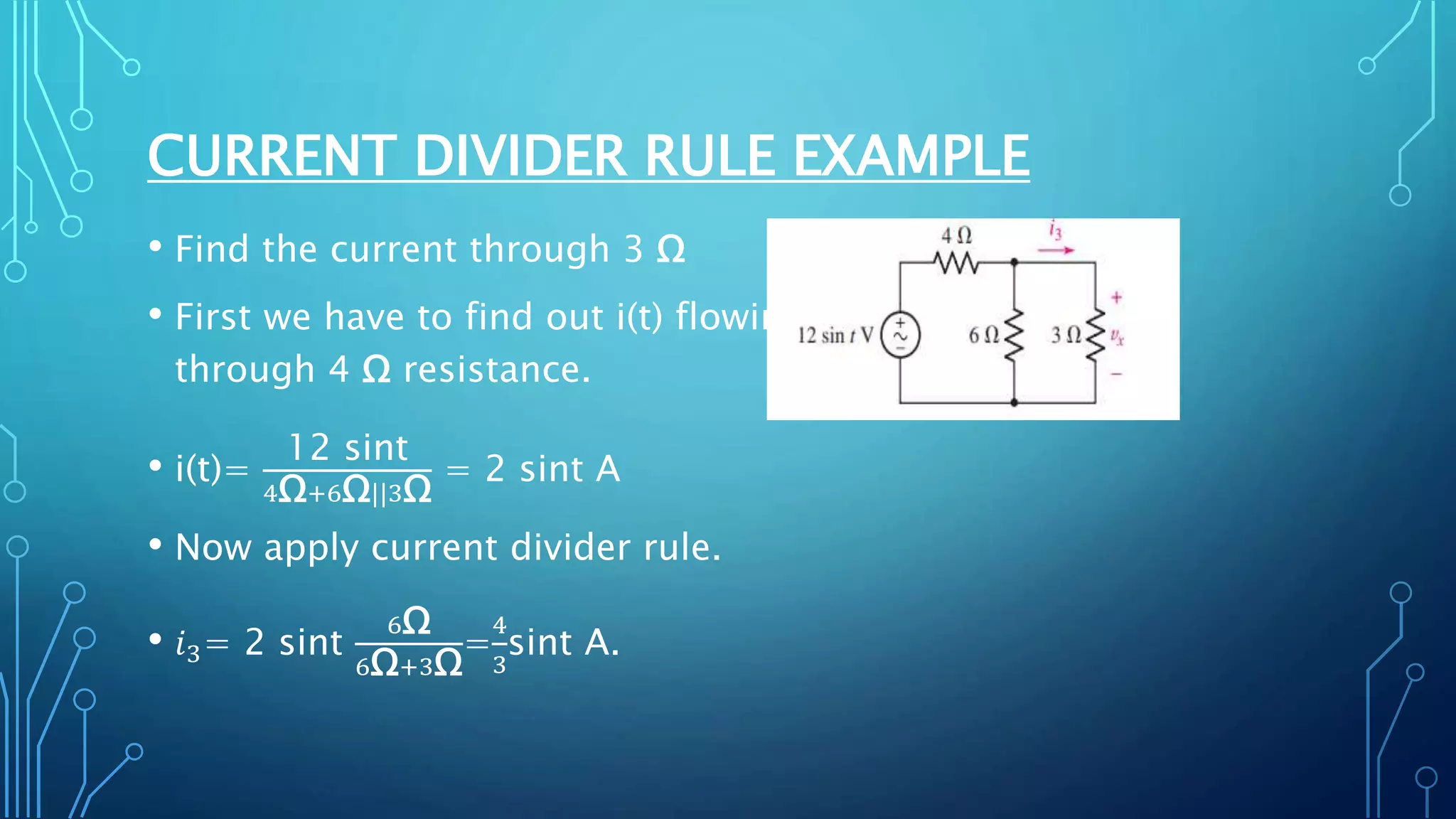
Understanding the Current Division Equation is fundamental for anyone working with electrical circuits. This equation allows engineers and technicians to determine the current flowing through different branches of a circuit, which is crucial for designing and troubleshooting electrical systems. Whether you are a student learning the basics of electronics or a professional dealing with complex circuits, grasping the Current Division Equation is essential.
What is the Current Division Equation?
The Current Division Equation is a formula used to calculate the current flowing through each branch of a parallel circuit. In a parallel circuit, the total current is divided among the branches according to their resistances. The equation is derived from Ohm's Law and Kirchhoff's Current Law (KCL).
The Current Division Equation is given by:
Ix = IT * (RT / Rx)
Where:
- Ix is the current through the branch with resistance Rx.
- IT is the total current entering the parallel circuit.
- RT is the total resistance of the parallel circuit.
- Rx is the resistance of the branch in question.
Understanding Parallel Circuits
Before diving into the Current Division Equation, it's important to understand the basics of parallel circuits. In a parallel circuit, the voltage across each branch is the same, but the current through each branch can vary. This is in contrast to series circuits, where the current is the same through all components, but the voltage drops across each component can differ.
Parallel circuits are commonly used in electrical systems because they allow for multiple devices to be powered simultaneously without affecting each other. For example, in a household electrical system, lights, appliances, and outlets are all connected in parallel.
Deriving the Current Division Equation
The Current Division Equation can be derived using Ohm's Law and Kirchhoff's Current Law. Let's go through the steps:
1. Ohm's Law: This law states that the current (I) through a conductor between two points is directly proportional to the voltage (V) across the two points and inversely proportional to the resistance (R). Mathematically, it is expressed as V = IR.
2. Kirchhoff's Current Law (KCL): This law states that the total current entering a junction is equal to the total current leaving the junction. In a parallel circuit, the total current IT is the sum of the currents through each branch.
3. Total Resistance in a Parallel Circuit: The total resistance RT of a parallel circuit can be calculated using the formula:
1/RT = 1/R1 + 1/R2 + ... + 1/Rn
Where R1, R2, ..., Rn are the resistances of the individual branches.
Using these principles, the Current Division Equation can be derived. The current through a branch Rx is given by:
Ix = IT * (RT / Rx)
This equation shows that the current through a branch is proportional to the total resistance of the circuit and inversely proportional to the resistance of the branch.
💡 Note: The Current Division Equation is particularly useful in circuits with multiple branches, where calculating the current through each branch individually would be time-consuming.
Applying the Current Division Equation
Let's consider an example to illustrate how the Current Division Equation is applied. Suppose we have a parallel circuit with three resistors: R1 = 10 Ω, R2 = 20 Ω, and R3 = 30 Ω. The total current entering the circuit is IT = 5 A.
First, we need to calculate the total resistance RT of the circuit:
1/RT = 1/10 + 1/20 + 1/30
1/RT = 0.1 + 0.05 + 0.0333
1/RT = 0.1833
RT = 1/0.1833 ≈ 5.45 Ω
Now, we can use the Current Division Equation to find the current through each branch:
I1 = IT * (RT / R1)
I1 = 5 A * (5.45 Ω / 10 Ω)
I1 = 5 A * 0.545
I1 ≈ 2.73 A
Similarly, for R2 and R3:
I2 = 5 A * (5.45 Ω / 20 Ω) ≈ 1.36 A
I3 = 5 A * (5.45 Ω / 30 Ω) ≈ 0.91 A
So, the currents through the branches are approximately 2.73 A, 1.36 A, and 0.91 A, respectively.
💡 Note: Always double-check your calculations to ensure accuracy, especially when dealing with complex circuits.
Practical Applications of the Current Division Equation
The Current Division Equation has numerous practical applications in electrical engineering and electronics. Some of the key areas where this equation is used include:
- Power Distribution Systems: In power distribution networks, the Current Division Equation helps in determining the current flowing through different branches, ensuring efficient power delivery and load balancing.
- Electronic Circuits: In electronic circuits, the equation is used to design and analyze circuits with multiple branches, ensuring that each component receives the correct amount of current.
- Automotive Electronics: In automotive systems, the Current Division Equation is used to design circuits for various components, such as lighting, sensors, and control systems.
- Telecommunications: In telecommunications, the equation is used to design and analyze circuits for signal transmission and reception, ensuring reliable communication.
Common Mistakes and Troubleshooting
When applying the Current Division Equation, there are some common mistakes that can lead to incorrect results. Here are a few tips to avoid these mistakes:
- Incorrect Resistance Values: Ensure that the resistance values used in the equation are accurate. Double-check the resistance values of each branch.
- Incorrect Total Current: Verify that the total current IT entering the circuit is correct. Any error in this value will affect the results.
- Incorrect Total Resistance: Calculate the total resistance RT carefully. A mistake in this calculation will lead to incorrect current values for each branch.
If you encounter issues with the Current Division Equation, consider the following troubleshooting steps:
- Recheck the resistance values of each branch.
- Verify the total current entering the circuit.
- Recalculate the total resistance of the circuit.
- Ensure that all components are properly connected and functioning.
💡 Note: Always use a multimeter to measure the actual resistance and current values in the circuit to verify your calculations.
Advanced Topics in Current Division
For those interested in more advanced topics related to the Current Division Equation, there are several areas to explore:
- Complex Impedances: In AC circuits, the Current Division Equation can be extended to include complex impedances, which account for both resistance and reactance.
- Non-Linear Components: In circuits with non-linear components, such as diodes and transistors, the Current Division Equation may need to be modified to account for the non-linear behavior.
- Transient Analysis: In transient analysis, the Current Division Equation can be used to determine the current distribution during transient states, such as when a circuit is first powered on.
These advanced topics require a deeper understanding of circuit theory and may involve more complex mathematical analysis.
Conclusion
The Current Division Equation is a powerful tool for analyzing parallel circuits. By understanding how current is divided among different branches, engineers and technicians can design and troubleshoot electrical systems more effectively. Whether you are working with simple circuits or complex systems, mastering the Current Division Equation is essential for success in the field of electrical engineering. By applying the principles of Ohm’s Law and Kirchhoff’s Current Law, you can accurately determine the current through each branch of a parallel circuit, ensuring efficient and reliable operation.
Related Terms:
- current divider with 3 branches
- voltage division
- current divider with 3 resistors
- current divider equation
- what is current division rule
- formula for current division rule