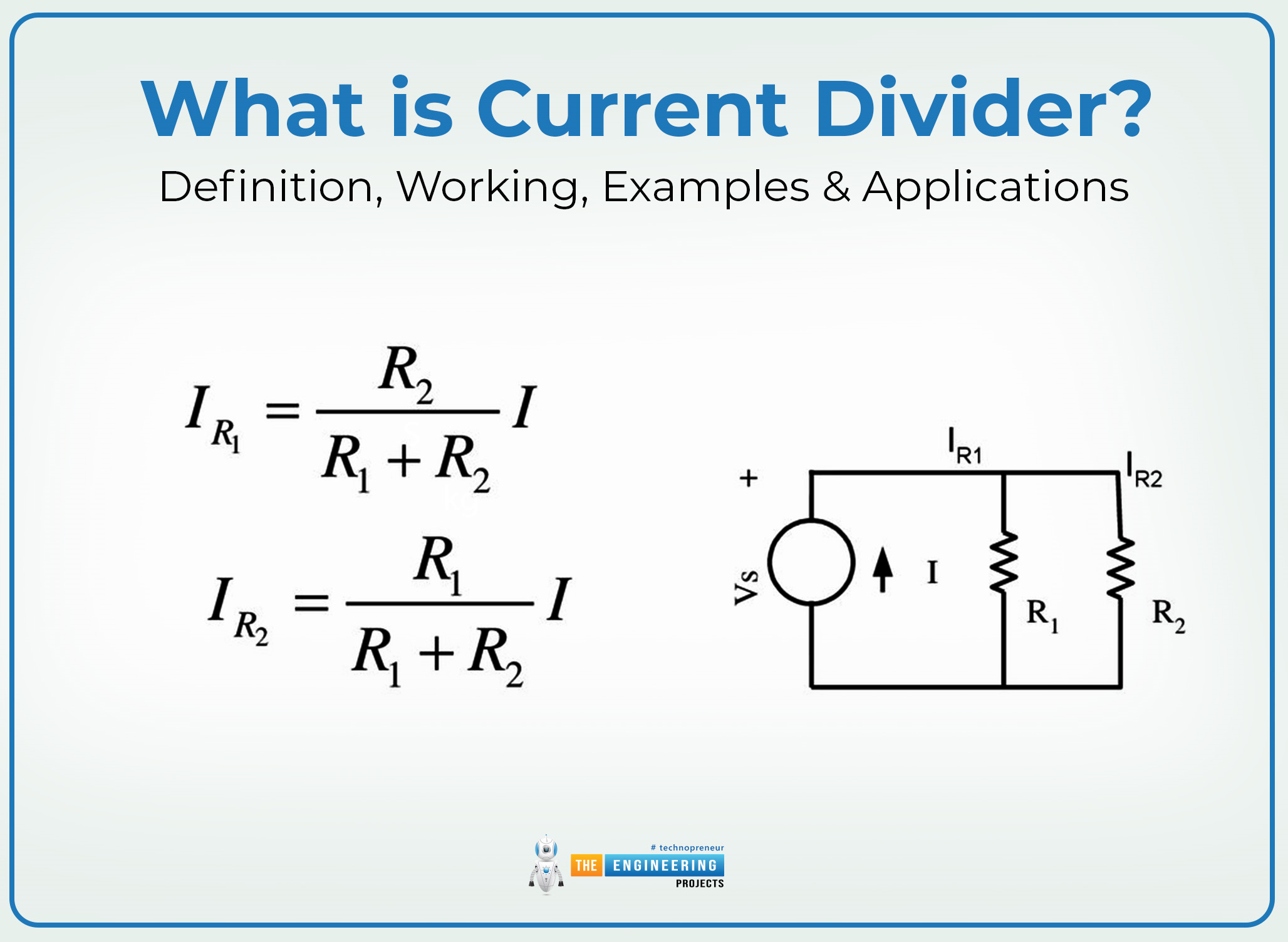
Understanding the Current Divider Rule is fundamental for anyone working with electrical circuits. This rule is a cornerstone of circuit analysis, particularly in the realm of series and parallel circuits. It allows engineers and technicians to determine the current flowing through different branches of a circuit, which is crucial for designing and troubleshooting electrical systems.
What is the Current Divider Rule?
The Current Divider Rule is a fundamental principle in electrical engineering that helps in determining the current through a branch in a parallel circuit. It is analogous to the voltage divider rule but applies to currents instead of voltages. The rule states that the current through a branch in a parallel circuit is proportional to the conductance of that branch relative to the total conductance of all branches.
Understanding Conductance
Before diving into the Current Divider Rule, it's essential to understand conductance. Conductance (G) is the reciprocal of resistance (R) and is measured in siemens (S). The formula for conductance is:
G = 1/R
In a parallel circuit, the total conductance (GT) is the sum of the conductances of all branches. If you have two branches with conductances G1 and G2, the total conductance is:
GT = G1 + G2
Applying the Current Divider Rule
The Current Divider Rule can be expressed mathematically as follows:
Ix = IT * (Gx / GT)
Where:
- Ix is the current through the branch of interest.
- IT is the total current entering the parallel branches.
- Gx is the conductance of the branch of interest.
- GT is the total conductance of all parallel branches.
Let's break down the steps to apply the Current Divider Rule:
- Identify the total current (IT) entering the parallel branches.
- Determine the conductance (Gx) of the branch for which you want to find the current.
- Calculate the total conductance (GT) of all parallel branches.
- Apply the formula to find the current through the branch of interest.
💡 Note: The Current Divider Rule is particularly useful in circuits with multiple parallel branches, where calculating individual currents manually can be complex.
Example Calculation
Consider a circuit with two parallel branches. Branch 1 has a resistance of 10 ohms, and Branch 2 has a resistance of 20 ohms. The total current entering the parallel branches is 5 amperes. Let's find the current through each branch.
First, calculate the conductances:
G1 = 1/10 = 0.1 S
G2 = 1/20 = 0.05 S
Next, calculate the total conductance:
GT = G1 + G2 = 0.1 S + 0.05 S = 0.15 S
Now, apply the Current Divider Rule to find the current through each branch:
I1 = IT * (G1 / GT) = 5 A * (0.1 S / 0.15 S) = 3.33 A
I2 = IT * (G2 / GT) = 5 A * (0.05 S / 0.15 S) = 1.67 A
So, the current through Branch 1 is 3.33 amperes, and the current through Branch 2 is 1.67 amperes.
Practical Applications of the Current Divider Rule
The Current Divider Rule has numerous practical applications in electrical engineering. Some of the key areas where this rule is applied include:
- Power Distribution Systems: In power distribution networks, the Current Divider Rule helps in determining the current flowing through different branches, ensuring balanced load distribution and efficient power delivery.
- Electronic Circuits: In electronic circuits, especially those involving multiple parallel components, the Current Divider Rule is used to analyze and design circuits for optimal performance.
- Sensor Networks: In sensor networks, where multiple sensors are connected in parallel, the Current Divider Rule helps in calculating the current drawn by each sensor, aiding in power management and data accuracy.
- Automotive Electronics: In automotive systems, the Current Divider Rule is used to analyze the current distribution in various electrical components, ensuring reliable operation and safety.
Common Mistakes to Avoid
When applying the Current Divider Rule, it's essential to avoid common mistakes that can lead to incorrect calculations. Some of these mistakes include:
- Incorrect Conductance Calculation: Ensure that you correctly calculate the conductance of each branch and the total conductance. A mistake here can lead to significant errors in the current calculation.
- Ignoring Parallel Branches: Make sure to consider all parallel branches in the circuit. Ignoring even a single branch can result in inaccurate current values.
- Confusing Resistance and Conductance: Remember that conductance is the reciprocal of resistance. Confusing these two can lead to incorrect calculations.
💡 Note: Double-check your calculations and ensure that all branches are accounted for to avoid errors in applying the Current Divider Rule.
Advanced Topics in Current Divider Rule
While the basic Current Divider Rule is straightforward, there are advanced topics and variations that can be explored for more complex circuits. Some of these include:
- Current Divider Rule in AC Circuits: In alternating current (AC) circuits, the Current Divider Rule can be applied using complex impedances instead of resistances. This involves understanding the concepts of reactance and impedance.
- Current Divider Rule in Non-Linear Circuits: In non-linear circuits, where components like diodes and transistors are present, the Current Divider Rule may need to be adapted to account for the non-linear behavior of these components.
- Current Divider Rule in Multi-Branch Circuits: In circuits with multiple parallel branches, the Current Divider Rule can be extended to calculate the current through each branch by considering the total conductance of all branches.
These advanced topics require a deeper understanding of circuit theory and may involve more complex mathematical calculations.
Conclusion
The Current Divider Rule is a powerful tool in the arsenal of electrical engineers and technicians. It simplifies the analysis of parallel circuits by providing a straightforward method to calculate the current through individual branches. By understanding and applying this rule, one can design and troubleshoot electrical systems more efficiently. Whether in power distribution, electronic circuits, or sensor networks, the Current Divider Rule plays a crucial role in ensuring accurate and reliable performance. Mastering this rule is essential for anyone working in the field of electrical engineering, as it forms the basis for more complex circuit analysis techniques.
Related Terms:
- current divider rule calculator
- voltage divider
- current divider rule examples
- current divider calculator
- current division rule