Understanding the concept of a constant of variation is crucial in various fields of mathematics and science. This concept helps in establishing relationships between variables and is fundamental in solving problems involving direct and inverse proportions. In this post, we will delve into the definition, applications, and examples of the constant of variation, providing a comprehensive guide for students and professionals alike.
What is a Constant of Variation?
A constant of variation is a value that remains unchanged in a relationship between two variables. It is often denoted by the letter 'k' and is used to describe the proportionality between two quantities. In direct variation, the ratio of the two variables is constant, while in inverse variation, the product of the two variables is constant.
Direct Variation
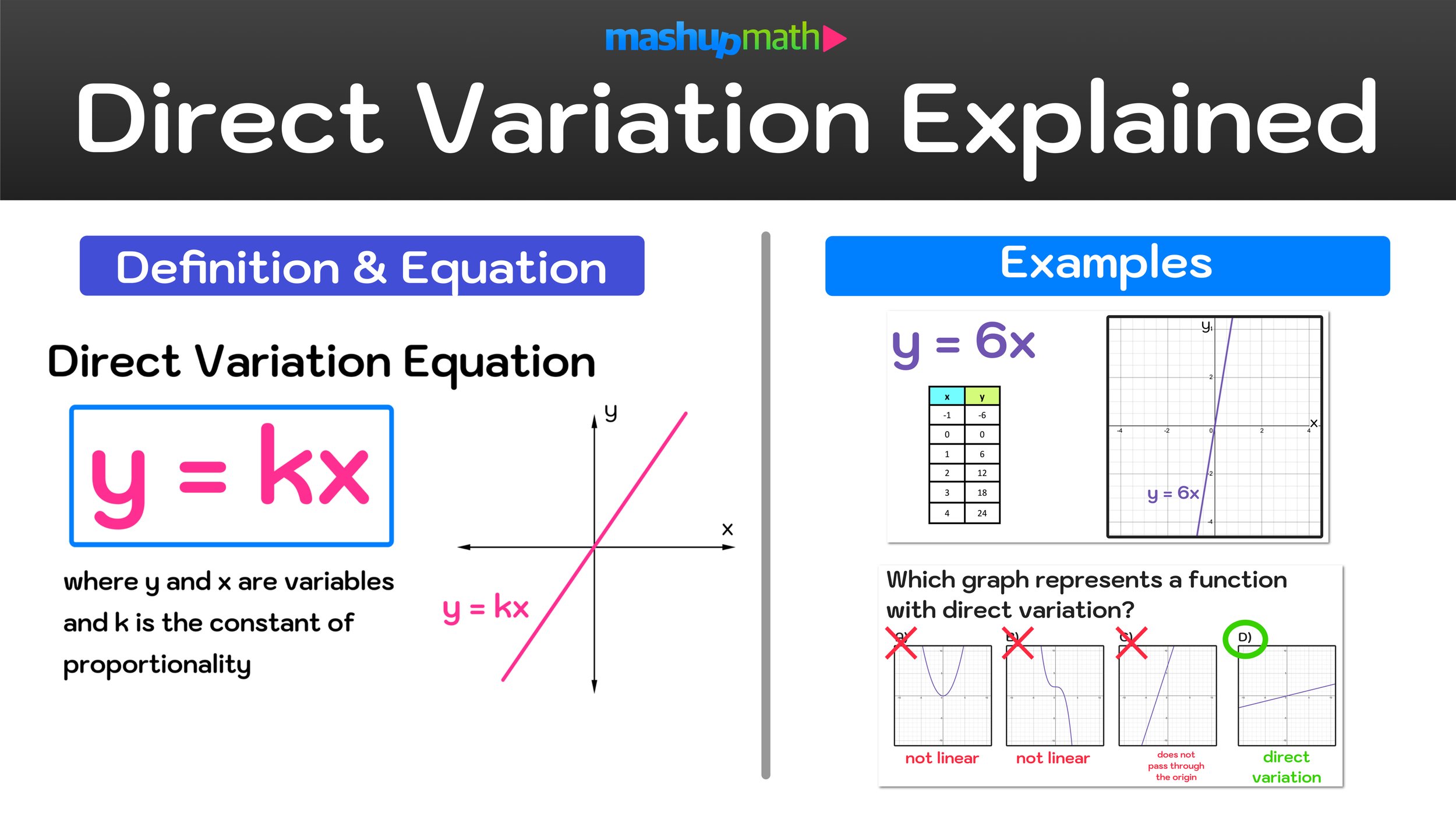
In direct variation, as one variable increases, the other variable also increases, and vice versa. The relationship can be expressed as:
y = kx
where y and x are the variables, and k is the constant of variation. For example, if the cost of apples is directly proportional to the number of apples, the cost per apple is the constant of variation.
Inverse Variation
In inverse variation, as one variable increases, the other variable decreases, and vice versa. The relationship can be expressed as:
y = k/x
where y and x are the variables, and k is the constant of variation. For example, if the time taken to complete a task is inversely proportional to the number of workers, the product of time and the number of workers is the constant of variation.
Applications of the Constant of Variation
The concept of the constant of variation is widely used in various fields. Here are some key applications:
- Physics: In physics, the constant of variation is used to describe relationships between physical quantities. For example, Hooke's Law states that the force exerted by a spring is directly proportional to the displacement of the spring.
- Economics: In economics, the constant of variation is used to describe relationships between economic variables. For example, the demand for a good may be inversely proportional to its price.
- Engineering: In engineering, the constant of variation is used to describe relationships between engineering parameters. For example, the resistance of a wire is directly proportional to its length and inversely proportional to its cross-sectional area.
Examples of the Constant of Variation
Let's look at some examples to illustrate the concept of the constant of variation.
Example 1: Direct Variation
If the cost of 5 apples is $10, find the cost of 8 apples.
Let the cost of apples be y and the number of apples be x. The constant of variation k can be found using the given information:
y = kx
Substituting the given values:
10 = k * 5
Solving for k:
k = 10 / 5 = 2
Now, to find the cost of 8 apples:
y = k * 8
y = 2 * 8 = 16
Therefore, the cost of 8 apples is $16.
Example 2: Inverse Variation
If 4 workers can complete a task in 6 hours, how long will it take for 6 workers to complete the same task?
Let the time taken be y and the number of workers be x. The constant of variation k can be found using the given information:
y = k/x
Substituting the given values:
6 = k / 4
Solving for k:
k = 6 * 4 = 24
Now, to find the time taken by 6 workers:
y = k / 6
y = 24 / 6 = 4
Therefore, it will take 6 workers 4 hours to complete the task.
Calculating the Constant of Variation
To calculate the constant of variation, you need to know the values of the two variables involved in the relationship. Here are the steps to calculate the constant of variation for both direct and inverse variations:
Direct Variation
1. Identify the two variables x and y.
2. Use the formula y = kx to express the relationship.
3. Substitute the known values of x and y into the formula.
4. Solve for k.
💡 Note: Ensure that the units of measurement for both variables are consistent.
Inverse Variation
1. Identify the two variables x and y.
2. Use the formula y = k/x to express the relationship.
3. Substitute the known values of x and y into the formula.
4. Solve for k.
💡 Note: Ensure that the units of measurement for both variables are consistent.
Common Mistakes to Avoid
When working with the constant of variation, it's important to avoid common mistakes that can lead to incorrect results. Here are some pitfalls to watch out for:
- Incorrect Formula: Ensure you are using the correct formula for direct or inverse variation. Mixing up the formulas can lead to incorrect calculations.
- Inconsistent Units: Make sure the units of measurement for both variables are consistent. Inconsistent units can result in incorrect values for the constant of variation.
- Incorrect Values: Double-check the values of the variables to ensure they are correct. Incorrect values can lead to incorrect calculations.
Practical Examples in Real Life
To further illustrate the concept of the constant of variation, let's look at some practical examples from real life.
Example 1: Distance and Speed
If a car travels at a constant speed of 60 miles per hour, how far will it travel in 3 hours?
Let the distance traveled be y and the time be x. The constant of variation k is the speed of the car:
y = kx
Substituting the given values:
y = 60 * 3
y = 180
Therefore, the car will travel 180 miles in 3 hours.
Example 2: Work and Time
If 5 workers can complete a task in 8 hours, how long will it take for 10 workers to complete the same task?
Let the time taken be y and the number of workers be x. The constant of variation k can be found using the given information:
y = k/x
Substituting the given values:
8 = k / 5
Solving for k:
k = 8 * 5 = 40
Now, to find the time taken by 10 workers:
y = k / 10
y = 40 / 10 = 4
Therefore, it will take 10 workers 4 hours to complete the task.
Advanced Concepts
Beyond the basic concepts of direct and inverse variation, there are more advanced topics that involve the constant of variation. These include joint variation, combined variation, and partial variation.
Joint Variation
In joint variation, a variable is directly proportional to two or more other variables. The relationship can be expressed as:
y = k * x1 * x2 * ... * xn
where y is the dependent variable, x1, x2, ..., xn are the independent variables, and k is the constant of variation. For example, the volume of a rectangular prism is jointly proportional to its length, width, and height.
Combined Variation
In combined variation, a variable is directly proportional to one variable and inversely proportional to another. The relationship can be expressed as:
y = k * x1 / x2
where y is the dependent variable, x1 and x2 are the independent variables, and k is the constant of variation. For example, the speed of a car is directly proportional to the distance traveled and inversely proportional to the time taken.
Partial Variation
In partial variation, a variable is directly proportional to one variable and inversely proportional to another, but with an additional constant term. The relationship can be expressed as:
y = k * x1 / x2 + c
where y is the dependent variable, x1 and x2 are the independent variables, k is the constant of variation, and c is a constant term. For example, the cost of producing a good may be partially proportional to the number of units produced and the cost of raw materials, with an additional fixed cost.
Conclusion
The concept of the constant of variation is fundamental in understanding relationships between variables in mathematics and science. Whether dealing with direct, inverse, joint, combined, or partial variations, the constant of variation provides a consistent framework for analyzing and solving problems. By mastering this concept, students and professionals can gain a deeper understanding of proportional relationships and apply them to real-world scenarios. The examples and applications discussed in this post illustrate the versatility and importance of the constant of variation in various fields, making it an essential tool for anyone working with mathematical and scientific principles.
Related Terms:
- constant of variation meaning
- constant of variation example
- constant of variation formula
- constant of variation definition math
- constant of variation calculator
- constant of proportionality