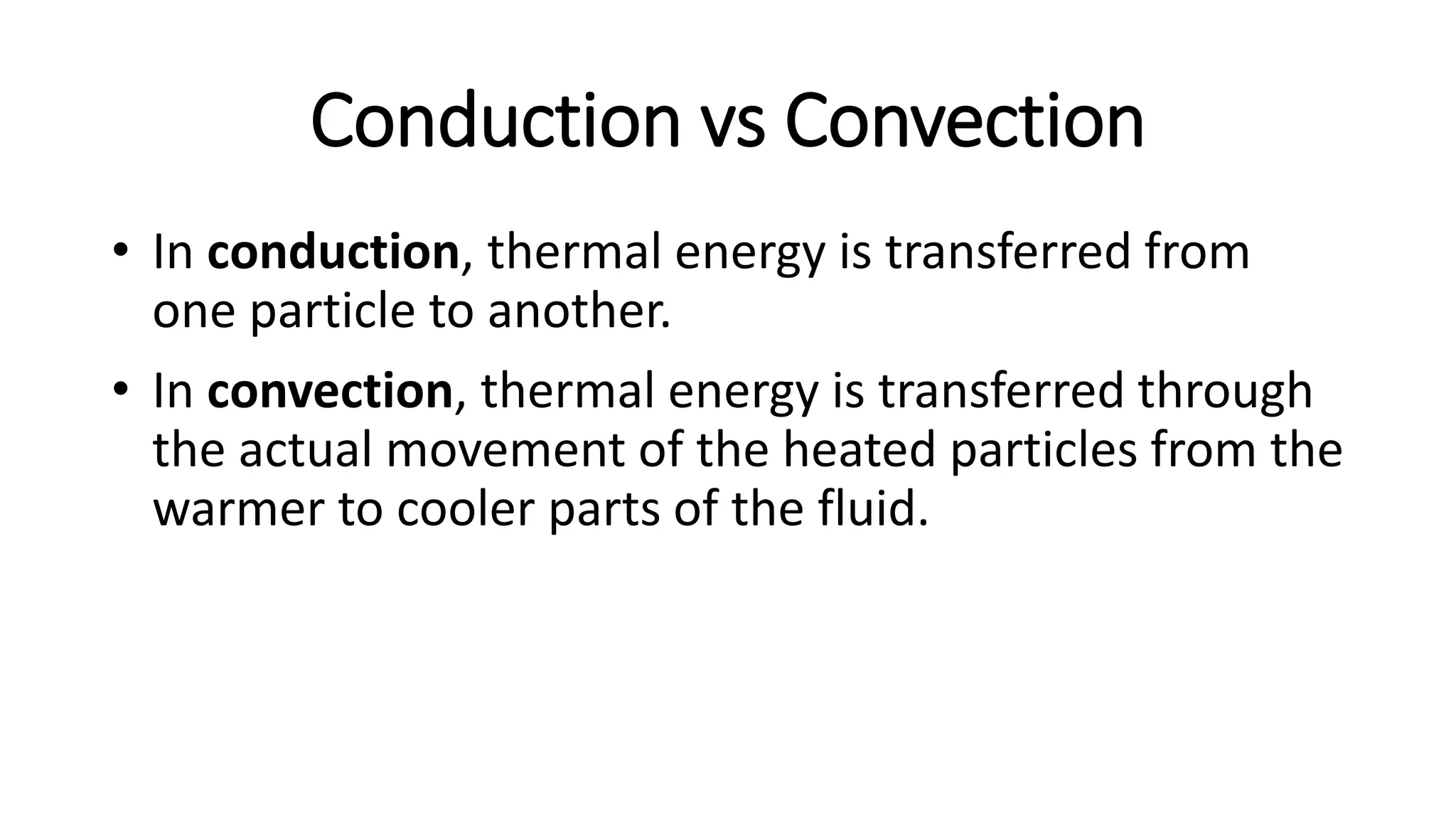
Understanding the principles of heat transfer is crucial in various fields, from engineering and physics to everyday applications like cooking and climate control. Two fundamental modes of heat transfer are conduction versus convection. While both processes involve the movement of heat from one place to another, they operate through different mechanisms and have distinct characteristics. This post will delve into the differences between conduction and convection, their applications, and the factors that influence each process.
Understanding Conduction
Conduction is the process by which heat is transferred through direct contact between objects or within a single object. This mode of heat transfer occurs when molecules in a substance collide with each other, transferring kinetic energy from hotter to cooler regions. The rate of heat transfer by conduction depends on several factors, including the material's thermal conductivity, the temperature difference, and the cross-sectional area through which the heat is flowing.
Materials with high thermal conductivity, such as metals, are excellent conductors of heat. For example, copper and aluminum are commonly used in heat exchangers and cooking utensils because they efficiently transfer heat. On the other hand, materials with low thermal conductivity, like wood and plastic, are poor conductors and are often used as insulators.
Factors Affecting Conduction
Several factors influence the rate of heat transfer by conduction:
- Thermal Conductivity: This is a material property that indicates how well a substance conducts heat. Metals generally have high thermal conductivity, while non-metals like wood and glass have lower values.
- Temperature Difference: A larger temperature difference between two points results in a higher rate of heat transfer.
- Cross-Sectional Area: A larger cross-sectional area allows for more heat to be transferred.
- Thickness: Thicker materials provide more resistance to heat flow, reducing the rate of conduction.
Applications of Conduction
Conduction has numerous practical applications in various industries:
- Cooking: Heat is transferred from the stove to the pot and then to the food through conduction.
- Electronics: Heat sinks and thermal pads use conduction to dissipate heat from electronic components.
- Building Insulation: Materials like fiberglass and foam are used to reduce heat transfer through walls and roofs.
Understanding Convection
Convection, on the other hand, is the transfer of heat through the movement of fluids (liquids or gases). This process involves the bulk movement of molecules from one place to another, carrying heat with them. Convection can be further classified into natural convection and forced convection.
Natural Convection occurs due to density differences caused by temperature variations. Warmer fluid rises because it is less dense, while cooler fluid sinks. This creates a convection current that transfers heat.
Forced Convection involves the use of external means, such as fans or pumps, to move the fluid and enhance heat transfer. This method is often used in cooling systems and heat exchangers to improve efficiency.
Factors Affecting Convection
Several factors influence the rate of heat transfer by convection:
- Fluid Properties: The thermal conductivity, viscosity, and density of the fluid affect the rate of heat transfer.
- Temperature Difference: A larger temperature difference between the fluid and the surface enhances heat transfer.
- Flow Rate: Higher flow rates increase the rate of convection, especially in forced convection systems.
- Surface Area: A larger surface area exposed to the fluid allows for more efficient heat transfer.
Applications of Convection
Convection is widely used in various applications:
- Heating and Cooling Systems: Radiators and air conditioners use convection to distribute heat or cool air throughout a space.
- Cooking: Ovens and stovetops use convection to cook food evenly by circulating hot air.
- Industrial Processes: Heat exchangers and cooling towers use convection to manage heat in manufacturing and power generation.
Conduction Versus Convection: A Comparative Analysis
While both conduction and convection are essential modes of heat transfer, they differ in several ways:
| Aspect | Conduction | Convection |
|---|---|---|
| Mechanism | Direct contact between molecules | Movement of fluids |
| Materials Involved | Solids, liquids, gases | Liquids, gases |
| Efficiency | Generally slower | Generally faster |
| Applications | Cooking utensils, electronics, insulation | Heating and cooling systems, cooking ovens, industrial processes |
Understanding the differences between conduction and convection is crucial for designing efficient heat transfer systems. For example, in a building, insulation materials are used to reduce conduction, while ventilation systems enhance convection to maintain a comfortable indoor environment.
💡 Note: In some cases, both conduction and convection can occur simultaneously. For instance, in a pot of boiling water, heat is transferred from the stove to the pot through conduction, and then from the pot to the water through convection.
In summary, conduction and convection are two fundamental modes of heat transfer that play crucial roles in various applications. Conduction involves the direct transfer of heat through molecular collisions, while convection relies on the movement of fluids to carry heat. Understanding the principles and factors affecting each process is essential for optimizing heat transfer in different scenarios. By leveraging the strengths of both conduction and convection, engineers and scientists can design more efficient and effective systems for heating, cooling, and energy management.
Related Terms:
- difference between conduction and convection
- conduction vs convection cooling
- radiant heat vs convection conduction
- conduction vs convection heat transfer
- convection and conduction current
- conduction vs convection heat loss