Understanding the concepts of concave up and concave down is fundamental in calculus and has wide-ranging applications in various fields such as physics, engineering, and economics. These concepts help in analyzing the behavior of functions and their derivatives, providing insights into the curvature and trends of data. This post will delve into the definitions, properties, and applications of concave up and concave down functions, offering a comprehensive guide for both beginners and advanced learners.
Understanding Concave Up and Concave Down
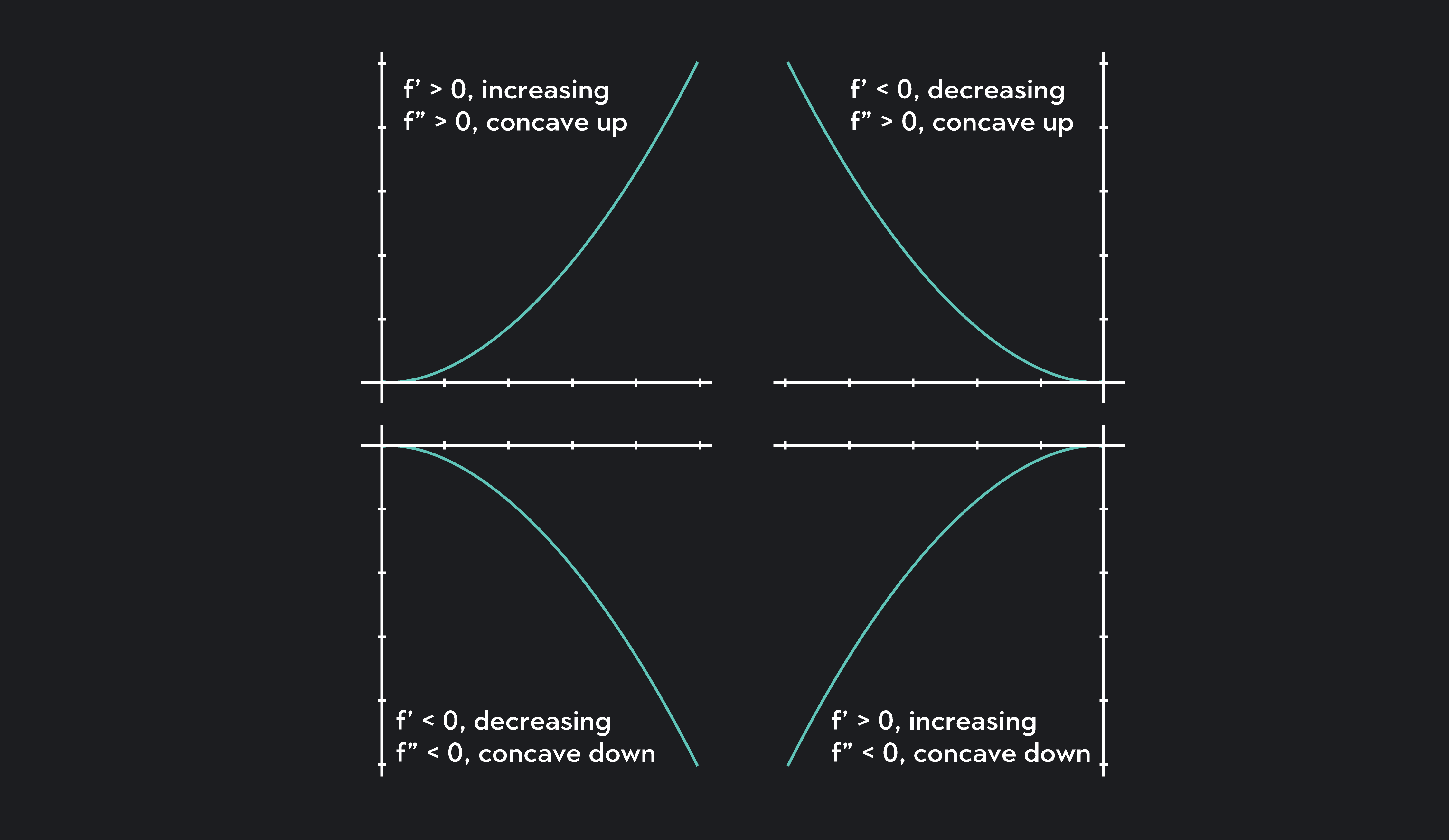
Concave up and concave down are terms used to describe the shape of a function's graph. A function is said to be concave up if its graph curves upwards, resembling a smile or the shape of a bowl. Conversely, a function is concave down if its graph curves downwards, resembling a frown or the shape of an inverted bowl. These concepts are crucial for understanding the behavior of functions and their derivatives.
Mathematical Definitions
To formally define concave up and concave down, we need to understand the second derivative of a function. The second derivative, denoted as f''(x), provides information about the concavity of the function.
- Concave Up: A function f(x) is concave up on an interval if f''(x) > 0 for all x in that interval. This means the function's graph curves upwards.
- Concave Down: A function f(x) is concave down on an interval if f''(x) < 0 for all x in that interval. This means the function's graph curves downwards.
For example, consider the function f(x) = x^2. The first derivative is f'(x) = 2x, and the second derivative is f''(x) = 2. Since f''(x) = 2 > 0 for all x, the function f(x) = x^2 is concave up for all x.
Graphical Representation
Visualizing concave up and concave down functions can help in understanding their properties. Below are the graphical representations of a concave up and a concave down function.

In the graph above, the function on the left is concave up, while the function on the right is concave down. The concave up function curves upwards, and the concave down function curves downwards.
Applications of Concave Up and Concave Down
The concepts of concave up and concave down have numerous applications in various fields. Here are some key areas where these concepts are applied:
- Physics: In physics, concave up and concave down functions are used to describe the motion of objects under the influence of forces. For example, the trajectory of a projectile can be analyzed using concave up and concave down functions.
- Engineering: In engineering, these concepts are used in the design and analysis of structures and systems. For instance, the stability of a bridge can be analyzed using concave up and concave down functions to ensure it can withstand various loads.
- Economics: In economics, concave up and concave down functions are used to model supply and demand curves, cost functions, and revenue functions. Understanding the concavity of these functions helps in making informed economic decisions.
Identifying Concave Up and Concave Down Functions
To identify whether a function is concave up or concave down, follow these steps:
- Find the first derivative of the function f(x).
- Find the second derivative of the function f(x).
- Analyze the sign of the second derivative f''(x):
- If f''(x) > 0, the function is concave up.
- If f''(x) < 0, the function is concave down.
For example, consider the function f(x) = -x^2 + 4x + 5. The first derivative is f'(x) = -2x + 4, and the second derivative is f''(x) = -2. Since f''(x) = -2 < 0 for all x, the function f(x) = -x^2 + 4x + 5 is concave down for all x.
💡 Note: Remember that the second derivative test is a powerful tool for determining the concavity of a function, but it is not the only method. Other techniques, such as the first derivative test and graphical analysis, can also be used to determine concavity.
Concavity and Inflection Points
Inflection points are points on a function's graph where the concavity changes. At an inflection point, the second derivative f''(x) is zero, and the concavity of the function changes from concave up to concave down or vice versa.
To find inflection points, follow these steps:
- Find the second derivative of the function f(x).
- Set the second derivative equal to zero and solve for x.
- Check the concavity of the function on either side of the critical points to determine if the concavity changes.
For example, consider the function f(x) = x^3 - 3x^2 + 3. The second derivative is f''(x) = 6x - 6. Setting f''(x) = 0 gives x = 1. Checking the concavity on either side of x = 1:
| Interval | Concavity |
|---|---|
| x < 1 | Concave down |
| x > 1 | Concave up |
Since the concavity changes from concave down to concave up at x = 1, x = 1 is an inflection point.
💡 Note: Inflection points are important in analyzing the behavior of functions, as they indicate where the concavity changes. Understanding inflection points can provide insights into the function's overall shape and behavior.
Real-World Examples
To illustrate the practical applications of concave up and concave down functions, let's consider a few real-world examples:
- Projectile Motion: The trajectory of a projectile can be modeled using a quadratic function, which is concave down. The height of the projectile as a function of time can be described by h(t) = -16t^2 + v_0t + h_0, where v_0 is the initial velocity and h_0 is the initial height. The second derivative h''(t) = -32 is always negative, indicating that the trajectory is concave down.
- Cost Functions: In economics, cost functions often exhibit concave up behavior. For example, the cost of producing x units of a product might be modeled by C(x) = 100 + 5x + 0.01x^2. The second derivative C''(x) = 0.02 is always positive, indicating that the cost function is concave up. This means that the marginal cost of production increases as more units are produced.
- Population Growth: Population growth models, such as the logistic growth model, can exhibit both concave up and concave down behavior. The logistic growth model is given by P(t) = frac{K}{1 + e^{-rt}}, where K is the carrying capacity and r is the growth rate. The second derivative of this function changes sign, indicating that the population growth rate first increases (concave up) and then decreases (concave down) as the population approaches the carrying capacity.
These examples demonstrate the versatility of concave up and concave down functions in modeling real-world phenomena. Understanding these concepts can provide valuable insights into the behavior of various systems and processes.
In conclusion, concave up and concave down functions are essential tools in calculus and have wide-ranging applications in various fields. By understanding the definitions, properties, and applications of these functions, one can gain a deeper appreciation for the behavior of functions and their derivatives. Whether analyzing projectile motion, cost functions, or population growth, the concepts of concave up and concave down provide a powerful framework for understanding and predicting the behavior of complex systems.
Related Terms:
- concave up and down explained
- concave up and down intervals
- concave up and down formula
- concave up and down calculator
- concave up and down function
- concave up and down examples