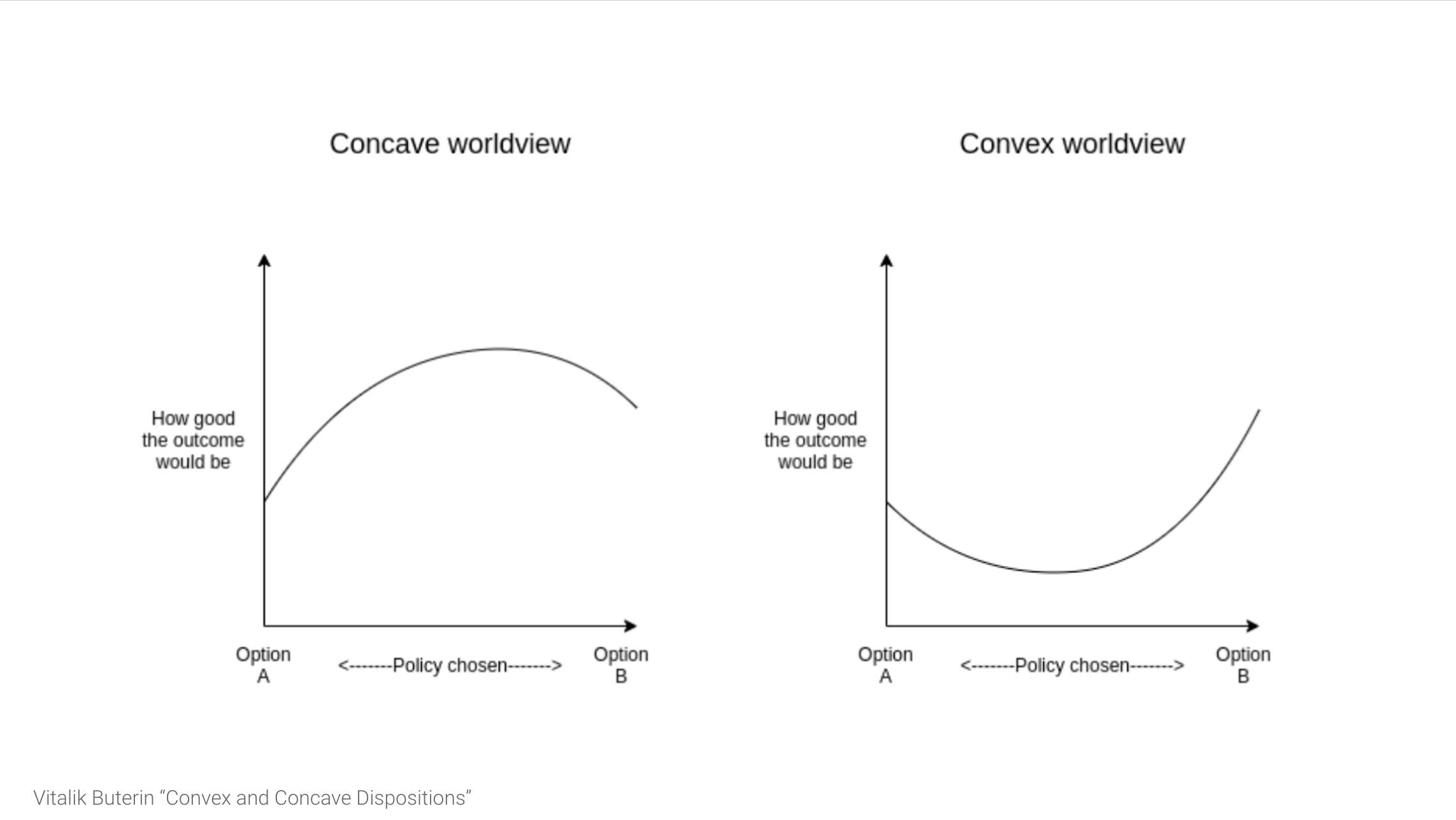
Understanding the behavior of functions and their graphs is a fundamental aspect of calculus and mathematics in general. One of the key concepts in this area is the concave down graph, which provides insights into how a function's rate of change varies over its domain. This post will delve into the intricacies of concave down graphs, their properties, and how to identify them.
What is a Concave Down Graph?
A concave down graph is a visual representation of a function where the curve bends downward. This means that as you move from left to right along the graph, the slope of the tangent lines decreases. In other words, the function’s rate of increase slows down, or the function’s rate of decrease speeds up. This behavior is often associated with functions that have a negative second derivative.
Properties of Concave Down Graphs
To better understand concave down graphs, let’s explore some of their key properties:
- Second Derivative Test: A function f(x) is concave down on an interval if its second derivative f”(x) is negative on that interval.
- Tangent Lines: The slope of the tangent lines to the graph decreases as you move from left to right.
- Inflection Points: Concave down graphs can have inflection points, where the concavity changes from down to up or vice versa.
- Visual Cue: The graph appears to “cup” downward, resembling the shape of a valley.
Identifying Concave Down Graphs
Identifying a concave down graph involves several steps. Here’s a systematic approach:
- Calculate the Second Derivative: Find the second derivative of the function. If the second derivative is negative over an interval, the function is concave down on that interval.
- Analyze the Graph: Visually inspect the graph to see if it bends downward. This can be a quick way to confirm concavity.
- Check Tangent Slopes: Determine the slopes of the tangent lines at various points. If the slopes decrease as you move along the graph, the function is likely concave down.
📝 Note: Remember that the second derivative test is a reliable method for determining concavity, but visual inspection can also be very helpful, especially for simple functions.
Examples of Concave Down Functions
Let’s look at a few examples to solidify our understanding:
Example 1: Quadratic Function
Consider the function f(x) = -x². This is a simple quadratic function.
- First Derivative: f’(x) = -2x
- Second Derivative: f”(x) = -2
Since the second derivative is negative, the function f(x) = -x² is concave down for all x.
Example 2: Cubic Function
Consider the function f(x) = x³ - 3x² + 3x.
- First Derivative: f’(x) = 3x² - 6x + 3
- Second Derivative: f”(x) = 6x - 6
To find where the function is concave down, set the second derivative less than zero:
- 6x - 6 < 0
- x < 1
Therefore, the function f(x) = x³ - 3x² + 3x is concave down for x < 1.
Applications of Concave Down Graphs
Concave down graphs have numerous applications in various fields, including economics, physics, and engineering. Here are a few examples:
Economics
In economics, concave down graphs are often used to model diminishing returns. For instance, the marginal cost of producing additional units of a good may decrease initially but then increase as production scales up. This behavior can be represented by a concave down graph.
Physics
In physics, concave down graphs can represent the motion of objects under certain conditions. For example, the velocity of a falling object under the influence of air resistance can be modeled by a concave down graph, as the velocity increases at a decreasing rate.
Engineering
In engineering, concave down graphs are used to analyze the performance of systems. For instance, the efficiency of a machine may increase initially but then decrease as it approaches its maximum capacity. This behavior can be represented by a concave down graph.
Visualizing Concave Down Graphs
Visualizing concave down graphs can be very helpful in understanding their behavior. Here are some tips for creating effective visualizations:
- Use Graphing Software: Tools like Desmos, GeoGebra, or even Excel can help you plot functions and visualize their concavity.
- Label Key Points: Mark important points such as inflection points, maxima, and minima to provide context.
- Include Tangent Lines: Drawing tangent lines at various points can help illustrate how the slope changes.
📝 Note: When creating visualizations, ensure that the scale of the axes is appropriate to capture the essential features of the graph.
Common Misconceptions
There are a few common misconceptions about concave down graphs that can lead to errors in analysis:
- Confusing Concavity with Monotonicity: Concavity refers to the direction in which the graph bends, not whether the function is increasing or decreasing.
- Ignoring Inflection Points: Inflection points are crucial as they indicate where the concavity changes. Ignoring them can lead to incorrect conclusions.
- Relying Solely on Visual Inspection: While visual inspection can be helpful, it should be complemented with mathematical analysis, especially for complex functions.
📝 Note: Always verify your conclusions with both visual and mathematical methods to ensure accuracy.
Conclusion
Understanding concave down graphs is essential for analyzing the behavior of functions and their rates of change. By examining the second derivative, visualizing the graph, and considering real-world applications, we can gain a comprehensive understanding of these important mathematical concepts. Whether in economics, physics, or engineering, concave down graphs provide valuable insights into the behavior of systems and processes.
Related Terms:
- what is concave downward
- concave up vs down graph
- decreasing and concave up graph
- positive vs negative concavity
- concave up vs down
- concave upward and downward examples