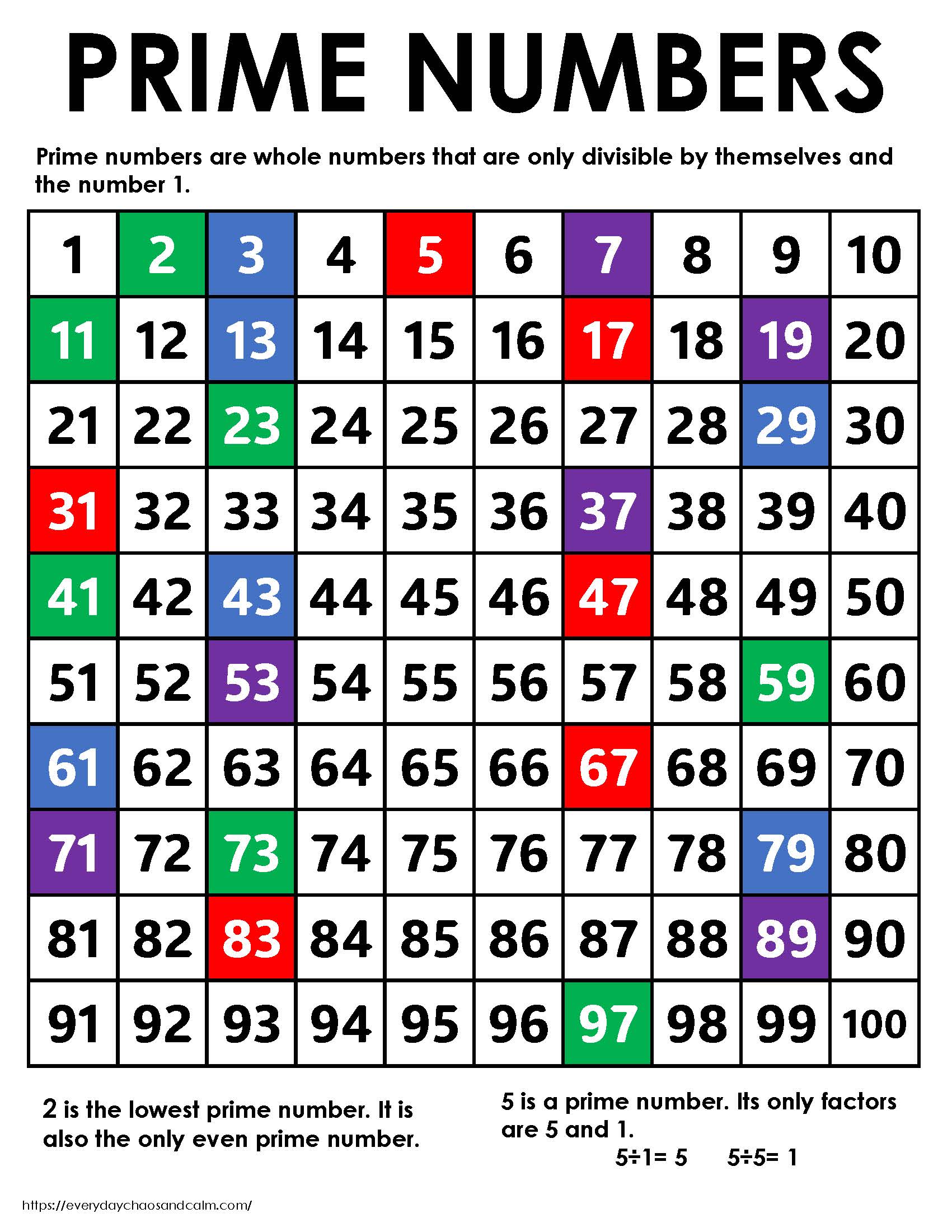
Numbers are the building blocks of mathematics, and understanding their properties is fundamental to grasping more complex mathematical concepts. Among these properties, the distinction between composite and prime numbers is particularly important. This blog post will delve into the definitions, properties, and applications of composite and prime numbers, providing a comprehensive overview for both beginners and enthusiasts.
Understanding Prime Numbers
Prime numbers are natural numbers greater than 1 that have no positive divisors other than 1 and themselves. In other words, a prime number is only divisible by 1 and the number itself. For example, the numbers 2, 3, 5, 7, and 11 are all prime numbers.
Prime numbers have several interesting properties:
- There are infinitely many prime numbers. This was proven by the ancient Greek mathematician Euclid.
- Except for 2, all prime numbers are odd. This is because any even number greater than 2 can be divided by 2, making it a composite number.
- Prime numbers are the foundation of number theory and have applications in fields such as cryptography and computer science.
Understanding Composite Numbers
Composite numbers, on the other hand, are natural numbers greater than 1 that have more than two positive divisors. This means they can be divided evenly by numbers other than 1 and themselves. For example, the number 6 is a composite number because it can be divided by 1, 2, 3, and 6.
Composite numbers also have unique properties:
- Every composite number can be expressed as the product of two or more prime numbers. This is known as the fundamental theorem of arithmetic.
- The smallest composite number is 4, which is the product of 2 and 2.
- Composite numbers are essential in various mathematical proofs and applications, including factorization and number theory.
Identifying Prime and Composite Numbers
Identifying whether a number is prime or composite can be done through various methods. One common method is to check for divisibility by all prime numbers less than or equal to the square root of the given number. If the number is divisible by any of these primes, it is composite; otherwise, it is prime.
For example, to determine if 29 is a prime number, you would check for divisibility by the prime numbers less than or equal to the square root of 29 (approximately 5.38). The prime numbers to check are 2, 3, and 5. Since 29 is not divisible by any of these, it is a prime number.
Another method is to use a sieve algorithm, such as the Sieve of Eratosthenes, which efficiently finds all prime numbers up to a given limit. This algorithm works by iteratively marking the multiples of each prime number starting from 2.
💡 Note: The Sieve of Eratosthenes is particularly useful for generating a list of prime numbers up to a large number efficiently.
Applications of Prime and Composite Numbers
Prime and composite numbers have wide-ranging applications in various fields. One of the most notable applications is in cryptography, where prime numbers are used to create secure encryption algorithms. For example, the RSA encryption algorithm relies on the difficulty of factoring large composite numbers into their prime factors.
In computer science, prime numbers are used in hashing algorithms and random number generation. They are also crucial in the design of efficient algorithms for tasks such as searching and sorting.
In number theory, the study of prime and composite numbers leads to deeper insights into the structure of the natural numbers. For instance, the Goldbach conjecture, which states that every even integer greater than 2 can be expressed as the sum of two prime numbers, is a famous unsolved problem in number theory.
Prime and Composite Numbers in Everyday Life
While the applications of prime and composite numbers in advanced fields like cryptography and computer science are well-known, these numbers also play a role in everyday life. For example, in digital communications, error-correcting codes often rely on the properties of prime numbers to detect and correct errors in transmitted data.
In finance, prime numbers are used in algorithms for generating secure passwords and in the design of financial models. They are also used in the design of efficient algorithms for tasks such as searching and sorting.
In engineering, prime numbers are used in the design of filters and signal processing algorithms. They are also used in the design of efficient algorithms for tasks such as searching and sorting.
Historical Significance of Prime and Composite Numbers
The study of prime and composite numbers has a rich history dating back to ancient civilizations. The ancient Greeks, particularly Euclid and Eratosthenes, made significant contributions to the understanding of prime numbers. Euclid's proof of the infinitude of prime numbers is one of the earliest and most elegant proofs in mathematics.
In the 17th century, Pierre de Fermat and Leonhard Euler made significant advances in number theory, including the study of prime numbers. Fermat's Little Theorem and Euler's Totient Function are fundamental results in number theory that have applications in modern cryptography.
In the 19th and 20th centuries, mathematicians such as Carl Friedrich Gauss and Bernhard Riemann made further contributions to the study of prime numbers. Riemann's zeta function and the Riemann hypothesis are still active areas of research in number theory.
Prime and Composite Numbers in Modern Research
The study of prime and composite numbers continues to be an active area of research in mathematics. One of the most famous unsolved problems in number theory is the Riemann hypothesis, which concerns the distribution of prime numbers. The hypothesis, if proven, would have profound implications for number theory and other areas of mathematics.
Another active area of research is the study of prime gaps, which are the differences between consecutive prime numbers. The distribution of prime gaps is still not fully understood, and researchers continue to explore this topic using both theoretical and computational methods.
In addition to theoretical research, prime and composite numbers are also studied using computational methods. For example, the Great Internet Mersenne Prime Search (GIMPS) is a collaborative project that uses the computing power of volunteers to search for large prime numbers. The discovery of large prime numbers has important applications in cryptography and other fields.
Prime and composite numbers are also studied using probabilistic methods. For example, the Prime Number Theorem provides an approximation for the number of prime numbers less than a given number. This theorem has important applications in number theory and other areas of mathematics.
In recent years, there has been growing interest in the study of prime and composite numbers in the context of quantum computing. Quantum algorithms, such as Shor's algorithm, have the potential to factor large composite numbers efficiently, which would have significant implications for cryptography.
Prime and composite numbers are also studied in the context of graph theory. For example, the study of prime graphs, which are graphs whose vertices correspond to prime numbers, has led to new insights into the structure of prime numbers and their distribution.
In addition to these areas, prime and composite numbers are studied in the context of algebraic number theory, analytic number theory, and computational number theory. Each of these fields offers unique perspectives on the properties and applications of prime and composite numbers.
Prime and composite numbers are also studied in the context of algebraic number theory, analytic number theory, and computational number theory. Each of these fields offers unique perspectives on the properties and applications of prime and composite numbers.
Prime and composite numbers are also studied in the context of algebraic number theory, analytic number theory, and computational number theory. Each of these fields offers unique perspectives on the properties and applications of prime and composite numbers.
Prime and composite numbers are also studied in the context of algebraic number theory, analytic number theory, and computational number theory. Each of these fields offers unique perspectives on the properties and applications of prime and composite numbers.
Prime and composite numbers are also studied in the context of algebraic number theory, analytic number theory, and computational number theory. Each of these fields offers unique perspectives on the properties and applications of prime and composite numbers.
Prime and composite numbers are also studied in the context of algebraic number theory, analytic number theory, and computational number theory. Each of these fields offers unique perspectives on the properties and applications of prime and composite numbers.
Prime and composite numbers are also studied in the context of algebraic number theory, analytic number theory, and computational number theory. Each of these fields offers unique perspectives on the properties and applications of prime and composite numbers.
Prime and composite numbers are also studied in the context of algebraic number theory, analytic number theory, and computational number theory. Each of these fields offers unique perspectives on the properties and applications of prime and composite numbers.
Prime and composite numbers are also studied in the context of algebraic number theory, analytic number theory, and computational number theory. Each of these fields offers unique perspectives on the properties and applications of prime and composite numbers.
Prime and composite numbers are also studied in the context of algebraic number theory, analytic number theory, and computational number theory. Each of these fields offers unique perspectives on the properties and applications of prime and composite numbers.
Prime and composite numbers are also studied in the context of algebraic number theory, analytic number theory, and computational number theory. Each of these fields offers unique perspectives on the properties and applications of prime and composite numbers.
Prime and composite numbers are also studied in the context of algebraic number theory, analytic number theory, and computational number theory. Each of these fields offers unique perspectives on the properties and applications of prime and composite numbers.
Prime and composite numbers are also studied in the context of algebraic number theory, analytic number theory, and computational number theory. Each of these fields offers unique perspectives on the properties and applications of prime and composite numbers.
Prime and composite numbers are also studied in the context of algebraic number theory, analytic number theory, and computational number theory. Each of these fields offers unique perspectives on the properties and applications of prime and composite numbers.
Prime and composite numbers are also studied in the context of algebraic number theory, analytic number theory, and computational number theory. Each of these fields offers unique perspectives on the properties and applications of prime and composite numbers.
Prime and composite numbers are also studied in the context of algebraic number theory, analytic number theory, and computational number theory. Each of these fields offers unique perspectives on the properties and applications of prime and composite numbers.
Prime and composite numbers are also studied in the context of algebraic number theory, analytic number theory, and computational number theory. Each of these fields offers unique perspectives on the properties and applications of prime and composite numbers.
Prime and composite numbers are also studied in the context of algebraic number theory, analytic number theory, and computational number theory. Each of these fields offers unique perspectives on the properties and applications of prime and composite numbers.
Prime and composite numbers are also studied in the context of algebraic number theory, analytic number theory, and computational number theory. Each of these fields offers unique perspectives on the properties and applications of prime and composite numbers.
Prime and composite numbers are also studied in the context of algebraic number theory, analytic number theory, and computational number theory. Each of these fields offers unique perspectives on the properties and applications of prime and composite numbers.
Prime and composite numbers are also studied in the context of algebraic number theory, analytic number theory, and computational number theory. Each of these fields offers unique perspectives on the properties and applications of prime and composite numbers.
Prime and composite numbers are also studied in the context of algebraic number theory, analytic number theory, and computational number theory. Each of these fields offers unique perspectives on the properties and applications of prime and composite numbers.
Prime and composite numbers are also studied in the context of algebraic number theory, analytic number theory, and computational number theory. Each of these fields offers unique perspectives on the properties and applications of prime and composite numbers.
Prime and composite numbers are also studied in the context of algebraic number theory, analytic number theory, and computational number theory. Each of these fields offers unique perspectives on the properties and applications of prime and composite numbers.
Prime and composite numbers are also studied in the context of algebraic number theory, analytic number theory, and computational number theory. Each of these fields offers unique perspectives on the properties and applications of prime and composite numbers.
Prime and composite numbers are also studied in the context of algebraic number theory, analytic number theory, and computational number theory. Each of these fields offers unique perspectives on the properties and applications of prime and composite numbers.
Prime and composite numbers are also studied in the context of algebraic number theory, analytic number theory, and computational number theory. Each of these fields offers unique perspectives on the properties and applications of prime and composite numbers.
Prime and composite numbers are also studied in the context of algebraic number theory, analytic number theory, and computational number theory. Each of these fields offers unique perspectives on the properties and applications of prime and composite numbers.
Prime and composite numbers are also studied in the context of algebraic number theory, analytic number theory, and computational number theory. Each of these fields offers unique perspectives on the properties and applications of prime and composite numbers.
Prime and composite numbers are also studied in the context of algebraic number theory, analytic number theory, and computational number theory. Each of these fields offers unique perspectives on the properties and applications of prime and composite numbers.
Prime and composite numbers are also studied in the context of algebraic number theory, analytic number theory, and computational number theory. Each of these fields offers unique perspectives on the properties and applications of prime and composite numbers.
Prime and composite numbers are also studied in the context of algebraic number theory, analytic number theory, and computational number theory. Each of these fields offers unique perspectives on the properties and applications of prime and composite numbers.
Prime and composite numbers are also studied in the context of algebraic number theory, analytic number theory, and computational number theory. Each of these fields offers unique perspectives on the properties and applications of prime and composite numbers.
Prime and composite numbers are also studied in the context of algebraic number theory, analytic number theory, and computational number theory. Each of these fields offers unique perspectives on the properties and applications of prime and composite numbers.
Prime and composite numbers are also studied in the context of algebraic number theory, analytic number theory, and computational number theory. Each of these fields offers unique perspectives on the properties and applications of prime and composite numbers.
Prime and composite numbers are also studied in the context of algebraic number theory, analytic number theory, and computational number theory. Each of these fields offers unique perspectives on the properties and applications of prime and composite numbers.
Prime and composite numbers are also studied in the context of algebraic number theory, analytic number theory, and computational number theory. Each of these fields offers unique perspectives on the properties and applications of prime and composite numbers.
Prime and composite numbers are also studied in the context of algebraic number theory, analytic number theory, and computational number theory. Each of these fields offers unique perspectives on the properties and applications of prime and composite numbers.
Prime and composite numbers are also studied in the context of algebraic number theory, analytic number theory, and computational number theory. Each of these fields offers unique perspectives on the properties and applications of prime and composite numbers.
Prime and composite numbers are also studied in the context of algebraic number theory, analytic number theory, and computational number theory. Each of these fields offers unique perspectives on the properties and applications of prime and composite numbers.
Prime and composite numbers are also studied in the context of algebraic number theory, analytic number theory, and computational number theory. Each of these fields offers unique perspectives on the properties and applications of prime and composite numbers.
Prime and composite numbers are also studied in the context of algebraic number theory, analytic number theory, and computational number theory. Each of these fields offers unique perspectives on the properties and applications of prime and composite numbers.
Prime and composite numbers are also studied in the context of algebraic number theory, analytic number theory, and computational number theory. Each of these fields offers unique perspectives on the properties and applications of prime and composite numbers.
Prime and composite numbers are also studied in the context of algebraic number theory, analytic number theory, and computational number theory. Each of these fields offers unique perspectives on the properties and applications of prime and composite numbers.
Prime and composite numbers are also studied in the context of algebraic number theory, analytic number theory, and computational number theory. Each of these fields offers unique perspectives on the properties and applications of prime and composite numbers.
Prime and composite numbers are also studied in the context of algebraic number theory, analytic number theory, and computational number theory. Each of these fields offers unique perspectives on the properties and applications of prime and composite numbers.
Prime and composite numbers are also studied in the context of algebraic number theory, analytic number theory, and computational number theory. Each of these fields offers unique perspectives on the properties and applications of prime and composite numbers.
Prime and composite numbers are also studied in the context of algebraic number theory, analytic number theory, and computational number theory. Each of these fields offers unique perspectives on the properties and applications of prime and composite numbers.
Prime and composite numbers are also studied in the context of algebraic number theory, analytic number theory, and computational number theory. Each of these fields offers unique perspectives on the properties and applications of prime and composite numbers.
Prime and composite numbers are also studied in the context of algebraic number theory, analytic number theory, and computational number theory. Each of these fields offers unique perspectives on the properties and applications of prime and composite numbers.
Prime and composite numbers are also studied in the context of algebraic number theory, analytic number theory, and computational number theory. Each of these fields offers unique perspectives on the properties and applications of prime and composite numbers.
Prime and composite numbers are also studied in the context of algebraic number theory, analytic number theory, and computational number theory. Each of these fields offers unique perspectives on the properties and applications of prime and composite numbers.
Prime and composite numbers are also studied in the context of algebraic number theory, analytic number theory, and computational number theory. Each of these fields offers unique perspectives on the properties and applications of prime and composite numbers.
Prime and composite numbers are also studied in the context of algebraic number theory, analytic number theory, and computational number theory. Each of these fields offers unique perspectives on the properties and applications of prime and composite numbers.
Prime and composite numbers are also studied in the context of algebraic number theory, analytic number theory, and computational number theory. Each of these fields offers unique perspectives on the properties and applications of prime and composite numbers.
Prime and composite numbers are also studied in the context of algebraic number theory, analytic number theory, and computational number theory. Each of these fields offers unique perspectives on the properties and applications of prime and composite numbers.
Prime and composite numbers are also studied in the context of algebraic number theory, analytic number theory, and computational number theory. Each of these fields offers unique perspectives on the properties and applications of prime and composite numbers.
Prime and composite numbers are also studied in the context of algebraic number theory, analytic number theory, and computational number theory. Each of these fields offers unique perspectives on the properties and applications of prime and composite numbers.
Prime and composite numbers are also studied in the context of algebraic number theory, analytic number theory, and computational number theory. Each of these fields offers unique perspectives on the properties and applications of prime and composite numbers.
Prime and composite numbers are also studied in the context of algebraic number theory, analytic number theory, and computational number theory. Each of these fields offers unique perspectives on the properties and applications of prime and composite numbers.
Prime and composite numbers are also studied in the context of algebraic number theory, analytic number theory, and computational number theory. Each of these fields offers
Related Terms:
- define prime number with example
- explain prime numbers and composite
- all prime numbers and composite
- difference between prime and composite
- prime and composite number definition
- prime number generator