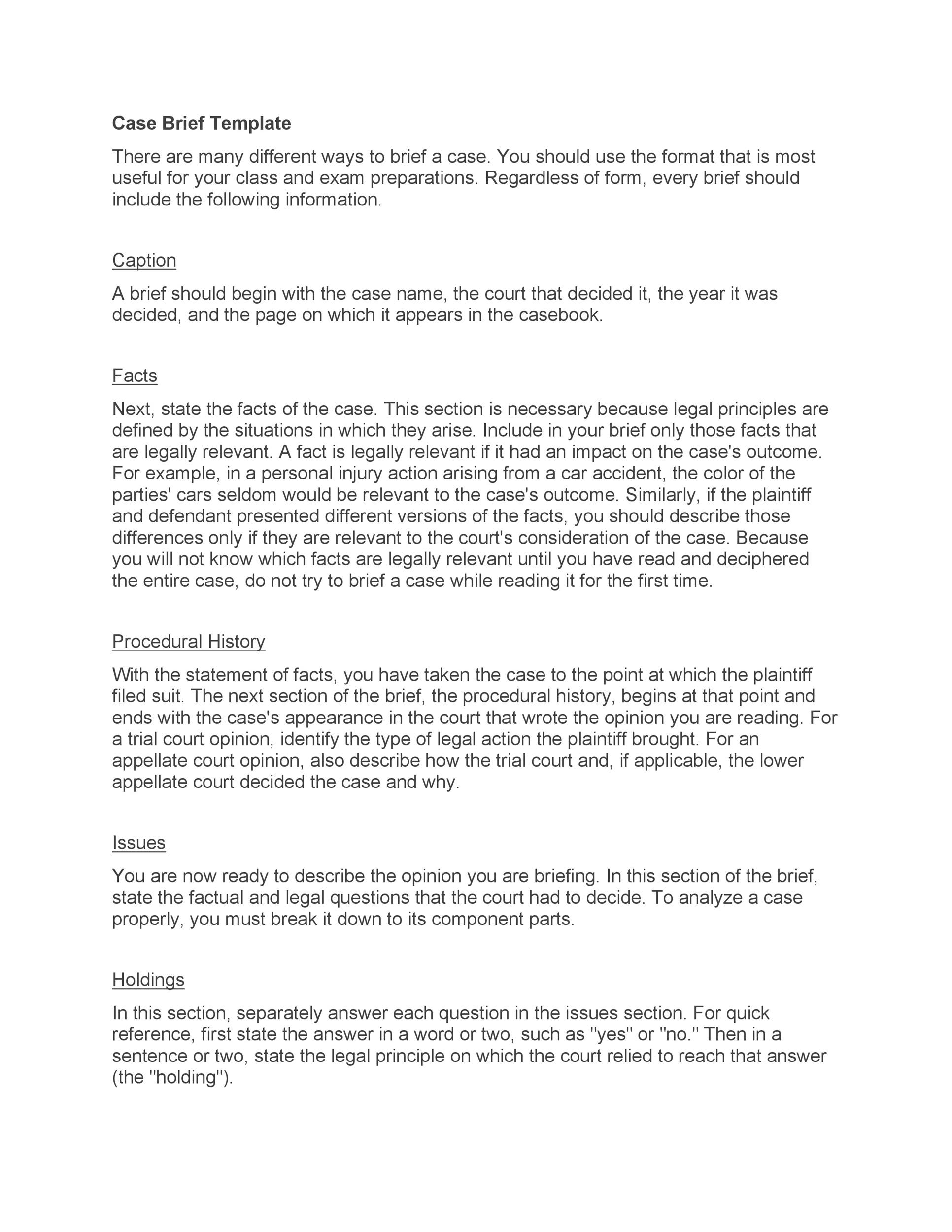
Legal writing is a critical skill for law students, lawyers, and legal professionals. One of the fundamental documents in legal writing is the case brief. A case brief is a concise summary of a legal case that highlights the key facts, issues, holdings, and reasoning. Understanding how to write a case brief is essential for analyzing and applying legal principles effectively. This post will guide you through the process of creating a case brief, using a case brief example to illustrate each step.
Understanding the Components of a Case Brief
A well-structured case brief includes several key components. These components help in organizing the information in a logical and coherent manner. The main components of a case brief are:
- Case Name and Citation: The full name of the case and the legal citation, which includes the volume number, reporter, page number, court, and year.
- Facts: A summary of the relevant facts of the case, including the parties involved, the events leading up to the lawsuit, and the key issues.
- Issues: The legal questions that the court must answer. These are the central points of contention in the case.
- Holding: The court's decision on the issues presented. This is the ruling or judgment of the court.
- Reasoning: The legal principles and arguments used by the court to reach its decision. This includes the application of statutes, regulations, and case law.
- Dissenting/Concurring Opinions: Any opinions written by judges who disagreed with the majority or who had additional points to make.
Creating a Case Brief Example
To illustrate the process of creating a case brief, let's use a hypothetical case brief example. Imagine you are briefing the landmark case Brown v. Board of Education. Here’s how you would structure it:
Case Name and Citation
Case Name: Brown v. Board of Education
Citation: 347 U.S. 483 (1954)
Facts
The case involved a group of African American parents who challenged the segregation of public schools in Topeka, Kansas. The plaintiffs argued that the "separate but equal" doctrine, established in Plessy v. Ferguson, was unconstitutional and that segregated schools were inherently unequal. The defendants, the Board of Education, argued that the schools were equal in terms of facilities and resources.
Issues
The primary issue in the case was whether racial segregation in public schools violated the Equal Protection Clause of the Fourteenth Amendment to the U.S. Constitution.
Holding
The Supreme Court held that racial segregation in public schools is unconstitutional. The Court unanimously ruled that separate educational facilities are inherently unequal and violate the Equal Protection Clause.
Reasoning
The Court's reasoning was based on several key points:
- The psychological and educational harm caused by segregation.
- The social and political implications of segregation.
- The violation of the Equal Protection Clause, which requires that all citizens be treated equally under the law.
The Court cited social science research and expert testimony to support its conclusion that segregated schools are inherently unequal. The decision overturned the "separate but equal" doctrine established in Plessy v. Ferguson and set a precedent for future civil rights cases.
Dissenting/Concurring Opinions
In this case, there were no dissenting opinions. All nine justices agreed with the majority opinion.
📝 Note: While Brown v. Board of Education is a well-known case, it is important to note that not all cases will have such clear-cut holdings and reasoning. Some cases may have multiple issues, complex reasoning, and dissenting or concurring opinions that add layers of analysis.
Step-by-Step Guide to Writing a Case Brief
Writing a case brief involves several steps. Here is a detailed guide to help you create an effective case brief:
Step 1: Read the Case Thoroughly
Before you start writing, read the case carefully. Pay attention to the facts, the legal issues, the court's reasoning, and the holding. Take notes on the key points and any questions you have.
Step 2: Identify the Key Components
Identify the key components of the case brief: the case name and citation, facts, issues, holding, reasoning, and any dissenting or concurring opinions. Use the case brief example provided earlier as a reference.
Step 3: Summarize the Facts
Write a concise summary of the facts. Include only the relevant information that is necessary to understand the legal issues and the court's decision. Avoid including unnecessary details.
Step 4: Identify the Legal Issues
Identify the legal questions that the court must answer. These are the central points of contention in the case. Clearly state the issues in a single sentence or a short paragraph.
Step 5: State the Holding
State the court's decision on the issues presented. This is the ruling or judgment of the court. Be clear and concise in your statement of the holding.
Step 6: Explain the Reasoning
Explain the legal principles and arguments used by the court to reach its decision. Include the application of statutes, regulations, and case law. Use quotes from the case to support your explanation.
Step 7: Include Dissenting/Concurring Opinions
If there are dissenting or concurring opinions, include a summary of these opinions. Explain why the dissenting or concurring judges disagreed with the majority or had additional points to make.
Step 8: Review and Edit
Review your case brief for clarity, accuracy, and completeness. Edit for grammar, punctuation, and style. Ensure that your case brief is well-organized and easy to read.
📝 Note: Writing a case brief is a skill that improves with practice. The more case briefs you write, the better you will become at identifying the key components and summarizing the information effectively.
Common Mistakes to Avoid in Case Briefs
When writing a case brief, it is important to avoid common mistakes that can undermine the effectiveness of your analysis. Here are some mistakes to avoid:
- Including Irrelevant Information: Focus on the relevant facts and legal issues. Avoid including unnecessary details that do not contribute to the analysis.
- Using Legal Jargon: Write in clear and concise language. Avoid using legal jargon that may confuse the reader.
- Ignoring Dissenting/Concurring Opinions: If there are dissenting or concurring opinions, include a summary of these opinions. They can provide valuable insights into alternative legal arguments.
- Not Citing Authorities: When explaining the reasoning, cite the relevant authorities, such as statutes, regulations, and case law. This adds credibility to your analysis.
- Poor Organization: Ensure that your case brief is well-organized. Use headings and subheadings to separate the different components of the brief.
Practical Tips for Writing Effective Case Briefs
Writing effective case briefs requires practice and attention to detail. Here are some practical tips to help you improve your case brief writing skills:
- Read Widely: Read a variety of cases to familiarize yourself with different legal issues and reasoning. This will help you develop a broader understanding of the law.
- Use Templates: Use case brief templates to ensure that you include all the necessary components. This can help you stay organized and focused.
- Practice Regularly: Write case briefs regularly to improve your skills. The more you practice, the better you will become at identifying key components and summarizing information.
- Seek Feedback: Share your case briefs with peers or mentors and seek their feedback. Constructive criticism can help you identify areas for improvement.
- Use Clear Language: Write in clear and concise language. Avoid using legal jargon that may confuse the reader.
By following these tips and practicing regularly, you can develop the skills necessary to write effective case briefs. Remember that a well-written case brief is a valuable tool for analyzing and applying legal principles.
Case briefs are essential for legal analysis and can be used in various contexts, such as:
- Legal Research: Case briefs help in understanding the legal principles and reasoning behind court decisions. They are useful for legal research and analysis.
- Class Preparation: Law students often use case briefs to prepare for class discussions and exams. A well-written case brief can help in understanding complex legal issues.
- Legal Writing: Case briefs are a fundamental component of legal writing. They help in organizing information and presenting arguments clearly and concisely.
- Practice and Advocacy: Lawyers use case briefs to prepare for court appearances and to support their arguments. A well-written case brief can be a powerful tool in legal advocacy.
In summary, case briefs are a crucial tool for legal professionals. They help in analyzing and applying legal principles effectively. By understanding the components of a case brief and following the steps outlined in this post, you can create effective case briefs that enhance your legal analysis and writing skills.
Case briefs are not just about summarizing information; they are about understanding the legal principles and reasoning behind court decisions. By practicing regularly and seeking feedback, you can develop the skills necessary to write effective case briefs. Whether you are a law student, a lawyer, or a legal professional, mastering the art of case brief writing is essential for success in the legal field.
Case briefs are a valuable tool for legal analysis and writing. They help in organizing information and presenting arguments clearly and concisely. By understanding the components of a case brief and following the steps outlined in this post, you can create effective case briefs that enhance your legal analysis and writing skills. Whether you are a law student, a lawyer, or a legal professional, mastering the art of case brief writing is essential for success in the legal field.
Case briefs are a crucial tool for legal professionals. They help in analyzing and applying legal principles effectively. By understanding the components of a case brief and following the steps outlined in this post, you can create effective case briefs that enhance your legal analysis and writing skills. Whether you are a law student, a lawyer, or a legal professional, mastering the art of case brief writing is essential for success in the legal field.
Case briefs are not just about summarizing information; they are about understanding the legal principles and reasoning behind court decisions. By practicing regularly and seeking feedback, you can develop the skills necessary to write effective case briefs. Whether you are a law student, a lawyer, or a legal professional, mastering the art of case brief writing is essential for success in the legal field.
Case briefs are a valuable tool for legal analysis and writing. They help in organizing information and presenting arguments clearly and concisely. By understanding the components of a case brief and following the steps outlined in this post, you can create effective case briefs that enhance your legal analysis and writing skills. Whether you are a law student, a lawyer, or a legal professional, mastering the art of case brief writing is essential for success in the legal field.
Case briefs are a crucial tool for legal professionals. They help in analyzing and applying legal principles effectively. By understanding the components of a case brief and following the steps outlined in this post, you can create effective case briefs that enhance your legal analysis and writing skills. Whether you are a law student, a lawyer, or a legal professional, mastering the art of case brief writing is essential for success in the legal field.
Case briefs are not just about summarizing information; they are about understanding the legal principles and reasoning behind court decisions. By practicing regularly and seeking feedback, you can develop the skills necessary to write effective case briefs. Whether you are a law student, a lawyer, or a legal professional, mastering the art of case brief writing is essential for success in the legal field.
Case briefs are a valuable tool for legal analysis and writing. They help in organizing information and presenting arguments clearly and concisely. By understanding the components of a case brief and following the steps outlined in this post, you can create effective case briefs that enhance your legal analysis and writing skills. Whether you are a law student, a lawyer, or a legal professional, mastering the art of case brief writing is essential for success in the legal field.
Case briefs are a crucial tool for legal professionals. They help in analyzing and applying legal principles effectively. By understanding the components of a case brief and following the steps outlined in this post, you can create effective case briefs that enhance your legal analysis and writing skills. Whether you are a law student, a lawyer, or a legal professional, mastering the art of case brief writing is essential for success in the legal field.
Case briefs are not just about summarizing information; they are about understanding the legal principles and reasoning behind court decisions. By practicing regularly and seeking feedback, you can develop the skills necessary to write effective case briefs. Whether you are a law student, a lawyer, or a legal professional, mastering the art of case brief writing is essential for success in the legal field.
Case briefs are a valuable tool for legal analysis and writing. They help in organizing information and presenting arguments clearly and concisely. By understanding the components of a case brief and following the steps outlined in this post, you can create effective case briefs that enhance your legal analysis and writing skills. Whether you are a law student, a lawyer, or a legal professional, mastering the art of case brief writing is essential for success in the legal field.
Case briefs are a crucial tool for legal professionals. They help in analyzing and applying legal principles effectively. By understanding the components of a case brief and following the steps outlined in this post, you can create effective case briefs that enhance your legal analysis and writing skills. Whether you are a law student, a lawyer, or a legal professional, mastering the art of case brief writing is essential for success in the legal field.
Case briefs are not just about summarizing information; they are about understanding the legal principles and reasoning behind court decisions. By practicing regularly and seeking feedback, you can develop the skills necessary to write effective case briefs. Whether you are a law student, a lawyer, or a legal professional, mastering the art of case brief writing is essential for success in the legal field.
Case briefs are a valuable tool for legal analysis and writing. They help in organizing information and presenting arguments clearly and concisely. By understanding the components of a case brief and following the steps outlined in this post, you can create effective case briefs that enhance your legal analysis and writing skills. Whether you are a law student, a lawyer, or a legal professional, mastering the art of case brief writing is essential for success in the legal field.
Case briefs are a crucial tool for legal professionals. They help in analyzing and applying legal principles effectively. By understanding the components of a case brief and following the steps outlined in this post, you can create effective case briefs that enhance your legal analysis and writing skills. Whether you are a law student, a lawyer, or a legal professional, mastering the art of case brief writing is essential for success in the legal field.
Case briefs are not just about summarizing information; they are about understanding the legal principles and reasoning behind court decisions. By practicing regularly and seeking feedback, you can develop the skills necessary to write effective case briefs. Whether you are a law student, a lawyer, or a legal professional, mastering the art of case brief writing is essential for success in the legal field.
Case briefs are a valuable tool for legal analysis and writing. They help in organizing information and presenting arguments clearly and concisely. By understanding the components of a case brief and following the steps outlined in this post, you can create effective case briefs that enhance your legal analysis and writing skills. Whether you are a law student, a lawyer, or a legal professional, mastering the art of case brief writing is essential for success in the legal field.
Case briefs are a crucial tool for legal professionals. They help in analyzing and applying legal principles effectively. By understanding the components of a case brief and following the steps outlined in this post, you can create effective case briefs that enhance your legal analysis and writing skills. Whether you are a law student, a lawyer, or a legal professional, mastering the art of case brief writing is essential for success in the legal field.
Case briefs are not just about summarizing information; they are about understanding the legal principles and reasoning behind court decisions. By practicing regularly and seeking feedback, you can develop the skills necessary to write effective case briefs. Whether you are a law student, a lawyer, or a legal professional, mastering the art of case brief writing is essential for success in the legal field.
Case briefs are a valuable tool for legal analysis and writing. They help in organizing information and presenting arguments clearly and concisely. By understanding the components of a case brief and following the steps outlined in this post, you can create effective case briefs that enhance your legal analysis and writing skills. Whether you are a law student, a lawyer, or a legal professional, mastering the art of case brief writing is essential for success in the legal field.
Case briefs are a crucial tool for legal professionals. They help in analyzing and applying legal principles effectively. By understanding the components of a case brief and following the steps outlined in this post, you can create effective case briefs that enhance your legal analysis and writing skills. Whether you are a law student, a lawyer, or a legal professional, mastering the art of case brief writing is essential for success in the legal field.
Case briefs are not just about summarizing information; they are about understanding the legal principles and reasoning behind court decisions. By practicing regularly and seeking feedback, you can develop the skills necessary to write effective case briefs. Whether you are a law student, a lawyer, or a legal professional, mastering the art of case brief writing is essential for success in the legal field.
Case briefs are a valuable tool for legal analysis and writing. They help in organizing information and presenting arguments clearly and concisely. By understanding the components of a case brief and following the steps outlined in this post, you can create effective case briefs that enhance your legal analysis and writing skills. Whether you are a law student, a lawyer, or a legal professional, mastering the art of case brief writing is essential for success in the legal field.
Case briefs are a crucial tool for legal professionals. They help in analyzing and applying legal principles effectively. By understanding the components of a case brief and following the steps outlined in this post, you can create effective case briefs that enhance your legal analysis and writing skills. Whether you are a law student,
Related Terms:
- case brief outline
- case briefs for law students
- case brief template word
- irac case brief template
- legal case brief example
- student brief example