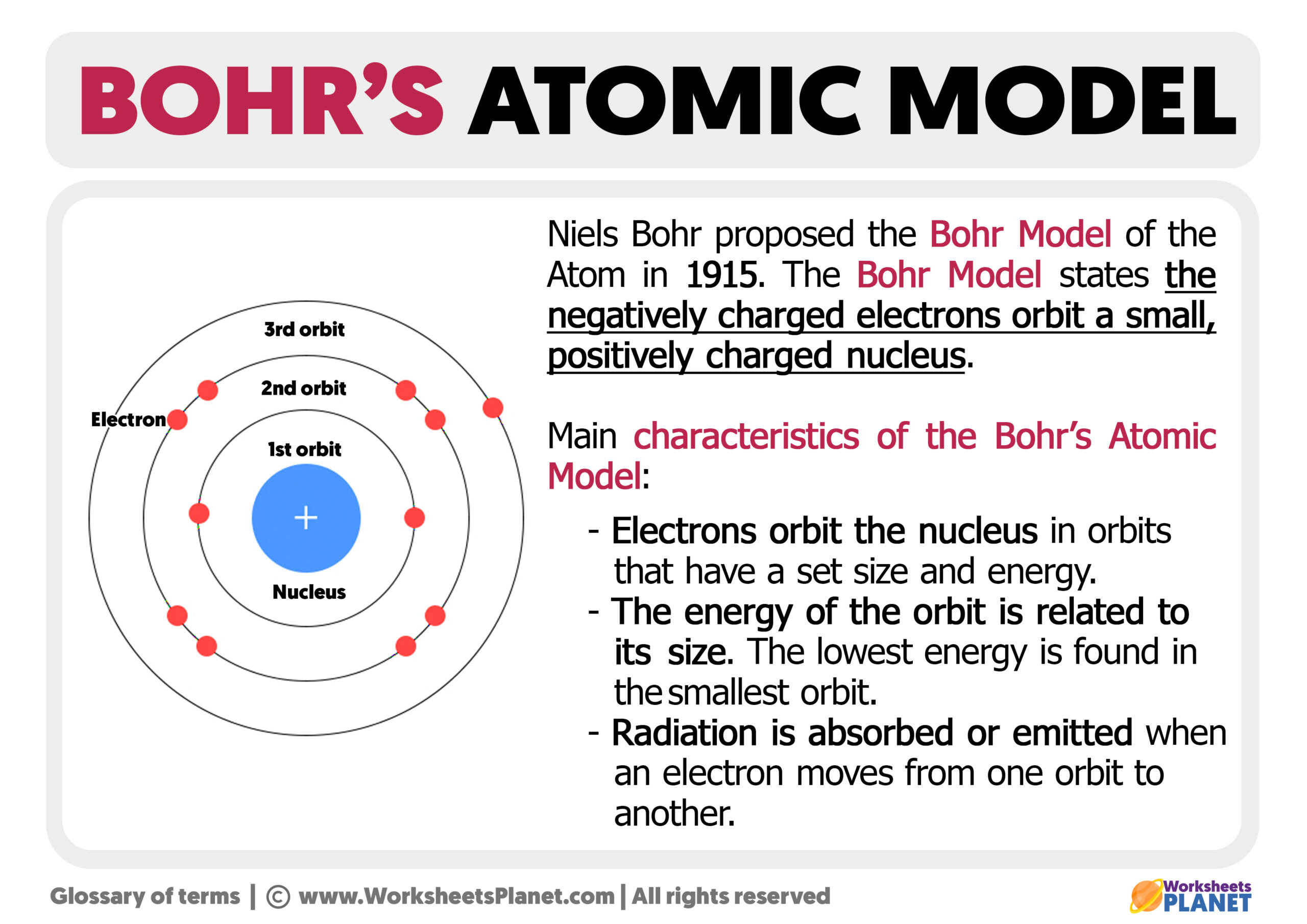
The Bohr Model Diagram is a fundamental concept in the study of atomic structure, providing a visual representation of the arrangement of electrons around the nucleus of an atom. Developed by Danish physicist Niels Bohr in 1913, this model revolutionized our understanding of atomic behavior and laid the groundwork for more advanced theories in quantum mechanics. This post will delve into the intricacies of the Bohr Model Diagram, its historical significance, and its applications in modern science.
The Historical Context of the Bohr Model
The Bohr Model Diagram emerged during a pivotal period in the history of physics. At the turn of the 20th century, scientists were grappling with the limitations of classical physics in explaining atomic phenomena. The discovery of the electron by J.J. Thomson in 1897 and the subsequent development of the plum pudding model of the atom highlighted the need for a more accurate representation of atomic structure.
Niels Bohr’s model addressed these shortcomings by introducing the concept of discrete energy levels. Unlike the plum pudding model, which depicted electrons embedded in a positively charged sphere, the Bohr Model Diagram depicted electrons orbiting the nucleus in fixed, circular paths. This innovation allowed for the explanation of atomic spectra and the stability of atoms, which classical physics could not adequately address.
Key Features of the Bohr Model Diagram
The Bohr Model Diagram is characterized by several key features that distinguish it from other atomic models:
- Nucleus: The central part of the atom, containing protons and neutrons.
- Electron Orbits: Electrons move in circular orbits around the nucleus at specific energy levels.
- Energy Levels: Electrons can only occupy discrete energy levels, denoted by the principal quantum number (n).
- Quantum Jumps: Electrons can jump between energy levels by absorbing or emitting photons of specific energies.
These features collectively provide a simplified yet effective framework for understanding atomic behavior. The Bohr Model Diagram is particularly useful for visualizing the structure of hydrogen and hydrogen-like ions, where the model’s assumptions hold true.
Understanding the Bohr Model Diagram
To fully grasp the Bohr Model Diagram, it is essential to understand its underlying principles and how it differs from other atomic models. The following sections will explore these aspects in detail.
Energy Levels and Quantum Numbers
The Bohr Model Diagram introduces the concept of energy levels, which are quantized states that electrons can occupy. Each energy level is associated with a specific principal quantum number (n), where n = 1, 2, 3, … The energy of an electron in a given level is determined by the formula:
En = -13.6 eV / n2
This formula shows that the energy of an electron decreases as it moves closer to the nucleus, with the lowest energy level (n = 1) being the most stable.
Electron Transitions and Spectral Lines
One of the most significant contributions of the Bohr Model Diagram is its explanation of atomic spectra. When an electron absorbs energy, it jumps to a higher energy level. Conversely, when it releases energy, it returns to a lower energy level. The energy difference between these levels is emitted or absorbed as a photon of specific wavelength, resulting in spectral lines.
The Bohr Model Diagram accurately predicts the spectral lines of hydrogen, providing a visual representation of the energy transitions. This aspect of the model has been instrumental in the development of spectroscopy and the study of atomic spectra.
Limitations of the Bohr Model Diagram
While the Bohr Model Diagram offers valuable insights into atomic structure, it has several limitations that became apparent as quantum mechanics evolved. Some of these limitations include:
- Inability to Explain Multi-Electron Atoms: The model fails to accurately describe the behavior of electrons in atoms with more than one electron.
- Lack of Wave-Particle Duality: The Bohr Model Diagram does not account for the wave-like properties of electrons, which are crucial in quantum mechanics.
- Fixed Orbits: The model assumes that electrons move in fixed, circular orbits, which is not supported by experimental evidence.
Despite these limitations, the Bohr Model Diagram remains a foundational concept in atomic theory, providing a starting point for more advanced models such as the Schrödinger equation and the quantum mechanical model.
Applications of the Bohr Model Diagram
The Bohr Model Diagram has numerous applications in various fields of science and technology. Some of the key applications include:
Chemistry
In chemistry, the Bohr Model Diagram is used to explain chemical bonding and the periodic properties of elements. By understanding the arrangement of electrons in different energy levels, chemists can predict the reactivity and behavior of elements. This knowledge is crucial in fields such as materials science, pharmaceuticals, and environmental chemistry.
Physics
In physics, the Bohr Model Diagram is essential for studying atomic spectra and the interaction of light with matter. It provides a basis for understanding phenomena such as the photoelectric effect, fluorescence, and the emission of X-rays. The model’s principles are also applied in the development of lasers and other optical devices.
Education
The Bohr Model Diagram is a fundamental concept in the teaching of atomic structure and quantum mechanics. It serves as an introductory tool for students to understand the basic principles of atomic behavior before delving into more complex theories. The visual representation of electron orbits and energy levels makes it an effective teaching aid in classrooms and textbooks.
Comparing the Bohr Model Diagram with Other Atomic Models
To fully appreciate the significance of the Bohr Model Diagram, it is helpful to compare it with other atomic models that have been developed over the years. The following table provides a brief comparison:
| Model | Key Features | Strengths | Weaknesses |
|---|---|---|---|
| Plum Pudding Model | Electrons embedded in a positively charged sphere | Simple and intuitive | Inaccurate representation of atomic structure |
| Bohr Model | Electrons in fixed orbits around the nucleus | Explains atomic spectra and energy levels | Limited to hydrogen-like ions, does not account for wave-particle duality |
| Quantum Mechanical Model | Electrons described by wave functions and probability distributions | Accurate for all atoms, accounts for wave-particle duality | More complex and abstract |
The Bohr Model Diagram stands out for its simplicity and effectiveness in explaining atomic spectra, making it a valuable tool in the study of atomic structure.
💡 Note: The Bohr Model Diagram is particularly useful for understanding the behavior of hydrogen and hydrogen-like ions, but it has limitations when applied to more complex atoms.
In conclusion, the Bohr Model Diagram has played a crucial role in the development of atomic theory and continues to be an essential concept in modern science. Its visual representation of electron orbits and energy levels provides a clear and intuitive understanding of atomic behavior, making it a valuable tool for students and researchers alike. While the model has its limitations, it serves as a foundational concept that paves the way for more advanced theories in quantum mechanics. The Bohr Model Diagram’s enduring significance lies in its ability to bridge the gap between classical physics and the quantum world, offering insights that continue to shape our understanding of the atomic realm.
Related Terms:
- bohr diagram for dummies
- bohr model diagram worksheet
- bohr diagram generator
- bohr model for every element
- how to draw bohr models
- bohr model diagram for hydrogen