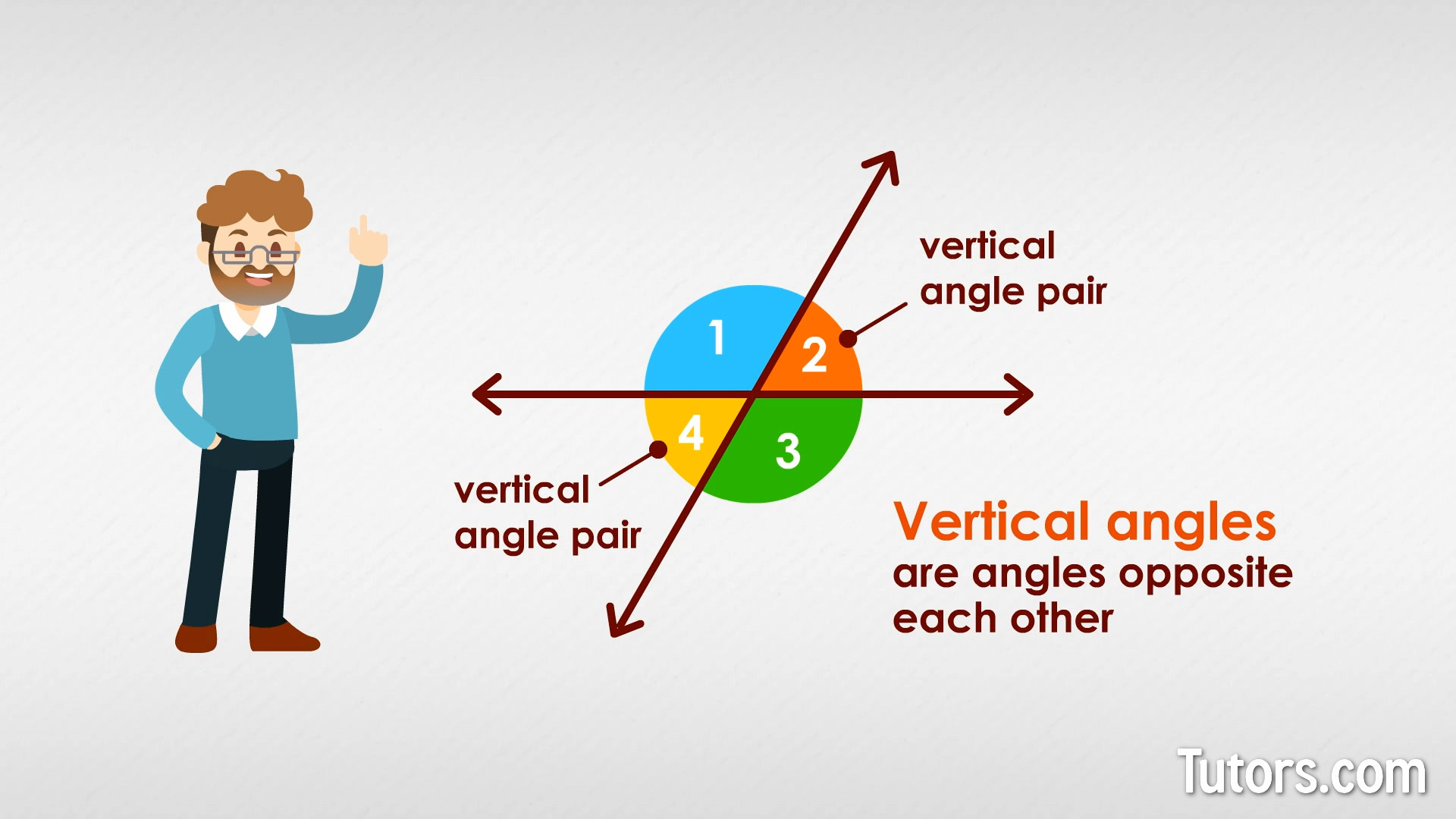
Understanding the fundamentals of geometry is crucial for anyone delving into the world of mathematics. One of the key concepts that often arises in geometric studies is the relationship between angles, particularly vertical angles. The question "Are Vertical Angles Congruent?" is a common one among students and educators alike. This post will explore the concept of vertical angles, their properties, and why they are congruent.
What Are Vertical Angles?
Vertical angles are formed when two lines intersect. They are the angles opposite each other when the lines cross. For example, if you draw two lines that intersect at a point, you will have four angles formed. The angles that are opposite each other are called vertical angles.
To visualize this, imagine a plus sign (+). The angles at the top and bottom are vertical angles, and the angles on the left and right are also vertical angles. These pairs of angles are always congruent, meaning they have the same measure.
Properties of Vertical Angles
Vertical angles have several important properties that make them unique:
- Congruence: As mentioned, vertical angles are always congruent. This means that if one vertical angle measures 45 degrees, the opposite vertical angle will also measure 45 degrees.
- Equality: Vertical angles are equal in measure. This property is derived from the fact that they are congruent.
- Intersection: Vertical angles are formed only when two lines intersect. They do not exist in parallel lines.
Why Are Vertical Angles Congruent?
The congruence of vertical angles can be proven using basic geometric principles. When two lines intersect, they form two pairs of vertical angles. These pairs are congruent because they are supplementary to the same pair of adjacent angles. Let's break this down:
Consider two intersecting lines forming angles A, B, C, and D. Angles A and C are vertical angles, and angles B and D are vertical angles. Angles A and B are supplementary (they add up to 180 degrees), as are angles C and D. Since A and C are supplementary to the same pair of angles, they must be congruent. The same logic applies to angles B and D.
This relationship can be summarized as follows:
| Angle Pair | Relationship |
|---|---|
| A and C | Vertical Angles |
| B and D | Vertical Angles |
| A and B | Supplementary Angles |
| C and D | Supplementary Angles |
This table illustrates the relationships between the angles formed by intersecting lines. The congruence of vertical angles is a direct result of these supplementary relationships.
Real-World Applications of Vertical Angles
Understanding vertical angles is not just an academic exercise; it has practical applications in various fields. For instance, in architecture and engineering, vertical angles are used to ensure that structures are built correctly and safely. Engineers often rely on the congruence of vertical angles to design stable and symmetrical structures.
In navigation, vertical angles are used to determine the position of objects relative to a reference point. This is particularly useful in fields like surveying and cartography, where precise measurements are crucial.
In everyday life, vertical angles can be observed in various scenarios. For example, when crossing roads, the angles formed by the intersecting lines of the road and the sidewalk are vertical angles. Understanding this concept can help in navigating and ensuring safety.
In the field of computer graphics and animation, vertical angles are used to create realistic and accurate 3D models. The congruence of vertical angles ensures that the models are proportionate and visually appealing.
Practical Examples and Exercises
To solidify your understanding of vertical angles, it's helpful to work through some practical examples and exercises. Here are a few exercises to try:
- Draw two intersecting lines and label the angles formed. Identify the vertical angles and measure them to confirm their congruence.
- Consider a real-world scenario, such as a crossroads, and identify the vertical angles formed by the intersecting roads.
- Use a protractor to measure the angles formed by intersecting lines in a diagram. Verify that the vertical angles are congruent.
These exercises will help you apply the concept of vertical angles in a practical setting and reinforce your understanding of their properties.
📝 Note: When measuring angles, ensure that your protractor is aligned correctly with the vertex of the angle to get accurate measurements.
Common Misconceptions About Vertical Angles
Despite their straightforward nature, there are some common misconceptions about vertical angles that can lead to confusion. Here are a few to be aware of:
- Vertical Angles Are Always Equal to 90 Degrees: This is not true. Vertical angles can have any measure, as long as they are congruent to their opposite angles.
- Vertical Angles Are Only Formed by Perpendicular Lines: Vertical angles can be formed by any two intersecting lines, not just perpendicular ones.
- Vertical Angles Are the Same as Adjacent Angles: Vertical angles are opposite each other, while adjacent angles share a common side and vertex.
Understanding these misconceptions can help clarify the true nature of vertical angles and their properties.
To further illustrate the concept, consider the following diagram:

This diagram shows two intersecting lines forming four angles. The vertical angles are labeled as A and C, and B and D. As you can see, angles A and C are congruent, as are angles B and D.
By understanding the properties of vertical angles and their congruence, you can apply this knowledge to various geometric problems and real-world scenarios.
In summary, vertical angles are a fundamental concept in geometry that have wide-ranging applications. The question “Are Vertical Angles Congruent?” is answered with a resounding yes, thanks to the properties of intersecting lines and supplementary angles. Whether you’re a student, educator, or professional, understanding vertical angles is essential for mastering geometry and its practical applications.
Related Terms:
- are vertical angles adjacent
- are vertical angles always congruent
- are alternate exterior angles congruent
- are vertical angles equal
- adjacent angles
- are consecutive interior angles congruent