Understanding the concept of absolute value is fundamental in mathematics, particularly in algebra and calculus. The absolute value of a number is its distance from zero on the number line, regardless of direction. This concept is crucial for solving various mathematical problems and is governed by specific rules known as Absolute Value Rules. These rules help in simplifying expressions and solving equations involving absolute values. This post will delve into the Absolute Value Rules, their applications, and how to use them effectively.
Understanding Absolute Value
The absolute value of a number is denoted by |x|, where x is the number in question. The absolute value function returns the non-negative value of x without regard to its sign. For example, |3| = 3 and |-3| = 3. This function is essential in many areas of mathematics, including solving inequalities, finding distances, and working with complex numbers.
Basic Absolute Value Rules
There are several key Absolute Value Rules that govern how absolute values behave in different mathematical operations. Understanding these rules is crucial for solving problems involving absolute values.
Rule 1: Non-Negativity
The absolute value of any number is always non-negative. This means that for any real number x, |x| ≥ 0.
Rule 2: Multiplicative Property
The absolute value of a product is the product of the absolute values. For any real numbers a and b, |a * b| = |a| * |b|.
Rule 3: Additive Property
The absolute value of a sum is not necessarily the sum of the absolute values. However, the triangle inequality states that for any real numbers a and b, |a + b| ≤ |a| + |b|.
Rule 4: Division Property
The absolute value of a quotient is the quotient of the absolute values. For any real numbers a and b (where b ≠ 0), |a / b| = |a| / |b|.
Rule 5: Exponentiation Property
The absolute value of an exponent is the exponent of the absolute value. For any real number a and integer n, |a^n| = |a|^n.
Applications of Absolute Value Rules
The Absolute Value Rules have numerous applications in mathematics and other fields. Here are some key areas where these rules are applied:
Solving Equations
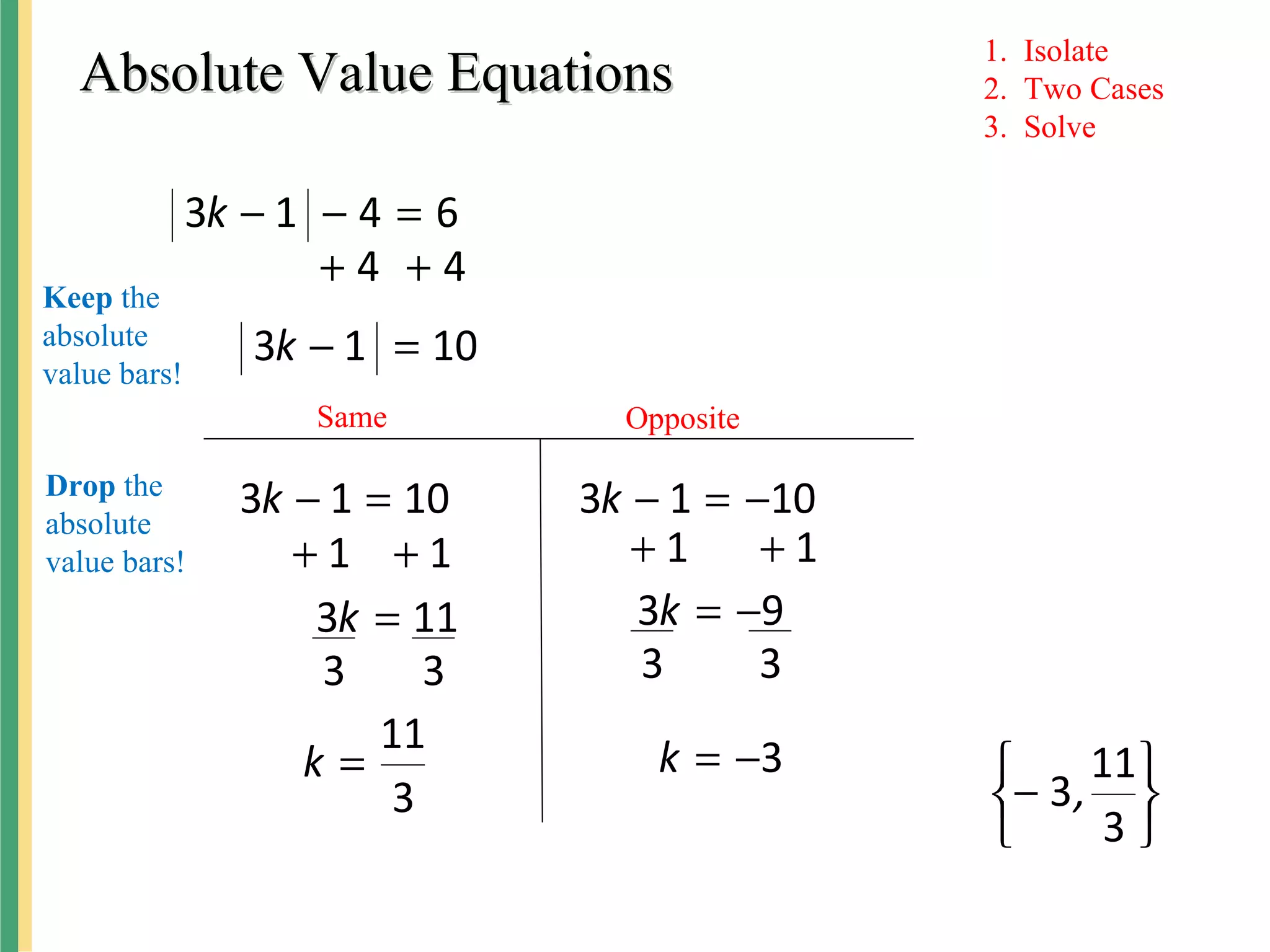
Absolute value equations often require the use of Absolute Value Rules to solve. For example, consider the equation |x - 2| = 5. This equation can be split into two cases:
- x - 2 = 5, which gives x = 7
- x - 2 = -5, which gives x = -3
Both solutions are valid because the absolute value of the difference between x and 2 is 5.
Solving Inequalities
Absolute value inequalities also benefit from the Absolute Value Rules. For example, consider the inequality |x - 3| < 4. This can be rewritten as:
- -4 < x - 3 < 4
Adding 3 to all parts of the inequality gives:
- -1 < x < 7
This shows that x must be between -1 and 7 to satisfy the inequality.
Distance and Geometry
In geometry, the absolute value is used to find the distance between two points on a number line. For example, the distance between -5 and 3 is |-5 - 3| = |-8| = 8. This concept extends to higher dimensions, where the absolute value is used in distance formulas.
Complex Numbers
In the realm of complex numbers, the absolute value (or modulus) of a complex number z = a + bi is given by |z| = √(a^2 + b^2). This is crucial for operations involving complex numbers, such as multiplication and division.
Practical Examples
Let’s go through some practical examples to illustrate the use of Absolute Value Rules in solving problems.
Example 1: Solving an Absolute Value Equation
Consider the equation |2x - 4| = 6. We can solve this by splitting it into two cases:
- 2x - 4 = 6, which gives 2x = 10 and x = 5
- 2x - 4 = -6, which gives 2x = -2 and x = -1
Both x = 5 and x = -1 are solutions to the equation.
Example 2: Solving an Absolute Value Inequality
Consider the inequality |3x + 2| ≤ 7. This can be rewritten as:
- -7 ≤ 3x + 2 ≤ 7
Subtracting 2 from all parts gives:
- -9 ≤ 3x ≤ 5
Dividing by 3 gives:
- -3 ≤ x ≤ 5⁄3
So, x must be between -3 and 5⁄3 to satisfy the inequality.
Example 3: Finding the Distance Between Two Points
To find the distance between the points -7 and 4 on the number line, we use the absolute value:
- |-7 - 4| = |-11| = 11
The distance between -7 and 4 is 11 units.
Common Mistakes and How to Avoid Them
When working with Absolute Value Rules, it’s easy to make mistakes. Here are some common errors and how to avoid them:
Mistake 1: Incorrectly Applying the Multiplicative Property
Remember that |a * b| = |a| * |b|. A common mistake is to assume that |a + b| = |a| + |b|, which is not always true. Use the triangle inequality instead.
Mistake 2: Forgetting the Non-Negativity Rule
Always remember that the absolute value is non-negative. This means that |x| ≥ 0 for any real number x.
Mistake 3: Misinterpreting Inequalities
When solving absolute value inequalities, be careful to correctly interpret the inequality signs. For example, |x - 3| < 4 means that x is within 4 units of 3, not that x is 4 units away from 3.
💡 Note: Always double-check your work when solving absolute value equations and inequalities to ensure accuracy.
Advanced Topics
For those interested in delving deeper into the world of absolute values, there are several advanced topics to explore.
Absolute Value Functions
An absolute value function is a function that involves the absolute value of its input. For example, f(x) = |x - 2| is an absolute value function. These functions are often used in optimization problems and have unique properties, such as being piecewise linear.
Absolute Value in Calculus
In calculus, the absolute value function is used in various contexts, such as finding the derivative of an absolute value function. The derivative of f(x) = |x| is given by:
- f’(x) = x / |x| for x ≠ 0
This function is discontinuous at x = 0, which is an important consideration in calculus.
Absolute Value in Probability
In probability theory, the absolute value is used to measure the difference between two probabilities. For example, the absolute difference between two probabilities P(A) and P(B) is |P(A) - P(B)|. This is useful in hypothesis testing and other statistical methods.
Conclusion
The Absolute Value Rules are fundamental in mathematics, providing a framework for solving equations, inequalities, and other problems involving absolute values. By understanding and applying these rules, you can tackle a wide range of mathematical challenges with confidence. Whether you’re solving simple equations or exploring advanced topics in calculus and probability, the Absolute Value Rules are an essential tool in your mathematical toolkit.
Related Terms:
- rules of absolute value inequalities
- absolute value explained simply
- how to calculate absolute value
- absolute value function rules
- absolute value calculator