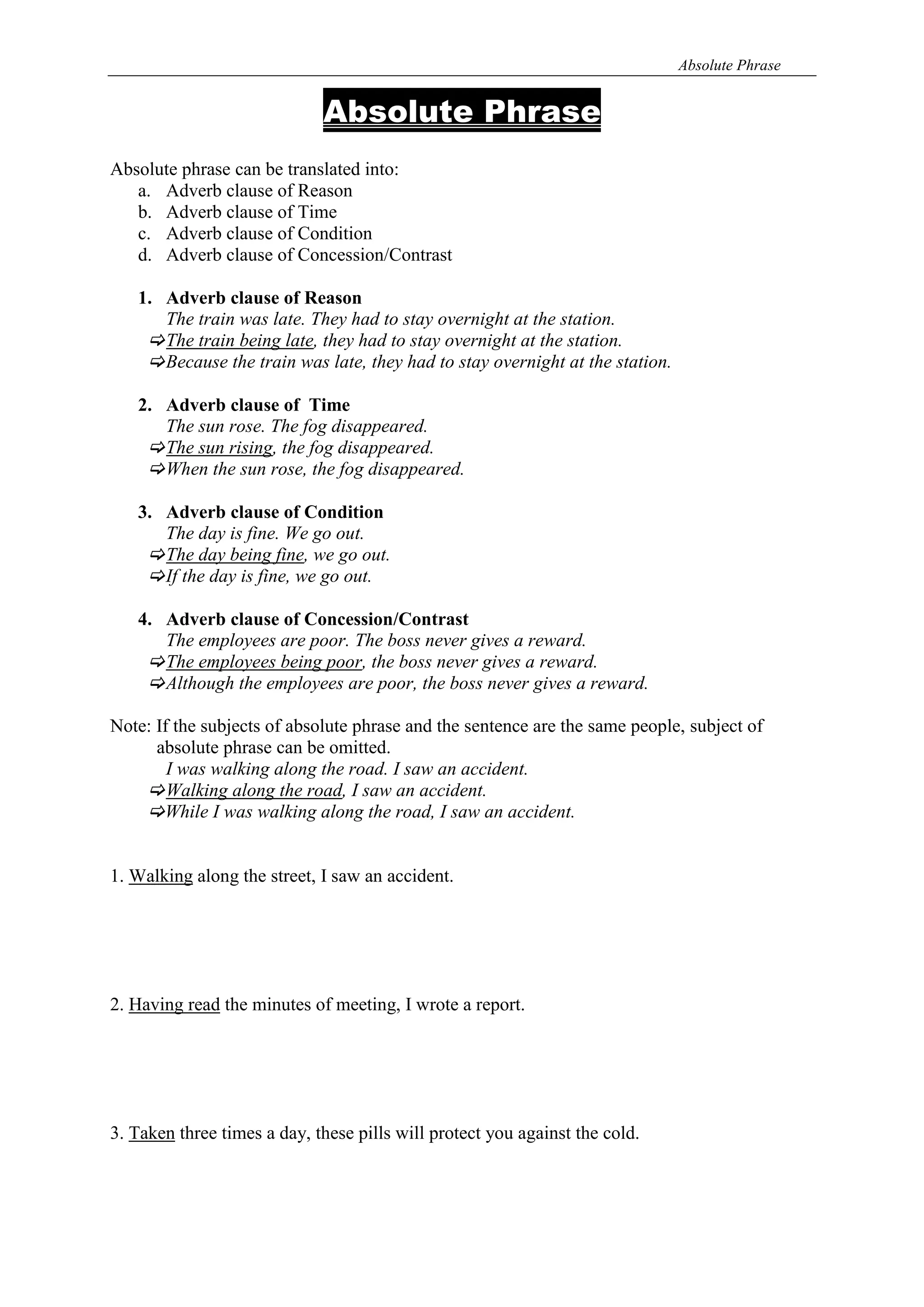
Understanding the nuances of English grammar can significantly enhance your writing skills. One of the lesser-known but highly effective tools in the English language is the absolute phrase. Absolute phrases are a powerful way to add depth and clarity to your sentences. They provide additional information without disrupting the main clause, making your writing more engaging and informative. In this post, we will delve into the intricacies of absolute phrases, explore various Absolute Phrase Examples, and discuss how to effectively use them in your writing.
What is an Absolute Phrase?
An absolute phrase is a group of words that modifies an entire sentence rather than a single word or phrase within the sentence. It typically consists of a noun or pronoun and a participle (a verb form that ends in -ing, -ed, or -en) along with any modifiers. Absolute phrases are not connected to the main clause by a conjunction and can be set off by commas.
For example, consider the sentence: "The sun shining brightly, we decided to go to the beach." Here, "The sun shining brightly" is an absolute phrase that provides additional context without being directly connected to the main clause "we decided to go to the beach."
Structure of an Absolute Phrase
Absolute phrases follow a specific structure that makes them easy to identify and use. The basic structure includes:
- A noun or pronoun
- A participle (present or past)
- Any modifiers or additional information
Here are a few examples to illustrate this structure:
- Noun + Participle: "The book lying on the table, I picked it up."
- Pronoun + Participle: "Her eyes sparkling with joy, she accepted the award."
- Noun + Participle + Modifiers: "The cat sleeping peacefully on the couch, I tiptoed out of the room."
Absolute Phrase Examples in Sentences
To better understand how absolute phrases work, let's look at some Absolute Phrase Examples in various contexts:
Descriptive Sentences:
- "The rain pouring down, we decided to stay indoors."
- "Her voice trembling with emotion, she delivered the speech."
Narrative Sentences:
- "The clock ticking loudly, I couldn't concentrate on my work."
- "The wind howling outside, we huddled closer to the fire."
Explanatory Sentences:
- "The project completed, we celebrated with a team dinner."
- "The exam over, students rushed out of the classroom."
Using Absolute Phrases Effectively
Absolute phrases can greatly enhance your writing by adding layers of meaning and context. Here are some tips on how to use them effectively:
Add Depth: Use absolute phrases to provide additional information that enriches the main clause. For example, "The sun setting over the horizon, we watched in awe."
Create Atmosphere: Absolute phrases can set the mood or atmosphere of a scene. For instance, "The room filled with laughter, we enjoyed the party."
Provide Context: They can offer background information that helps the reader understand the situation better. For example, "The storm raging outside, we stayed indoors."
Avoid Overuse: While absolute phrases are powerful, using them too frequently can make your writing feel cluttered. Use them sparingly and strategically.
Punctuation: Always set off absolute phrases with commas to ensure clarity. For example, "The dog barking loudly, we couldn't sleep."
Common Mistakes to Avoid
When using absolute phrases, it's important to avoid common mistakes that can confuse the reader. Here are some pitfalls to watch out for:
Incorrect Placement: Ensure that the absolute phrase is placed correctly in the sentence. It should not interrupt the flow of the main clause. For example, "The rain pouring down, we decided to stay indoors" is correct, but "We decided to stay indoors, the rain pouring down" is not.
Lack of Clarity: Make sure the absolute phrase clearly modifies the entire sentence. Ambiguity can lead to confusion. For example, "The book lying on the table, I picked it up" is clear, but "The book lying on the table, I read it" could be confusing if the book is not the subject of the main clause.
Overuse of Modifiers: While modifiers can enhance an absolute phrase, too many can make it cumbersome. Keep it simple and to the point. For example, "The cat sleeping peacefully on the couch" is better than "The cat sleeping peacefully and quietly on the couch, which was very comfortable."
📝 Note: Always proofread your sentences to ensure that the absolute phrase adds value and does not disrupt the flow of the main clause.
Absolute Phrases in Literature
Absolute phrases are commonly used in literature to create vivid and engaging narratives. Authors use them to set the scene, describe characters, and convey emotions. Here are a few examples from famous works:
Jane Austen's "Pride and Prejudice": "Her eyes sparkling with mischief, Elizabeth teased her sister."
Charles Dickens' "A Tale of Two Cities": "The city bustling with activity, the streets were filled with people."
Mark Twain's "The Adventures of Huckleberry Finn": "The river flowing gently, Huck and Jim drifted downstream."
Practice Exercises
To improve your understanding and usage of absolute phrases, try these practice exercises:
Exercise 1: Identify Absolute Phrases
Read the following sentences and identify the absolute phrases:
- "The rain pouring down, we decided to stay indoors."
- "Her voice trembling with emotion, she delivered the speech."
- "The clock ticking loudly, I couldn't concentrate on my work."
Exercise 2: Create Your Own Sentences
Write five sentences using absolute phrases. Make sure to vary the context and subject matter.
Exercise 3: Rewrite Sentences
Rewrite the following sentences to include absolute phrases:
- "We stayed indoors because it was raining."
- "She delivered the speech with a trembling voice."
- "I couldn't concentrate on my work because the clock was ticking loudly."
Exercise 4: Analyze Literature
Choose a passage from a book or poem and identify any absolute phrases. Analyze how they contribute to the overall meaning and atmosphere of the passage.
Absolute Phrases in Different Tenses
Absolute phrases can be used in various tenses to convey different time frames. Here are some examples:
Present Tense:
- "The sun shining brightly, we decided to go to the beach."
- "Her eyes sparkling with joy, she accepted the award."
Past Tense:
- "The rain pouring down, we decided to stay indoors."
- "Her voice trembling with emotion, she delivered the speech."
Future Tense:
- "The project completed, we will celebrate with a team dinner."
- "The exam over, students will rush out of the classroom."
Perfect Tense:
- "The book having been read, I returned it to the library."
- "The task having been completed, we took a break."
Absolute Phrases with Different Parts of Speech
Absolute phrases can include various parts of speech to add richness and complexity to your sentences. Here are some examples:
Nouns and Pronouns:
- "The cat sleeping on the couch, I tiptoed out of the room."
- "Her eyes sparkling with joy, she accepted the award."
Verbs:
- "The rain pouring down, we decided to stay indoors."
- "The clock ticking loudly, I couldn't concentrate on my work."
Adjectives and Adverbs:
- "The room filled with laughter, we enjoyed the party."
- "The wind howling outside, we huddled closer to the fire."
Prepositions:
- "The book lying on the table, I picked it up."
- "The cat sleeping under the bed, I couldn't find it."
Absolute Phrases in Formal and Informal Writing
Absolute phrases can be used in both formal and informal writing, but their application may vary depending on the context. Here are some guidelines:
Formal Writing:
- Use absolute phrases to add depth and clarity to academic papers, reports, and essays.
- Ensure that the phrases are grammatically correct and enhance the overall meaning of the sentence.
- Example: "The data analyzed, we concluded that the experiment was successful."
Informal Writing:
- Use absolute phrases to create a more engaging and conversational tone in blogs, emails, and social media posts.
- Keep the phrases simple and to the point to maintain a casual style.
- Example: "The sun shining brightly, we decided to go to the beach."
Absolute Phrases in Different Genres
Absolute phrases can be effectively used in various genres to enhance storytelling and description. Here are some examples:
Fiction:
- "The room filled with laughter, we enjoyed the party."
- "The wind howling outside, we huddled closer to the fire."
Non-Fiction:
- "The project completed, we celebrated with a team dinner."
- "The exam over, students rushed out of the classroom."
Poetry:
- "The sun setting over the horizon, we watched in awe."
- "The rain pouring down, we decided to stay indoors."
Journalism:
- "The storm raging outside, we stayed indoors."
- "The clock ticking loudly, I couldn't concentrate on my work."
Absolute Phrases in Different Languages
While this post focuses on English, it's interesting to note that absolute phrases can be found in other languages as well. Here are a few examples:
Spanish:
- "El sol brillando intensamente, decidimos ir a la playa."
- "Sus ojos brillando de alegría, aceptó el premio."
French:
- "Le soleil brillant intensément, nous avons décidé d'aller à la plage."
- "Ses yeux brillants de joie, elle a accepté le prix."
German:
- "Die Sonne hell scheinend, entschieden wir uns, an den Strand zu gehen."
- "Ihre Augen vor Freude funkelnd, nahm sie den Preis an."
Italian:
- "Il sole splendente, abbiamo deciso di andare in spiaggia."
- "I suoi occhi brillanti di gioia, ha accettato il premio."
Indonesian:
- "Matahari bersinar terang, kami memutuskan untuk pergi ke pantai."
- "Matanya bersinar dengan kebahagiaan, dia menerima penghargaan."
Absolute Phrases in Conversational English
Absolute phrases can also be used in everyday conversations to make your speech more engaging and descriptive. Here are some examples:
Describing a Scene:
- "The rain pouring down, we decided to stay indoors."
- "The sun shining brightly, we decided to go to the beach."
Expressing Emotions:
- "Her eyes sparkling with joy, she accepted the award."
- "His voice trembling with emotion, he delivered the speech."
Providing Context:
- "The project completed, we celebrated with a team dinner."
- "The exam over, students rushed out of the classroom."
Setting the Mood:
- "The room filled with laughter, we enjoyed the party."
- "The wind howling outside, we huddled closer to the fire."
Absolute Phrases in Academic Writing
In academic writing, absolute phrases can be used to provide additional information and context without disrupting the flow of the main argument. Here are some examples:
Introducing a Concept:
- "The theory proposed, we conducted a series of experiments to test its validity."
- "The data analyzed, we concluded that the hypothesis was correct."
Providing Background Information:
- "The research completed, we published our findings in a scientific journal."
- "The literature reviewed, we identified several gaps in the existing knowledge."
Explaining a Process:
- "The experiment conducted, we observed the results and recorded our observations."
- "The data collected, we analyzed it using statistical methods."
Summarizing Findings:
- "The results analyzed, we found that the treatment was effective."
- "The conclusions drawn, we recommended further research in this area."
Absolute Phrases in Technical Writing
In technical writing, absolute phrases can be used to provide clear and concise instructions or explanations. Here are some examples:
Providing Instructions:
- "The software installed, you can start using it immediately."
- "The device connected, you can begin the setup process."
Explaining a Process:
- "The data entered, the system will process it automatically."
- "The file saved, you can close the application."
Describing a System:
- "The network configured, you can access the internet."
- "The system updated, you can install the new software."
Providing Safety Information:
- "The machine running, do not touch the moving parts."
- "The equipment turned off, you can perform maintenance."
Absolute Phrases in Business Writing
In business writing, absolute phrases can be used to convey information clearly and concisely. Here are some examples:
Writing Reports:
- "The project completed, we submitted the final report to the client."
- "The data analyzed, we presented our findings to the management."
Writing Emails:
- "The meeting scheduled, please confirm your availability."
- "The deadline approaching, we need to finalize the project."
Writing Proposals:
- "The research conducted, we propose the following solutions."
- "The market analyzed, we recommend the following strategies."
Writing Memos:
- "The policy implemented, please follow the new guidelines."
- "The changes approved, we will proceed with the updates."
Absolute Phrases in Creative Writing
In creative writing, absolute phrases can be used to create vivid and engaging narratives. Here are some examples:
Describing a Scene:
- "The sun setting over the horizon, we watched in awe."
- "The rain pouring down, we decided to stay indoors."
Developing Characters:
- "Her eyes sparkling with joy, she accepted the award."
- "His voice trembling with emotion, he delivered the speech."
Creating Atmosphere:
- "The room filled with laughter, we enjoyed the party."
- "The wind howling outside, we huddled closer to the fire."
Building Tension:
- "The clock ticking loudly, I couldn't concentrate on my work."
- "The storm raging outside, we stayed indoors."
Conveying Emotions:
- "Her heart pounding with excitement, she opened the letter."
- "His mind racing with thoughts, he couldn't sleep."
Absolute Phrases in Journalistic Writing
In journalistic writing, absolute phrases can be used to provide context and enhance the narrative. Here are some examples:
Describing an Event:
- “The rain pouring down, the streets were flooded.”
- “The sun shining brightly, the park was filled with people.”
Providing Background Information:
- “The election results announced, the crowd erupted in cheers.”
Related Terms:
- what are absolutes in grammar
- examples of absolutes in writing
- absolute modifier examples
- examples of absolute
- an absolute phrase
- select the absolute phrase sentence