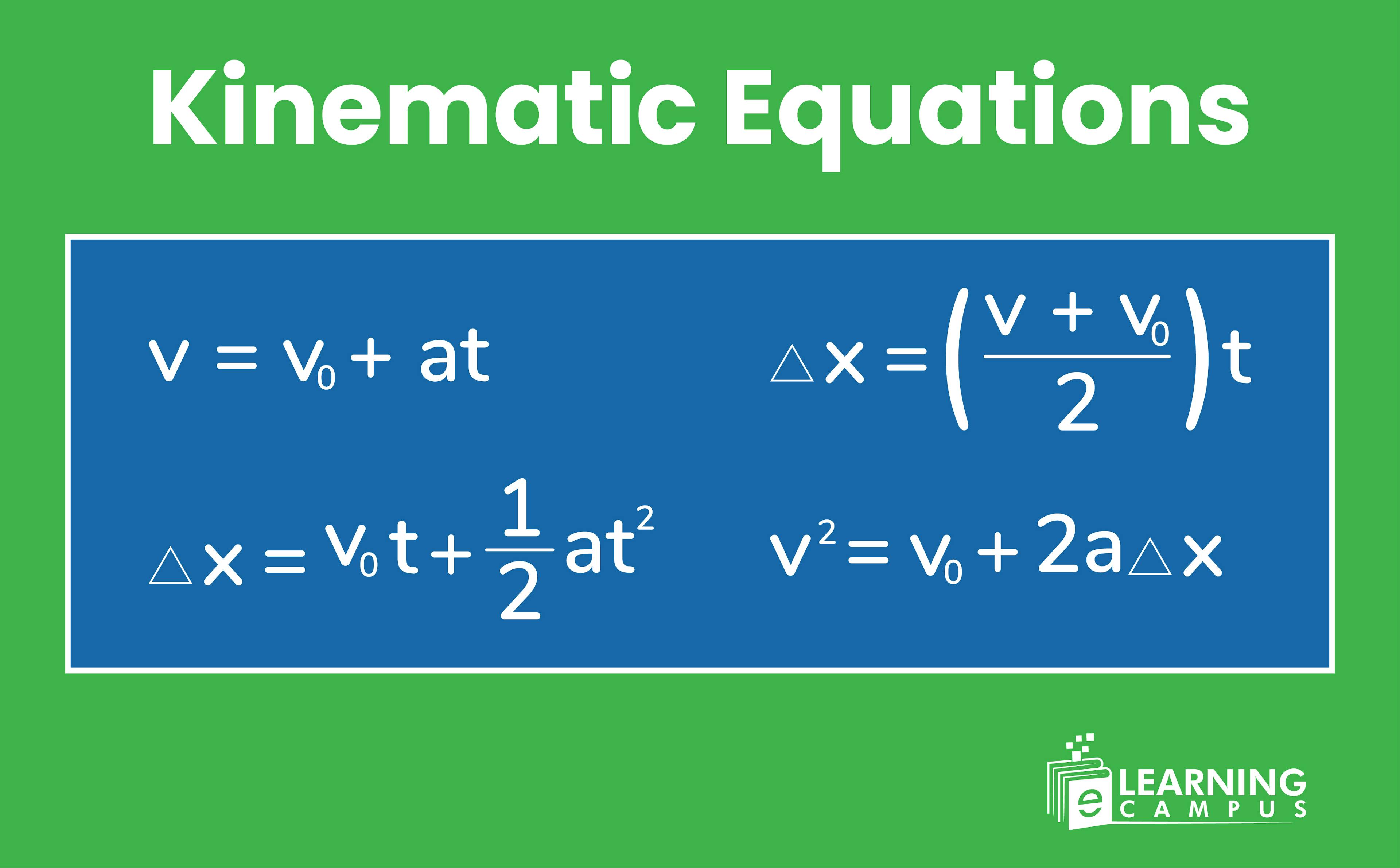
Understanding the principles of motion is fundamental to physics, and one of the key tools for analyzing motion is the 4th kinematic equation. This equation, along with the other three kinematic equations, provides a comprehensive framework for describing the motion of objects under constant acceleration. Whether you're a student studying for an exam or a professional engineer working on a project, mastering these equations is essential.
What is the 4th Kinematic Equation?
The 4th kinematic equation is often expressed as:
v2 = u2 + 2as
Where:
- v is the final velocity
- u is the initial velocity
- a is the acceleration
- s is the displacement
This equation is particularly useful when you need to relate the initial and final velocities of an object to its acceleration and displacement. It is derived from the basic definitions of velocity, acceleration, and displacement, and it assumes that the acceleration is constant.
Derivation of the 4th Kinematic Equation
To understand how the 4th kinematic equation is derived, let's start with the basic definitions of velocity and acceleration. Velocity is the rate of change of displacement, and acceleration is the rate of change of velocity. Mathematically, these can be expressed as:
v = ds/dt
a = dv/dt
Where t is time. If we integrate the acceleration equation with respect to time, we get:
v = u + at
This is the first kinematic equation. Now, if we integrate the velocity equation with respect to time, we get:
s = ut + (1/2)at2
This is the second kinematic equation. To derive the 4th kinematic equation, we can eliminate time from these two equations. First, solve the first equation for t:
t = (v - u) / a
Substitute this expression for t into the second equation:
s = u((v - u) / a) + (1/2)a((v - u) / a)2
Simplify this equation to get:
s = (v2 - u2) / (2a)
Rearrange this equation to get the 4th kinematic equation:
v2 = u2 + 2as
Applications of the 4th Kinematic Equation
The 4th kinematic equation has a wide range of applications in physics and engineering. Some of the most common applications include:
- Projectile Motion: When analyzing the motion of a projectile, such as a ball thrown into the air, the 4th kinematic equation can be used to relate the initial and final velocities to the displacement and acceleration due to gravity.
- Vehicle Dynamics: In automotive engineering, the equation is used to analyze the acceleration and deceleration of vehicles, as well as the distance required to stop or reach a certain speed.
- Sports Science: In sports, the equation can be used to analyze the motion of athletes, such as the velocity and displacement of a runner or the acceleration of a sprinter.
- Astronomy: In astronomy, the equation is used to analyze the motion of celestial bodies, such as the velocity and displacement of planets or satellites.
Examples of Using the 4th Kinematic Equation
Let's look at a few examples to see how the 4th kinematic equation can be applied in different scenarios.
Example 1: Projectile Motion
Consider a ball thrown vertically upward with an initial velocity of 20 m/s. The acceleration due to gravity is 9.8 m/s2. We want to find the maximum height the ball reaches.
At the maximum height, the final velocity v is 0 m/s. Using the 4th kinematic equation:
v2 = u2 + 2as
Substitute the given values:
0 = (20 m/s)2 + 2(-9.8 m/s2)s
Solve for s:
s = (20 m/s)2 / (2 * 9.8 m/s2)
s = 20.4 m
So, the maximum height the ball reaches is 20.4 meters.
Example 2: Vehicle Dynamics
Consider a car that accelerates from rest to a velocity of 30 m/s over a distance of 100 meters. We want to find the acceleration of the car.
Using the 4th kinematic equation:
v2 = u2 + 2as
Substitute the given values:
(30 m/s)2 = 0 + 2a(100 m)
Solve for a:
a = (30 m/s)2 / (2 * 100 m)
a = 4.5 m/s2
So, the acceleration of the car is 4.5 m/s2.
Limitations of the 4th Kinematic Equation
While the 4th kinematic equation is a powerful tool for analyzing motion, it does have some limitations. These include:
- Constant Acceleration: The equation assumes that the acceleration is constant. If the acceleration varies, the equation may not be accurate.
- One-Dimensional Motion: The equation is typically used for one-dimensional motion. For two- or three-dimensional motion, additional equations and considerations are needed.
- Initial and Final Conditions: The equation requires knowledge of the initial and final conditions (velocity, displacement, and acceleration). If these are not known, the equation may not be applicable.
💡 Note: When using the 4th kinematic equation, it's important to ensure that the assumptions of constant acceleration and one-dimensional motion are met. If these assumptions are not valid, other methods of analysis may be required.
Comparing the 4th Kinematic Equation with Other Kinematic Equations
The 4th kinematic equation is one of four fundamental kinematic equations used to describe motion under constant acceleration. The other three equations are:
v = u + at
s = ut + (1/2)at2
s = (v + u)t / 2
Each of these equations has its own strengths and weaknesses, and the choice of which equation to use depends on the specific problem and the known variables. Here's a comparison of the four equations:
| Equation | Known Variables | Unknown Variable |
|---|---|---|
| v = u + at | u, a, t | v |
| s = ut + (1/2)at2 | u, a, t | s |
| s = (v + u)t / 2 | v, u, t | s |
| v2 = u2 + 2as | u, a, s | v |
As you can see, each equation is useful in different scenarios, and understanding when to use each one is key to solving kinematic problems effectively.
Advanced Topics in Kinematics
While the 4th kinematic equation and the other basic kinematic equations are essential for understanding motion under constant acceleration, there are more advanced topics in kinematics that can provide deeper insights into the behavior of moving objects. Some of these topics include:
- Variable Acceleration: In many real-world scenarios, the acceleration of an object is not constant. Analyzing motion under variable acceleration requires more advanced mathematical tools, such as calculus.
- Two- and Three-Dimensional Motion: Motion in two or three dimensions involves additional complexities, such as vector analysis and the resolution of forces into components.
- Relative Motion: When analyzing the motion of objects relative to each other, it's important to consider the reference frame and the relative velocities and accelerations.
- Circular Motion: Objects moving in a circular path experience centripetal acceleration, which is directed towards the center of the circle. Analyzing circular motion requires understanding the relationship between velocity, radius, and centripetal acceleration.
These advanced topics build on the foundations provided by the basic kinematic equations and allow for a more comprehensive understanding of motion in various scenarios.
💡 Note: For more advanced topics in kinematics, it's important to have a strong foundation in calculus and vector analysis. These mathematical tools are essential for understanding and solving problems involving variable acceleration, two- and three-dimensional motion, and other complex scenarios.
In conclusion, the 4th kinematic equation is a fundamental tool for analyzing motion under constant acceleration. It provides a straightforward way to relate the initial and final velocities of an object to its acceleration and displacement. By understanding and applying this equation, along with the other basic kinematic equations, you can gain a deep understanding of the principles of motion and apply them to a wide range of problems in physics and engineering. Whether you’re studying for an exam or working on a real-world project, mastering these equations is essential for success.
Related Terms:
- kinematic equation for displacement
- 4 kinematic equations explained
- 4 main kinematic equations
- 4 basic kinematic equations
- kinematic equations without final velocity
- 4 formulas of kinematics