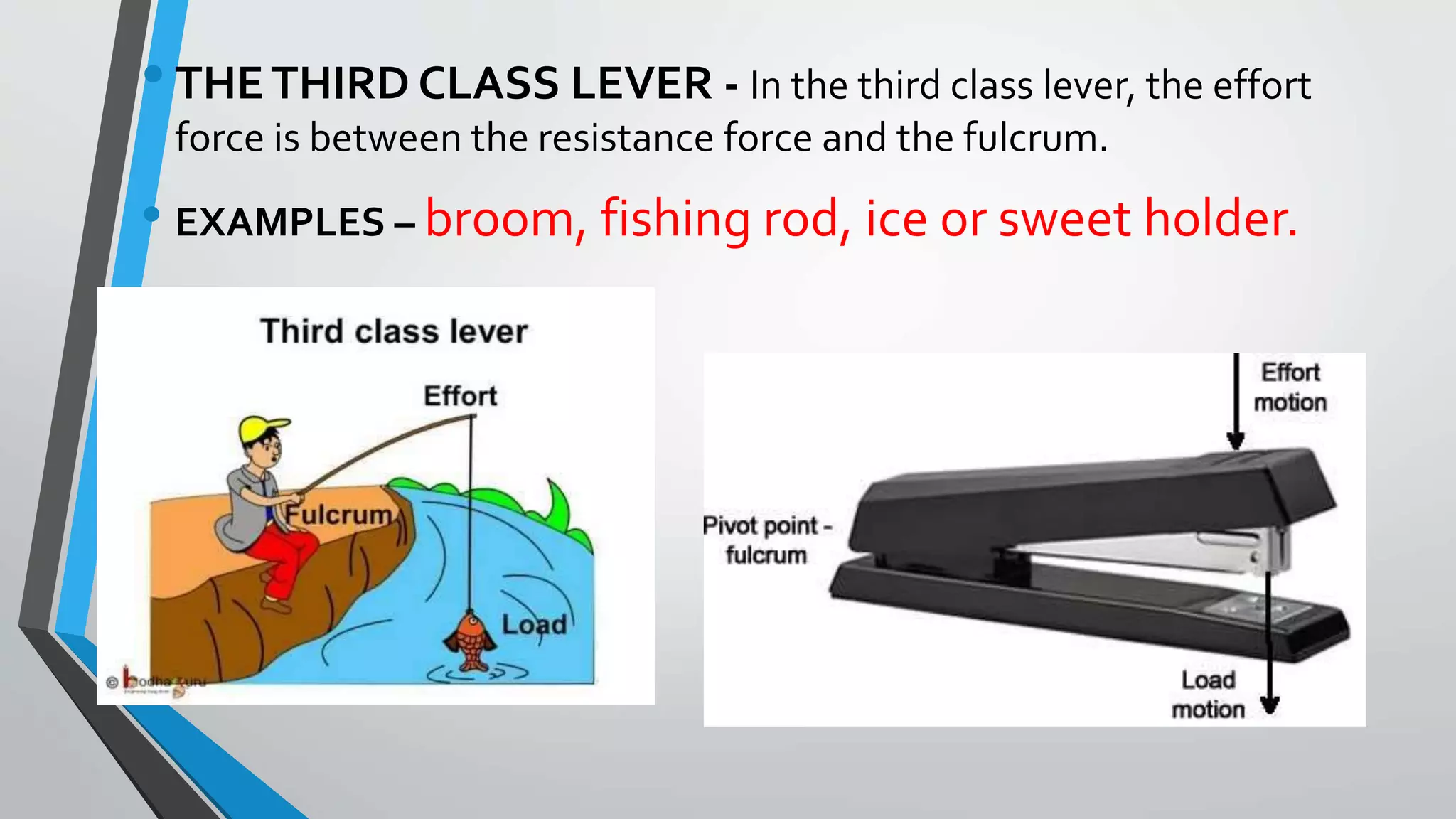
Understanding the mechanics of a 3rd class lever is fundamental for anyone interested in physics, engineering, or even everyday activities that involve simple machines. Levers are one of the six simple machines identified by Renaissance scientists, and they are ubiquitous in our daily lives, from seesaws and crowbars to tweezers and human bones. This post delves into the intricacies of 3rd class levers, their applications, and how they differ from other types of levers.
What is a Lever?
A lever is a rigid bar that pivots around a fixed point, known as the fulcrum. The lever amplifies the input force to lift or move a load. The three classes of levers are defined by the relative positions of the fulcrum, the effort (input force), and the load (output force).
Understanding the Three Classes of Levers
Levers are categorized into three classes based on the placement of the fulcrum, effort, and load. The three classes are:
- 1st Class Lever: The fulcrum is located between the effort and the load. Examples include seesaws and scissors.
- 2nd Class Lever: The load is between the fulcrum and the effort. Examples include wheelbarrows and nutcrackers.
- 3rd Class Lever: The effort is applied between the fulcrum and the load. Examples include tweezers, human arms, and fishing rods.
Characteristics of a 3rd Class Lever
A 3rd class lever is characterized by the effort being applied between the fulcrum and the load. This configuration allows for a mechanical advantage of less than 1, meaning the output force is less than the input force. However, 3rd class levers are advantageous in situations where speed and range of motion are more critical than force amplification.
Mechanical Advantage of a 3rd Class Lever
The mechanical advantage (MA) of a lever is calculated as the ratio of the load to the effort. For a 3rd class lever, the mechanical advantage is always less than 1. This is because the effort arm (the distance from the fulcrum to the point where the effort is applied) is shorter than the load arm (the distance from the fulcrum to the point where the load is applied).
The formula for mechanical advantage is:
MA = Load / Effort
Since the effort arm is shorter, the effort required to lift the load is greater than the load itself, resulting in a mechanical advantage of less than 1.
Applications of 3rd Class Levers
3rd class levers are widely used in various applications where speed and range of motion are more important than force amplification. Some common examples include:
- Human Arms and Legs: The muscles in our arms and legs act as 3rd class levers, allowing us to move quickly and with a wide range of motion.
- Tweezers: Used for precise tasks like plucking eyebrows or handling small objects, tweezers provide fine control and dexterity.
- Fishing Rods: The rod acts as a 3rd class lever, allowing anglers to cast the line over long distances with a quick, smooth motion.
- Shovels: When used to lift and move material, the shovel acts as a 3rd class lever, providing a longer reach and faster movement.
Advantages and Disadvantages of 3rd Class Levers
3rd class levers offer several advantages and disadvantages, depending on the application. Understanding these can help in choosing the right type of lever for a specific task.
Advantages
- Speed and Range of Motion: 3rd class levers allow for faster and more extensive movements, making them ideal for tasks that require quick actions.
- Precision and Control: These levers provide fine control and precision, which is essential in tasks like surgery or handling delicate objects.
- Versatility: 3rd class levers are used in a wide range of applications, from everyday tools to complex machinery.
Disadvantages
- Reduced Force Amplification: The mechanical advantage is less than 1, meaning more effort is required to lift a load compared to other types of levers.
- Limited Load Capacity: Due to the reduced mechanical advantage, 3rd class levers are not suitable for lifting heavy loads.
Comparing 3rd Class Levers with Other Types
To better understand the unique characteristics of 3rd class levers, it’s helpful to compare them with 1st and 2nd class levers.
| Type of Lever | Fulcrum Position | Mechanical Advantage | Examples |
|---|---|---|---|
| 1st Class Lever | Between effort and load | Can be greater than, less than, or equal to 1 | Seesaws, scissors |
| 2nd Class Lever | Between load and effort | Greater than 1 | Wheelbarrows, nutcrackers |
| 3rd Class Lever | Between effort and load | Less than 1 | Tweezers, human arms, fishing rods |
As shown in the table, the mechanical advantage and the position of the fulcrum vary significantly among the three classes of levers. This variation determines their suitability for different tasks.
💡 Note: The choice of lever type depends on the specific requirements of the task, including the need for force amplification, speed, and precision.
Real-World Examples of 3rd Class Levers
3rd class levers are prevalent in our daily lives and various industries. Here are some real-world examples to illustrate their applications:
Human Anatomy
The human body is a remarkable example of 3rd class levers in action. Our muscles, bones, and joints work together to create levers that allow us to move efficiently. For instance, the biceps muscle acts as a 3rd class lever when lifting an object. The fulcrum is the elbow joint, the effort is applied by the biceps muscle, and the load is the weight being lifted.
Sports Equipment
Many sports equipment utilize 3rd class levers to enhance performance. For example, a baseball bat acts as a 3rd class lever when hitting a ball. The fulcrum is the hands holding the bat, the effort is applied by the swing, and the load is the ball being hit. This configuration allows for a faster swing and greater control over the bat.
Medical Instruments
In the medical field, 3rd class levers are used in various instruments that require precision and control. Surgical tweezers, for example, are designed as 3rd class levers to provide fine control during delicate procedures. The fulcrum is the pivot point of the tweezers, the effort is applied by the surgeon’s fingers, and the load is the tissue being manipulated.
Everyday Tools
Many everyday tools are designed as 3rd class levers to make tasks easier and more efficient. A shovel, for instance, acts as a 3rd class lever when used to lift and move material. The fulcrum is the hands holding the shovel, the effort is applied by the arms and back, and the load is the material being moved. This configuration allows for a longer reach and faster movement.

This image illustrates the basic structure of a 3rd class lever, highlighting the positions of the fulcrum, effort, and load.

This image shows how the human arm functions as a 3rd class lever, with the elbow acting as the fulcrum, the biceps muscle providing the effort, and the weight being lifted as the load.

This image demonstrates how a baseball bat acts as a 3rd class lever, with the hands holding the bat as the fulcrum, the swing providing the effort, and the ball being hit as the load.

This image illustrates how surgical tweezers function as a 3rd class lever, with the pivot point as the fulcrum, the surgeon's fingers providing the effort, and the tissue being manipulated as the load.

This image shows how a shovel acts as a 3rd class lever, with the hands holding the shovel as the fulcrum, the arms and back providing the effort, and the material being moved as the load.
Understanding the mechanics of a 3rd class lever is crucial for appreciating the efficiency and versatility of these simple machines. From human anatomy to sports equipment and medical instruments, 3rd class levers play a vital role in our daily lives and various industries. By leveraging the principles of 3rd class levers, we can design tools and machinery that enhance performance, precision, and control.