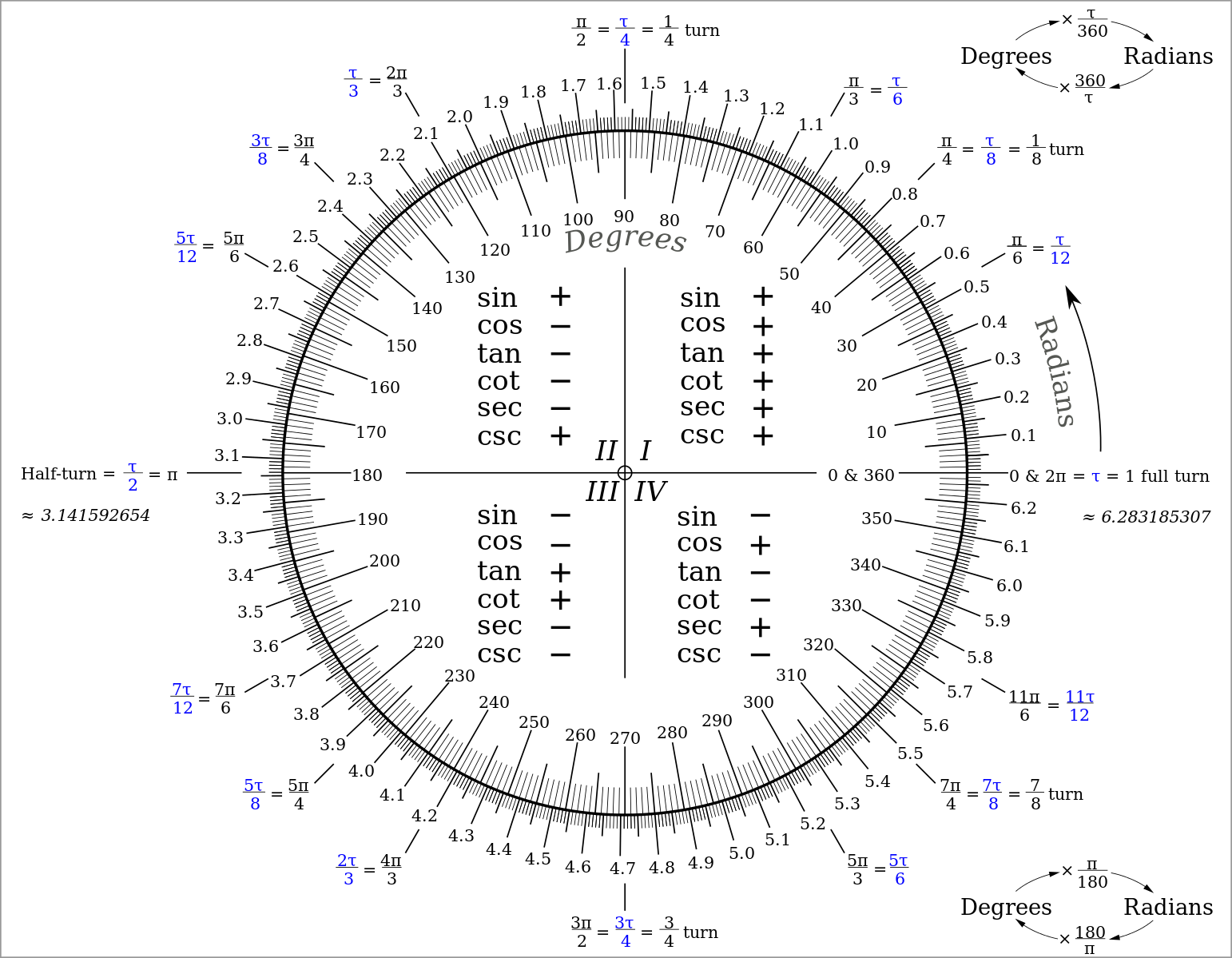
Understanding the concept of 360 degrees in radians is fundamental in various fields of mathematics, physics, and engineering. Radians are a unit of angular measurement that is widely used in calculus and other advanced mathematical disciplines. Unlike degrees, which are based on the division of a circle into 360 parts, radians are based on the radius of a circle. This fundamental difference makes radians a more natural and convenient unit for many mathematical calculations.
What are Radians?
Radians are a unit of angular measurement defined as the angle subtended at the center of a circle by an arc that is equal in length to the radius of the circle. One radian is approximately 57.2958 degrees. This relationship is crucial for converting between degrees and radians, a skill that is essential for many mathematical and scientific applications.
Converting Degrees to Radians
To convert degrees to radians, you can use the following formula:
📝 Note: The formula for converting degrees to radians is radians = degrees × (π / 180).
For example, to convert 360 degrees to radians:
radians = 360 × (π / 180) = 2π
This means that 360 degrees is equivalent to 2π radians. This conversion is straightforward and highlights the simplicity of using radians in mathematical calculations.
Why Use Radians?
Radians offer several advantages over degrees, making them the preferred unit of angular measurement in many scientific and engineering contexts. Some of the key benefits include:
- Natural Unit for Calculus: Radians are the natural unit for calculus because they simplify many trigonometric identities and derivatives. For example, the derivative of sine and cosine functions is much simpler when expressed in radians.
- Simpler Formulas: Many formulas in physics and engineering are simpler when expressed in radians. For instance, the formula for the period of a pendulum is more straightforward when using radians.
- Consistency with Other Units: Radians are dimensionless, which means they are consistent with other units of measurement. This consistency makes them easier to work with in complex calculations.
Applications of Radians
Radians are used in a wide range of applications, from basic trigonometry to advanced calculus and physics. Some of the most common applications include:
- Trigonometry: Radians are used to measure angles in trigonometric functions such as sine, cosine, and tangent. These functions are essential for solving problems involving triangles and circular motion.
- Calculus: Radians are the standard unit for angular measurement in calculus. They simplify the derivatives and integrals of trigonometric functions, making calculations more straightforward.
- Physics: Radians are used in physics to describe angular velocity, angular acceleration, and other rotational quantities. For example, the angular velocity of a rotating object is often expressed in radians per second.
- Engineering: Radians are used in engineering to design and analyze mechanical systems, electrical circuits, and other complex systems. They provide a precise and consistent way to measure angles and rotations.
Common Conversions
Understanding how to convert between degrees and radians is essential for many applications. Here are some common conversions:
| Degrees | Radians |
|---|---|
| 0 | 0 |
| 30 | π/6 |
| 45 | π/4 |
| 60 | π/3 |
| 90 | π/2 |
| 180 | π |
| 270 | 3π/2 |
| 360 | 2π |
Practical Examples
To illustrate the use of radians in practical scenarios, let’s consider a few examples:
Example 1: Angular Velocity
Suppose a wheel is rotating at an angular velocity of 2 radians per second. To find the angular velocity in degrees per second, we use the conversion factor:
degrees per second = radians per second × (180 / π)
degrees per second = 2 × (180 / π) ≈ 114.59 degrees per second
Example 2: Trigonometric Functions
Consider the trigonometric function sine(π/4). To find the value of this function, we can use a calculator or trigonometric tables. The value of sine(π/4) is approximately 0.7071. This example demonstrates how radians are used in trigonometric calculations.
Example 3: Circular Motion
In circular motion, the angular displacement is often measured in radians. For example, if an object moves along a circular path with a radius of 5 meters and completes one full revolution, the angular displacement is 2π radians. This information can be used to calculate the distance traveled by the object.
Advanced Topics
For those interested in more advanced topics, radians play a crucial role in several areas of mathematics and physics. Some of these topics include:
- Complex Numbers: Radians are used to represent angles in the complex plane. The polar form of a complex number involves an angle measured in radians.
- Fourier Analysis: Radians are used in Fourier analysis to describe the frequency components of a signal. The Fourier transform involves integrals that are simpler when expressed in radians.
- Quantum Mechanics: Radians are used in quantum mechanics to describe the phase of a wave function. The Schrödinger equation involves derivatives that are more straightforward when using radians.
Conclusion
Understanding 360 degrees in radians is essential for anyone working in mathematics, physics, or engineering. Radians provide a natural and convenient unit for angular measurement, simplifying many calculations and formulas. Whether you are studying trigonometry, calculus, or advanced physics, a solid grasp of radians will be invaluable. By mastering the conversion between degrees and radians and understanding their applications, you can tackle a wide range of problems with confidence and precision.
Related Terms:
- 180 degrees in radians
- degrees to radians calculator
- how to calculate degrees radians
- radians vs degrees
- degree into radian calculator