Exploring the vast expanse of our solar system reveals a myriad of fascinating planets or moons, each with its unique characteristics and mysteries. From the scorching surface of Mercury to the icy moons of Jupiter, the diversity of these celestial bodies is astonishing. This blog post delves into the wonders of our solar system, highlighting key features of the planets and their moons, and providing insights into their significance in astronomical studies.
The Inner Planets
The inner planets, also known as the terrestrial planets, include Mercury, Venus, Earth, and Mars. These planets are relatively small and rocky, with solid surfaces that have been shaped by geological processes over billions of years.
Mercury
Mercury is the closest planet to the Sun and the smallest of the terrestrial planets. Its surface is heavily cratered, similar to the Moon, and it has a thin atmosphere composed mainly of oxygen, sodium, hydrogen, helium, and potassium. Mercury's extreme temperatures, ranging from -173°C to 427°C, make it one of the most inhospitable places in the solar system.
Venus
Venus, often referred to as Earth's sister planet due to its similar size and mass, is shrouded in a thick atmosphere of carbon dioxide and sulfuric acid clouds. This dense atmosphere creates a runaway greenhouse effect, resulting in surface temperatures hot enough to melt lead. Venus' slow rotation on its axis means that a day on Venus is longer than a year on Venus.
Earth
Earth is the only known planet to support life. Its unique combination of a stable atmosphere, liquid water, and a suitable distance from the Sun has created an environment where life can thrive. Earth's moon, the largest relative to its planet in the solar system, plays a crucial role in stabilizing Earth's axial tilt, which helps maintain a relatively stable climate.
Mars
Mars, often called the Red Planet due to its rusty, iron-rich soil, has long captivated scientists and enthusiasts alike. Its thin atmosphere, composed mainly of carbon dioxide, and its cold temperatures make it inhospitable for human life. However, Mars' past may have been more hospitable, with evidence of ancient water flows and potential habitable environments.
The Outer Planets
The outer planets, also known as the gas giants and ice giants, include Jupiter, Saturn, Uranus, and Neptune. These planets are much larger than the terrestrial planets and are composed primarily of hydrogen and helium, with no solid surface.
Jupiter
Jupiter is the largest planet in our solar system, with a mass more than twice that of all the other planets combined. Its most famous feature is the Great Red Spot, a massive storm that has been raging for at least 350 years. Jupiter has 79 known moons, including the four Galilean moons—Io, Europa, Ganymede, and Callisto—which are among the largest in the solar system.

Saturn
Saturn is known for its stunning ring system, which is composed of ice particles with a smaller amount of rocky debris and dust. The rings are believed to be the remnants of a shattered moon or comets that were torn apart by Saturn's gravity. Saturn has 82 known moons, including Titan, the second-largest moon in the solar system and the only one known to have a dense atmosphere.
Uranus
Uranus is unique among the planets because it rotates on its side, with an axial tilt of 98 degrees. This unusual orientation results in extreme seasonal variations. Uranus has 27 known moons, the largest of which is Titania. The planet's pale blue color is due to the absorption of red light by methane gas in its atmosphere.
Neptune
Neptune is the farthest planet from the Sun and is known for its strong winds, some of which exceed 2,000 km/h. The planet's deep blue color is due to the absorption of red light by methane gas, similar to Uranus. Neptune has 14 known moons, the largest of which is Triton, which is geologically active and has geysers that spew nitrogen gas and dust.
Dwarf Planets and Other Celestial Bodies
Beyond the eight major planets, our solar system is home to numerous dwarf planets and other celestial bodies, including asteroids, comets, and Kuiper Belt objects. These bodies provide valuable insights into the formation and evolution of the solar system.
Pluto
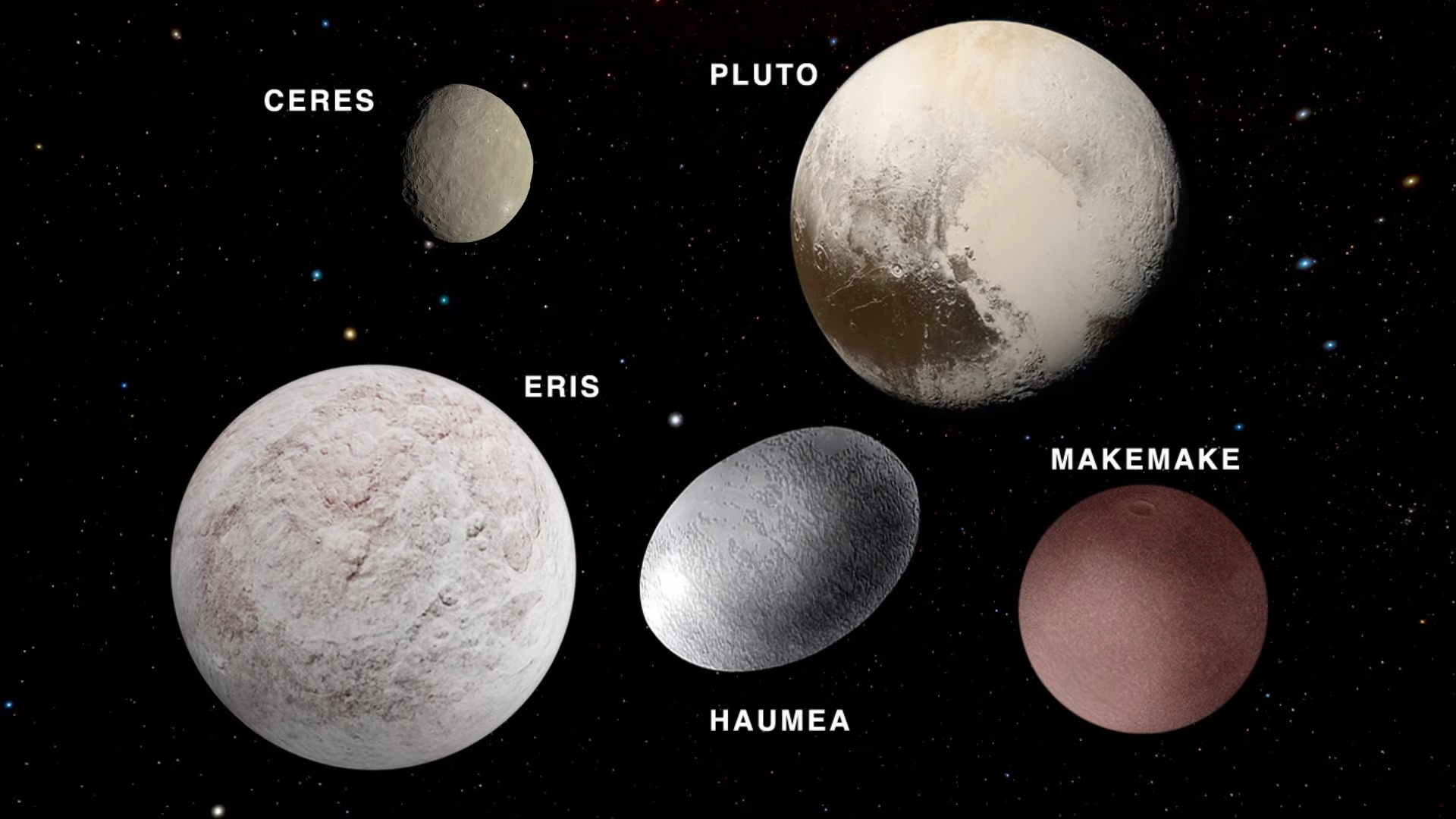
Pluto, once considered the ninth planet, was reclassified as a dwarf planet in 2006. It is located in the Kuiper Belt, a region of icy bodies beyond Neptune's orbit. Pluto has five known moons, the largest of which is Charon. The New Horizons spacecraft provided detailed images and data of Pluto and its moons during its flyby in 2015.
Ceres
Ceres is the largest object in the asteroid belt and the only dwarf planet located there. It is believed to have a rocky core and an icy mantle, with a thin atmosphere of water vapor. Ceres has no known moons, but its surface features, including bright spots and craters, have been studied by the Dawn spacecraft.
Eris
Eris is a dwarf planet located in the scattered disk, a region of the solar system beyond the Kuiper Belt. It is slightly more massive than Pluto and has one known moon, Dysnomia. Eris' discovery in 2005 led to the reclassification of Pluto as a dwarf planet.
Exploring Planets Or Moons
Exploring planets or moons has been a significant focus of space missions over the past few decades. These missions have provided invaluable data that has deepened our understanding of the solar system and its formation. Some notable missions include:
- Voyager 1 and 2: Launched in 1977, these spacecraft provided detailed images and data of the outer planets and their moons. Voyager 1 is now in interstellar space, while Voyager 2 continues to explore the outer reaches of the solar system.
- Galileo: This spacecraft orbited Jupiter from 1995 to 2003, providing detailed studies of the planet and its moons, particularly the Galilean moons.
- Cassini: Launched in 1997, Cassini spent 13 years exploring Saturn and its moons, including Titan and Enceladus. The mission ended in 2017 with a deliberate plunge into Saturn's atmosphere.
- New Horizons: This spacecraft performed a flyby of Pluto in 2015, providing the first detailed images and data of the dwarf planet and its moons. It continues to explore the Kuiper Belt.
📌 Note: The exploration of planets or moons is an ongoing endeavor, with future missions planned to further our understanding of these celestial bodies.
In addition to these missions, numerous rovers and landers have explored the surfaces of Mars, Venus, and the Moon, providing detailed data on their geology, atmosphere, and potential for past or present life.

Significance of Planets Or Moons
The study of planets or moons is crucial for several reasons. Firstly, it helps us understand the formation and evolution of our solar system. By examining the composition, structure, and dynamics of these celestial bodies, scientists can piece together the history of the solar system and the processes that shaped it.
Secondly, the exploration of planets or moons has practical applications. For example, understanding the geology and resources of other celestial bodies can inform future space missions and potential colonization efforts. Additionally, studying the atmospheres and climates of other planets can provide insights into climate change on Earth.
Thirdly, the search for life beyond Earth is a driving force behind the exploration of planets or moons. While no definitive evidence of extraterrestrial life has been found, the discovery of potential habitable environments, such as the subsurface oceans of Europa and Enceladus, has sparked excitement and further investigation.
Finally, the exploration of planets or moons inspires and educates future generations of scientists, engineers, and explorers. The wonders of the solar system captivate the imagination and foster a sense of curiosity and discovery that drives innovation and progress.
In summary, the exploration of planets or moons is a multifaceted endeavor that enriches our understanding of the universe, drives technological advancements, and inspires future generations. As we continue to explore the cosmos, the mysteries of these celestial bodies will undoubtedly yield even more fascinating discoveries.
Related Terms:
- moons of different planets
- planets in order with moon
- what planet covers the moon
- planets and moon alignment today
- how do moons orbit planets
- difference between moons and planets